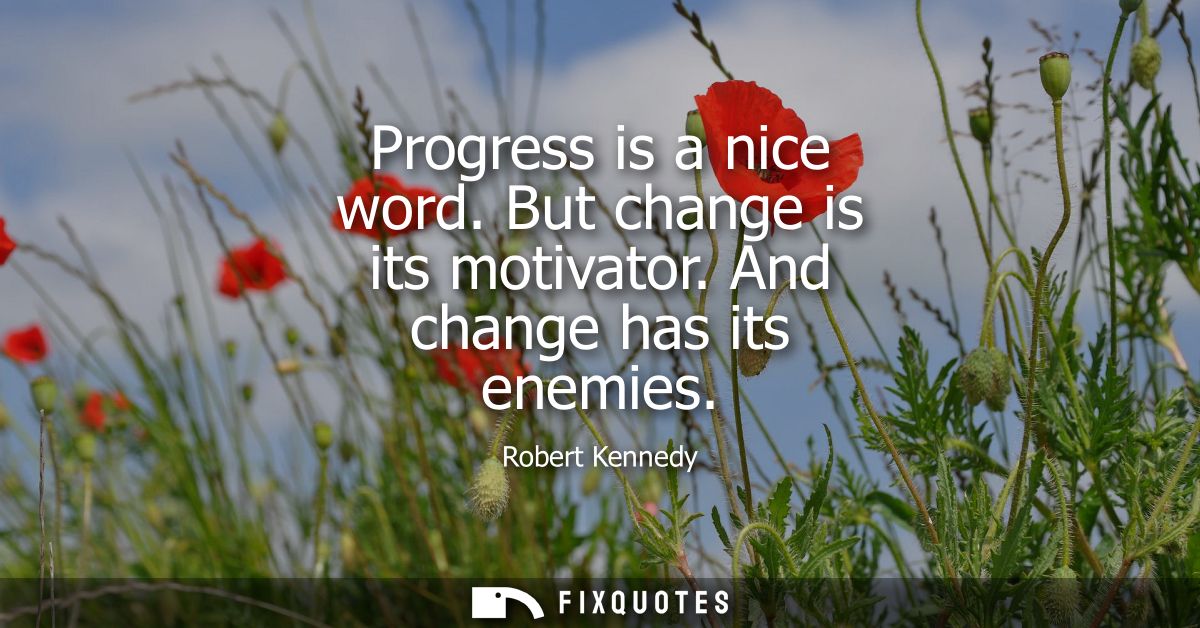
"Progress is a nice word. But change is its motivator. And change has its enemies"
About this Quote
The sentence structure is doing political work. Three short clauses, each tightening the screws: first the honey (“nice word”), then the mechanism (“motivator”), then the bill that comes due (“enemies”). Kennedy isn’t describing an unfortunate side effect; he’s arguing that opposition is a feature of meaningful reform. If no one is angry, you probably haven’t changed anything that matters.
Context sharpens the edge. In the 1960s, “progress” was the language of American self-mythology - the nation steadily perfecting itself. Kennedy, speaking amid civil rights upheaval, urban unrest, and Vietnam-era distrust, signals that moral advancement collides with entrenched interests: segregationists, political machines, economic gatekeepers, even complacent moderates who prefer harmony to justice. The subtext is a warning to reformers and a challenge to voters: don’t romanticize the destination while flinching from the journey.
It’s also a quiet confession of governing. Politicians love claiming progress because it implies inevitability. Kennedy insists on contingency: change requires force, and force invites backlash. The enemy, in other words, is proof you’re moving.
Quote Details
| Topic | Change |
|---|---|
| Source | Later attribution: Managing in Times of Change (Michael Maginn, 2006) modern compilationISBN: 9780071484367 · ID: 8Mw8DfgWFvEC
Evidence:
... Progress is a nice word . But change is its motivator . And change has its enemies . " -Robert Kennedy GOOD SOLUTION BOB . NOW ALL WE NEED IS A 77 Managing in Times_Maginn 10/6/06 3:39 PM Page 77. |
| Cite |
Citation Formats
APA Style (7th ed.)
Kennedy, Robert. (2026, February 27). Progress is a nice word. But change is its motivator. And change has its enemies. FixQuotes. https://fixquotes.com/quotes/progress-is-a-nice-word-but-change-is-its-25646/
Chicago Style
Kennedy, Robert. "Progress is a nice word. But change is its motivator. And change has its enemies." FixQuotes. February 27, 2026. https://fixquotes.com/quotes/progress-is-a-nice-word-but-change-is-its-25646/.
MLA Style (9th ed.)
"Progress is a nice word. But change is its motivator. And change has its enemies." FixQuotes, 27 Feb. 2026, https://fixquotes.com/quotes/progress-is-a-nice-word-but-change-is-its-25646/. Accessed 28 Mar. 2026.