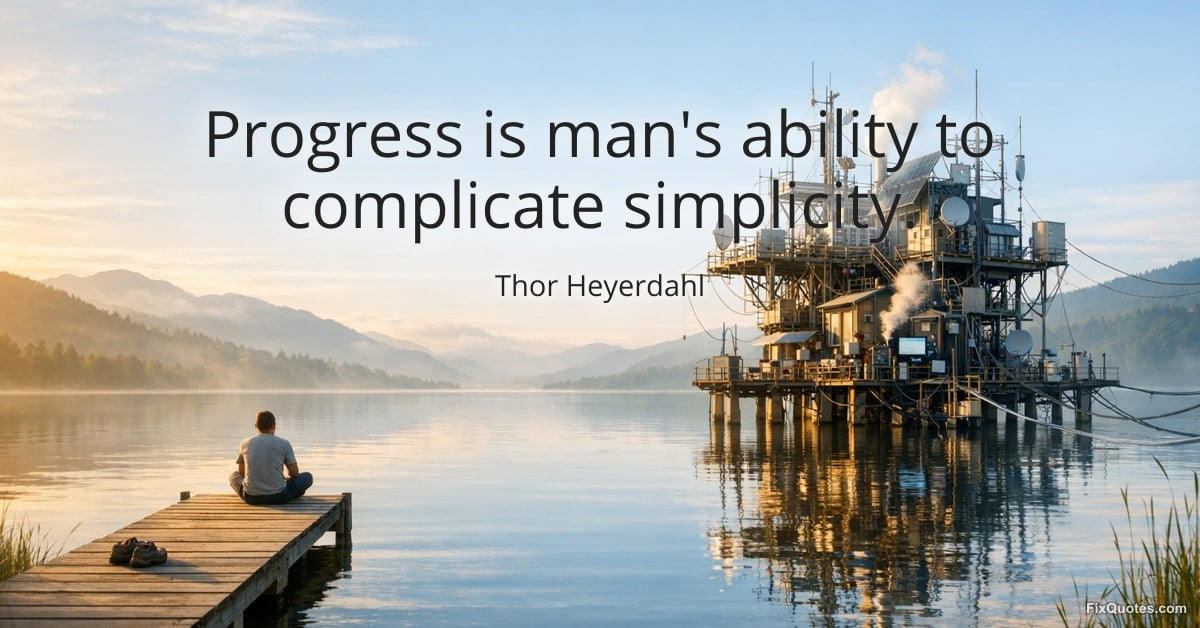
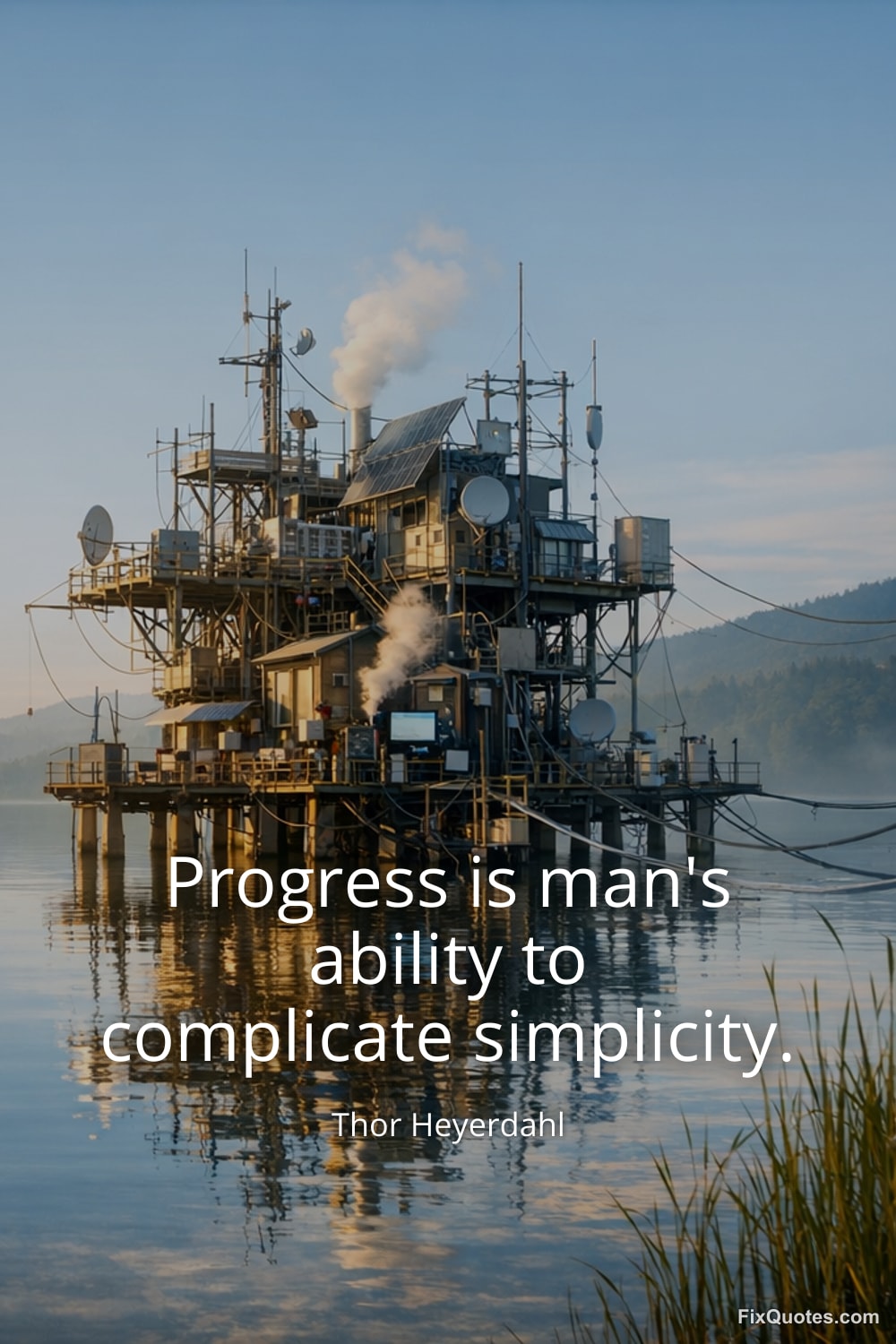
"Progress is man's ability to complicate simplicity"
About this Quote
Heyerdahl’s line lands like a compass that suddenly starts spinning: progress, the sacred word of modernity, is redefined as a talent for making the obvious difficult. Coming from an explorer, it’s not armchair contrarianism. It’s field-tested skepticism from someone who watched “advancement” arrive as extra equipment, extra bureaucracy, extra theories - and sometimes less direct contact with the world itself.
The phrasing is slyly accusatory. “Ability” is almost a compliment, but the object is “complicate simplicity,” turning human ingenuity into a kind of self-sabotage. Heyerdahl isn’t denying invention; he’s questioning the mythology that newer equals better. The subtext: we often treat complexity as proof of intelligence and organization as proof of civilization, even when the outcome is fragility. A simple solution can be repaired, understood, and owned. A complicated one demands specialists, supply chains, permission slips - dependence dressed up as sophistication.
Context matters: Heyerdahl’s career was built on stripping things back. The Kon-Tiki expedition wasn’t just a stunt; it was an argument that “primitive” tools could accomplish what modern gatekeepers insisted required modern systems. In that light, the quote reads as a jab at institutional certainty: progress as credentialism, as the accumulation of procedures that protect authority more than they solve problems.
It works because it flips the moral valence of progress. Instead of a ladder upward, it’s a maze we keep building, then congratulating ourselves for needing a map.
The phrasing is slyly accusatory. “Ability” is almost a compliment, but the object is “complicate simplicity,” turning human ingenuity into a kind of self-sabotage. Heyerdahl isn’t denying invention; he’s questioning the mythology that newer equals better. The subtext: we often treat complexity as proof of intelligence and organization as proof of civilization, even when the outcome is fragility. A simple solution can be repaired, understood, and owned. A complicated one demands specialists, supply chains, permission slips - dependence dressed up as sophistication.
Context matters: Heyerdahl’s career was built on stripping things back. The Kon-Tiki expedition wasn’t just a stunt; it was an argument that “primitive” tools could accomplish what modern gatekeepers insisted required modern systems. In that light, the quote reads as a jab at institutional certainty: progress as credentialism, as the accumulation of procedures that protect authority more than they solve problems.
It works because it flips the moral valence of progress. Instead of a ladder upward, it’s a maze we keep building, then congratulating ourselves for needing a map.
Quote Details
| Topic | Wisdom |
|---|---|
| Source | Unverified source: Fatu-Hiva: Back to Nature (Thor Heyerdahl, 1974)
Evidence: Page 262 (exact sentence begins: “Progress today can be defined as man's ability to complicate simplicity.”). Primary-source location appears to be Heyerdahl’s own text in Fatu-Hiva: Back to Nature (UK first edition 1974). Multiple secondary quote-index sites independently point to the same book/... Other candidates (2) Further Reflections on the Journey to the Omega Point (Tom Reidy) compilation95.0% Tom Reidy. " Progress " " Progress is Man's ability to complicate simplicity " ( Thor Heyerdahl ) ( AUTHOR'S NOTE : T... Thor Heyerdahl (Thor Heyerdahl) compilation71.4% d ask yourself how in the world it all came about 1 progress is mans ability to |
| Featured | This quote was our Quote of the Day on April 28, 2023 |
| Cite |
Citation Formats
APA Style (7th ed.)
Heyerdahl, Thor. (2026, January 18). Progress is man's ability to complicate simplicity. FixQuotes. https://fixquotes.com/quotes/progress-is-mans-ability-to-complicate-simplicity-19002/
Chicago Style
Heyerdahl, Thor. "Progress is man's ability to complicate simplicity." FixQuotes. January 18, 2026. https://fixquotes.com/quotes/progress-is-mans-ability-to-complicate-simplicity-19002/.
MLA Style (9th ed.)
"Progress is man's ability to complicate simplicity." FixQuotes, 18 Jan. 2026, https://fixquotes.com/quotes/progress-is-mans-ability-to-complicate-simplicity-19002/. Accessed 6 Mar. 2026.
More Quotes by Thor
Add to List