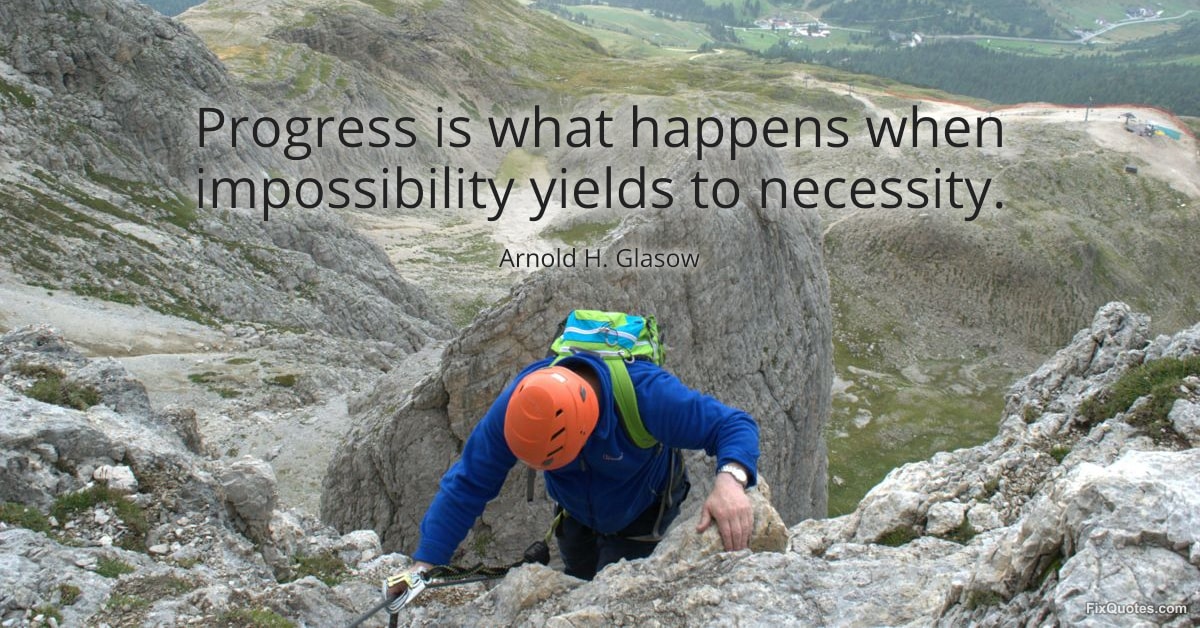
"Progress is what happens when impossibility yields to necessity"
About this Quote
Progress, Glasow suggests, isn’t a heroic march powered by optimism; it’s a reluctant concession extracted by pressure. The line flips the usual inspirational script. “Impossibility” sounds like a wall, a final verdict delivered by convention, cost, or fear. “Necessity” is the market, the deadline, the emergency: the moment when not changing becomes more expensive than changing. In that swap lies his worldview as a businessman, and it’s bracingly unsentimental.
The sentence works because it’s built like a corporate post-mortem. Nobody “believed it could be done” until a competitor ate their lunch, a supply chain snapped, a regulation changed, or customers simply stopped tolerating the old way. Progress arrives not as enlightenment but as triage. Glasow’s subtext is that human institutions default to inertia; they move only when reality corners them. It’s a quiet critique of how organizations treat innovation as a luxury item, something to be funded in good times and cut in bad ones, even though the real breakthroughs often come from the bad ones.
There’s also a subtle jab at the romance of “impossible.” In business culture, declaring something impossible can be a way to protect status and avoid accountability. Necessity strips that cover: when survival is on the line, the impossible suddenly develops a budget, a timeline, and a task force. Glasow isn’t praising desperation so much as exposing it as the true engine behind most change.
The sentence works because it’s built like a corporate post-mortem. Nobody “believed it could be done” until a competitor ate their lunch, a supply chain snapped, a regulation changed, or customers simply stopped tolerating the old way. Progress arrives not as enlightenment but as triage. Glasow’s subtext is that human institutions default to inertia; they move only when reality corners them. It’s a quiet critique of how organizations treat innovation as a luxury item, something to be funded in good times and cut in bad ones, even though the real breakthroughs often come from the bad ones.
There’s also a subtle jab at the romance of “impossible.” In business culture, declaring something impossible can be a way to protect status and avoid accountability. Necessity strips that cover: when survival is on the line, the impossible suddenly develops a budget, a timeline, and a task force. Glasow isn’t praising desperation so much as exposing it as the true engine behind most change.
Quote Details
| Topic | Motivational |
|---|---|
| Source | Later attribution: The Economist Book of Business Quotations (Bill Ridgers, 2012) modern compilationISBN: 9781847658173 · ID: wk6KAgAAQBAJ
Evidence:
... Progress is what happens when impossibility yields to necessity . Arnold H. Glasow , humorist ( 1905–98 ) Those who do not industrialise become hewers of wood and haulers of water . Alexander Hamilton , statesman ( 1755-1894 ) One ... |
| Featured | This quote was our Quote of the Day on March 8, 2025 |
More Quotes by Arnold
Add to List