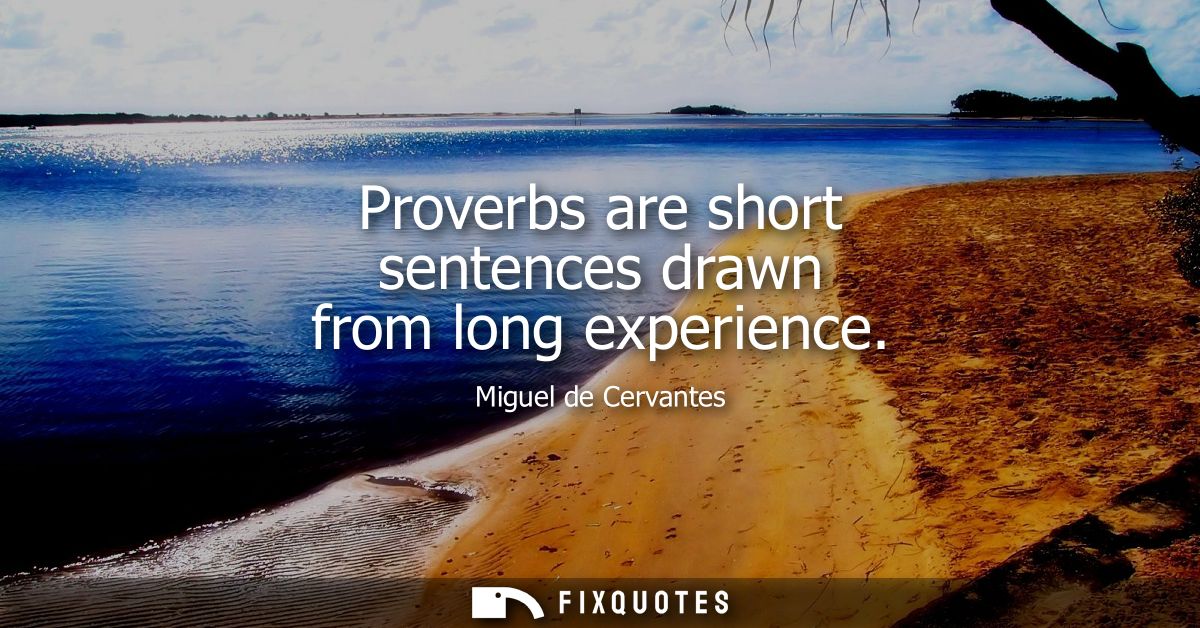
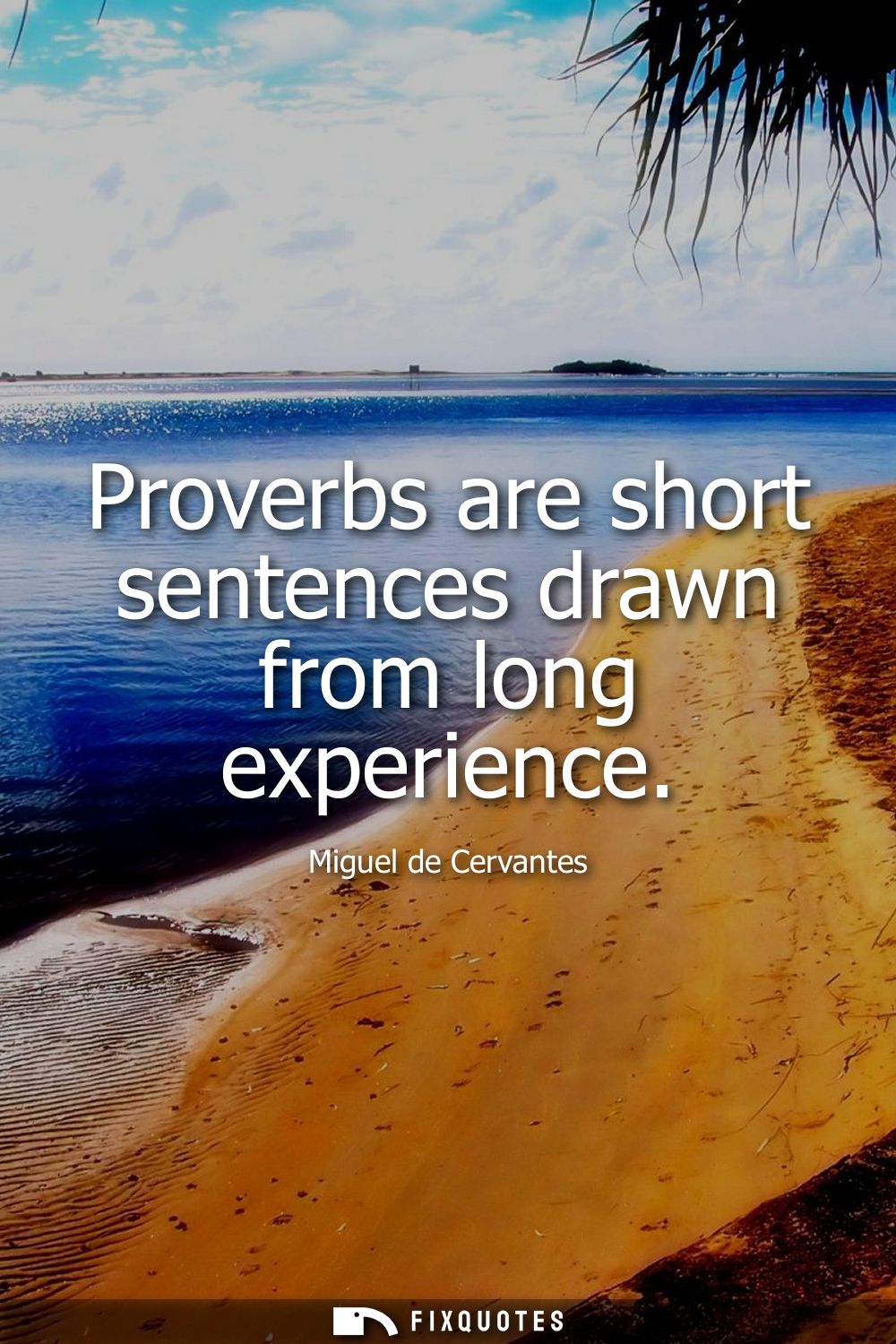
"Proverbs are short sentences drawn from long experience"
About this Quote
Proverbs don’t arrive as wisdom; they arrive as compression. Cervantes, the great engineer of illusions and bruised ideals, is quietly telling you that a proverb is a scar made portable: a neat little line that pretends to be simple because it has already paid the price of complexity. “Short sentences” isn’t just a description of form; it’s a warning about seduction. The smoother the phrasing, the easier it is to mistake the capsule for the cure.
The subtext is about authority and its disguise. Experience is messy, humiliating, inconsistent; a proverb makes it sound inevitable. In early modern Spain, where honor codes, religious orthodoxy, and social hierarchies demanded public certainty, folk wisdom offered a street-level substitute for theory. You didn’t need to be a cleric or a court philosopher to speak with confidence; you just needed a well-worn line. Cervantes knew how that works because he built Don Quixote partly out of inherited scripts-chivalric maxims, romantic formulas, the kind of “wisdom” that can hijack a life when taken literally.
So the intent isn’t to canonize proverbs as timeless truth; it’s to locate their power. They function as cultural shorthand, social glue, and occasionally a weapon: a proverb can end an argument by sounding older than the person you’re talking to. Cervantes appreciates the elegance, but he’s also hinting at the danger: when you forget the “long experience” behind the line, you start worshipping the sentence instead of learning from the life that made it.
The subtext is about authority and its disguise. Experience is messy, humiliating, inconsistent; a proverb makes it sound inevitable. In early modern Spain, where honor codes, religious orthodoxy, and social hierarchies demanded public certainty, folk wisdom offered a street-level substitute for theory. You didn’t need to be a cleric or a court philosopher to speak with confidence; you just needed a well-worn line. Cervantes knew how that works because he built Don Quixote partly out of inherited scripts-chivalric maxims, romantic formulas, the kind of “wisdom” that can hijack a life when taken literally.
So the intent isn’t to canonize proverbs as timeless truth; it’s to locate their power. They function as cultural shorthand, social glue, and occasionally a weapon: a proverb can end an argument by sounding older than the person you’re talking to. Cervantes appreciates the elegance, but he’s also hinting at the danger: when you forget the “long experience” behind the line, you start worshipping the sentence instead of learning from the life that made it.
Quote Details
| Topic | Wisdom |
|---|---|
| Source | Help us find the source |
| Cite |
Citation Formats
APA Style (7th ed.)
Cervantes, Miguel de. (2026, January 17). Proverbs are short sentences drawn from long experience. FixQuotes. https://fixquotes.com/quotes/proverbs-are-short-sentences-drawn-from-long-80157/
Chicago Style
Cervantes, Miguel de. "Proverbs are short sentences drawn from long experience." FixQuotes. January 17, 2026. https://fixquotes.com/quotes/proverbs-are-short-sentences-drawn-from-long-80157/.
MLA Style (9th ed.)
"Proverbs are short sentences drawn from long experience." FixQuotes, 17 Jan. 2026, https://fixquotes.com/quotes/proverbs-are-short-sentences-drawn-from-long-80157/. Accessed 5 Mar. 2026.
More Quotes by Miguel
Add to List