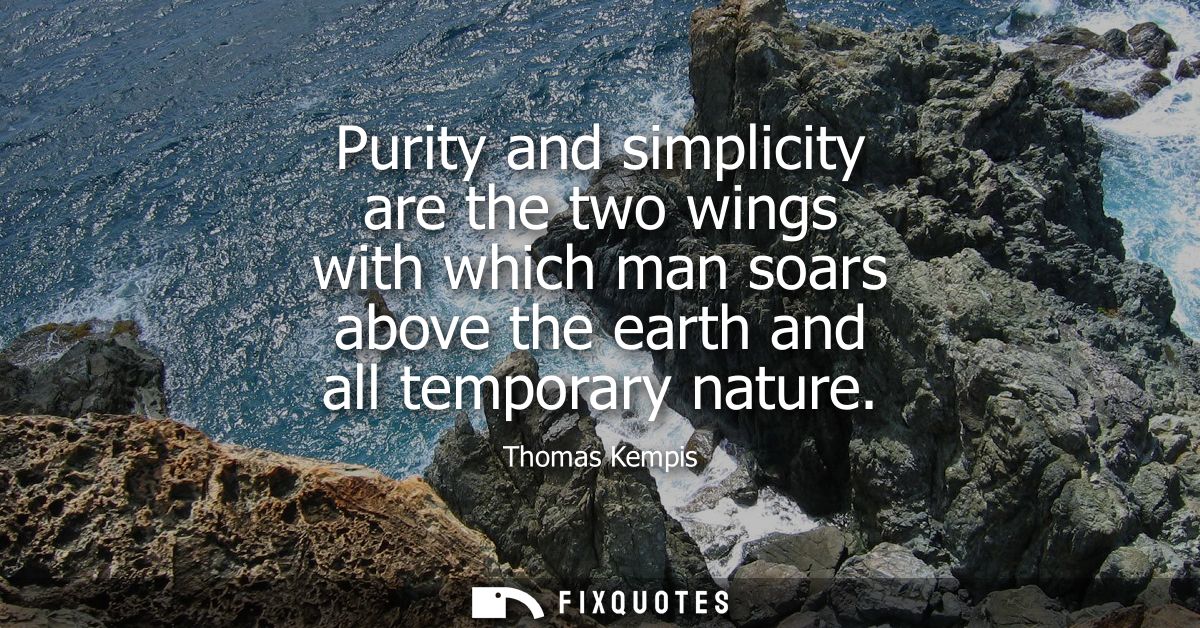
"Purity and simplicity are the two wings with which man soars above the earth and all temporary nature"
About this Quote
The phrase “above the earth and all temporary nature” is the tell. Kempis isn’t asking you to appreciate nature; he’s asking you to transcend its claims. “Earth” means appetite, status, distraction, the constant churn of wanting. “Temporary nature” signals the medieval Christian hierarchy of value: time-bound goods are not evil, just dangerously persuasive. The subtext is a warning about attachment. You don’t have to renounce everything, but you do have to stop letting everything own you.
Context matters: Kempis writes from a monastic-inflected world (the Devotio Moderna) that prized inwardness over spectacle, daily practice over public piety. The sentence reads like a corrective to performative religion and restless consumer desire before either had modern names. Its elegance is also its provocation: it reframes freedom not as adding options but subtracting dependencies. The “soaring” isn’t escapism; it’s a spiritual vantage point where the temporary can finally be seen as temporary.
Quote Details
| Topic | Wisdom |
|---|---|
| Source | Help us find the source |
| Cite |
Citation Formats
APA Style (7th ed.)
Kempis, Thomas. (2026, January 15). Purity and simplicity are the two wings with which man soars above the earth and all temporary nature. FixQuotes. https://fixquotes.com/quotes/purity-and-simplicity-are-the-two-wings-with-11635/
Chicago Style
Kempis, Thomas. "Purity and simplicity are the two wings with which man soars above the earth and all temporary nature." FixQuotes. January 15, 2026. https://fixquotes.com/quotes/purity-and-simplicity-are-the-two-wings-with-11635/.
MLA Style (9th ed.)
"Purity and simplicity are the two wings with which man soars above the earth and all temporary nature." FixQuotes, 15 Jan. 2026, https://fixquotes.com/quotes/purity-and-simplicity-are-the-two-wings-with-11635/. Accessed 8 Mar. 2026.