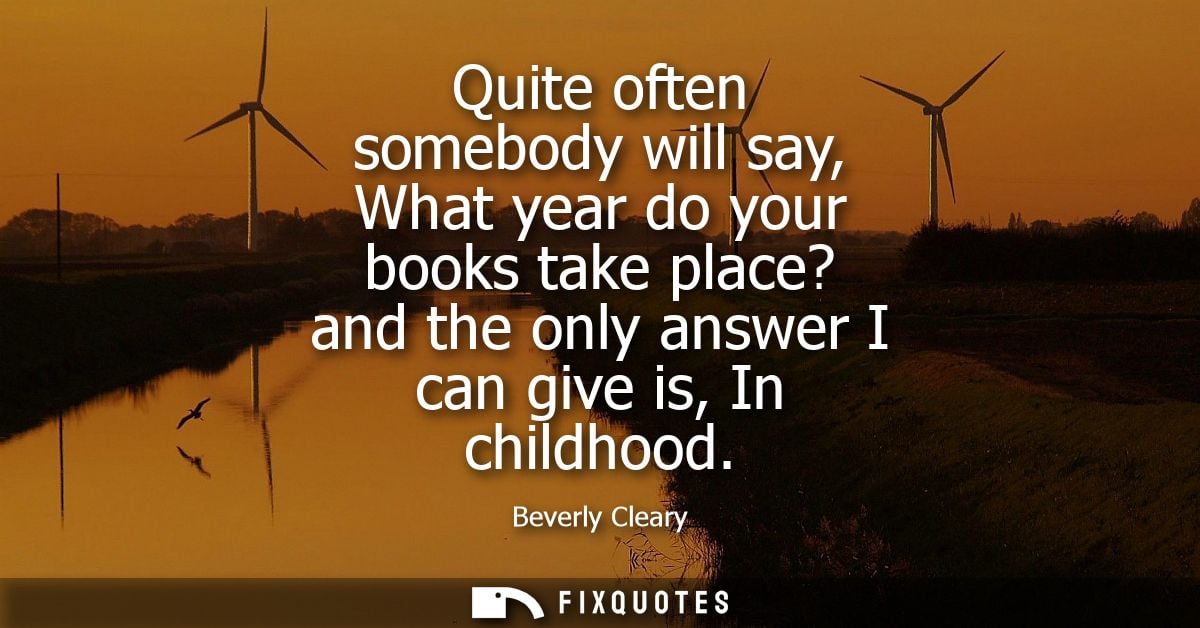
"Quite often somebody will say, What year do your books take place? And the only answer I can give is, In childhood"
About this Quote
The subtext is a quiet rebuke to nostalgia culture. Her books aren’t period pieces dressed up in saddle shoes; they’re emotional documents. By declining to timestamp Ramona or Henry Huggins, she protects them from becoming artifacts and keeps them as companions. Childhood, in her framing, is not a phase you graduate from so much as a place you revisit - sometimes fondly, sometimes against your will.
Context matters: Cleary wrote across eras of rapid social change, yet her Portland neighborhoods remain legible because the stakes are domestic and immediate. She’s also answering a common critical misunderstanding: that realism requires specificity of date. Cleary’s realism is psychological. Her setting is the age when feelings are oversized, rules are puzzling, and dignity is fragile - a country with its own weather, and no need for a year stamped on the map.
Quote Details
| Topic | Youth |
|---|---|
| Source | Help us find the source |
| Cite |
Citation Formats
APA Style (7th ed.)
Cleary, Beverly. (2026, February 19). Quite often somebody will say, What year do your books take place? And the only answer I can give is, In childhood. FixQuotes. https://fixquotes.com/quotes/quite-often-somebody-will-say-what-year-do-your-42758/
Chicago Style
Cleary, Beverly. "Quite often somebody will say, What year do your books take place? And the only answer I can give is, In childhood." FixQuotes. February 19, 2026. https://fixquotes.com/quotes/quite-often-somebody-will-say-what-year-do-your-42758/.
MLA Style (9th ed.)
"Quite often somebody will say, What year do your books take place? And the only answer I can give is, In childhood." FixQuotes, 19 Feb. 2026, https://fixquotes.com/quotes/quite-often-somebody-will-say-what-year-do-your-42758/. Accessed 4 Apr. 2026.