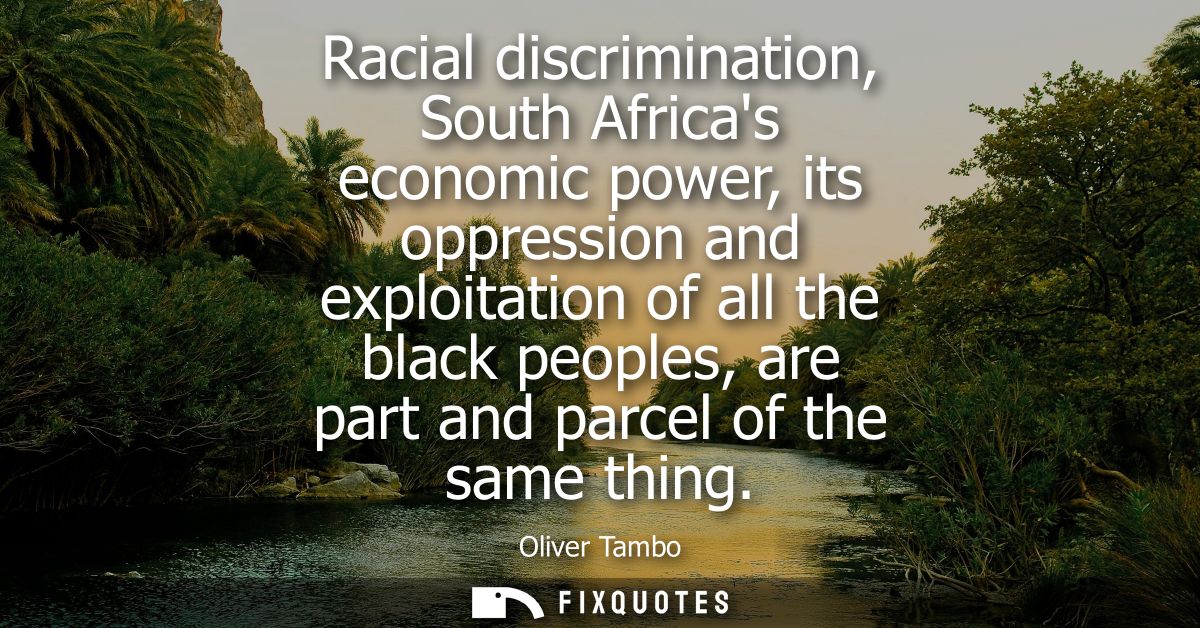
"Racial discrimination, South Africa's economic power, its oppression and exploitation of all the black peoples are part and parcel of the same thing"
About this Quote
The sequencing matters, too. “Racial discrimination” comes first, the moral offense most outsiders can recognize; “South Africa’s economic power” follows as the payoff; then “oppression and exploitation” land as the method. Tambo is building a chain of causation, not offering a list. If the country is prosperous, he implies, we should ask: prosperous for whom, and at what price?
Context sharpens the intent. As ANC president in exile during the apartheid era, Tambo was speaking to multiple audiences at once: to black South Africans who experienced the daily reality of pass laws, migrant labor, and dispossession; and to international governments and corporations tempted to treat apartheid as an internal social problem rather than a global business arrangement. The subtext is a demand: you cannot oppose apartheid while profiting from it. Sanctions, divestment, and solidarity aren’t symbolic gestures in his framing; they’re the logical response to a system whose economics and racism are inseparable.
Quote Details
| Topic | Equality |
|---|---|
| Source | Help us find the source |
| Cite |
Citation Formats
APA Style (7th ed.)
Tambo, Oliver. (2026, February 16). Racial discrimination, South Africa's economic power, its oppression and exploitation of all the black peoples are part and parcel of the same thing. FixQuotes. https://fixquotes.com/quotes/racial-discrimination-south-africas-economic-123162/
Chicago Style
Tambo, Oliver. "Racial discrimination, South Africa's economic power, its oppression and exploitation of all the black peoples are part and parcel of the same thing." FixQuotes. February 16, 2026. https://fixquotes.com/quotes/racial-discrimination-south-africas-economic-123162/.
MLA Style (9th ed.)
"Racial discrimination, South Africa's economic power, its oppression and exploitation of all the black peoples are part and parcel of the same thing." FixQuotes, 16 Feb. 2026, https://fixquotes.com/quotes/racial-discrimination-south-africas-economic-123162/. Accessed 30 Mar. 2026.