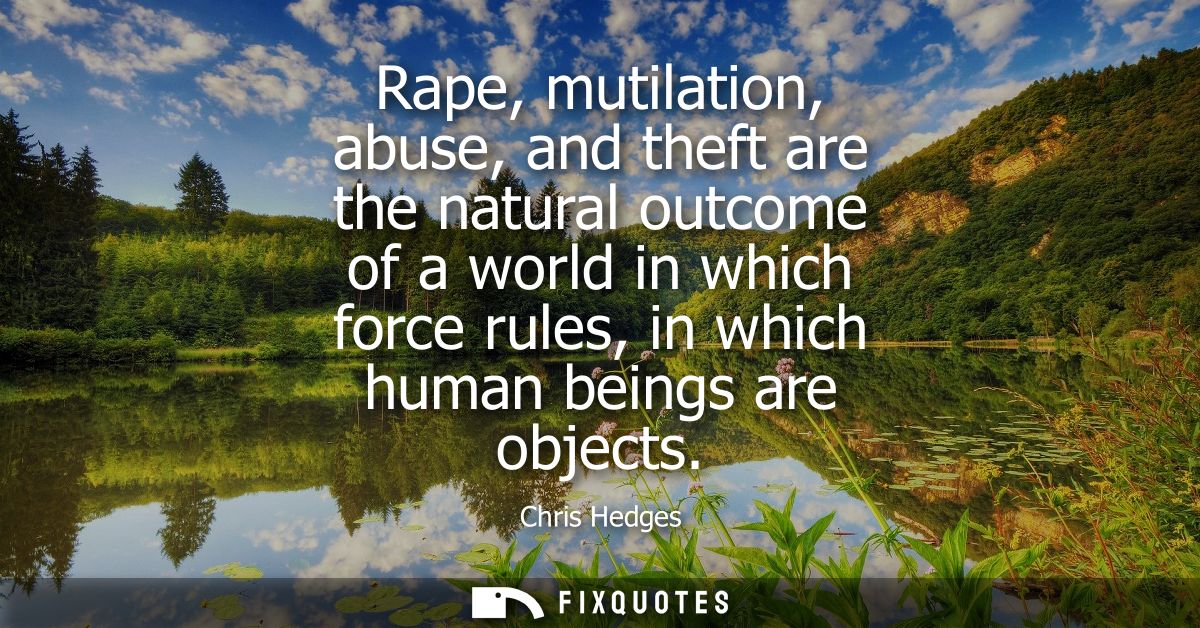
"Rape, mutilation, abuse, and theft are the natural outcome of a world in which force rules, in which human beings are objects"
About this Quote
The list is deliberate: “rape, mutilation, abuse, and theft” moves from the intimate to the extractive, from violations of bodies to violations of property. That sequencing makes a bleak point about how domination scales. Once people are reduced to “objects,” every form of taking becomes thinkable: sex, limbs, dignity, resources. The subtext is not just anti-war in the abstract; it’s anti-dehumanization as policy, the kind that turns civilians into “collateral,” prisoners into “detainees,” and hunger into “security.”
As a journalist shaped by conflict zones and the post-9/11 security state, Hedges is also indicting language. “Force rules” isn’t only about guns; it’s about institutions that treat power as the only persuasive argument. The sentence functions like a moral diagnostic: show me where humans are spoken of as units, targets, or costs, and I’ll show you the conditions where violence doesn’t merely occur - it reproduces.
Quote Details
| Topic | Human Rights |
|---|---|
| Source | Help us find the source |
| Cite |
Citation Formats
APA Style (7th ed.)
Hedges, Chris. (2026, January 16). Rape, mutilation, abuse, and theft are the natural outcome of a world in which force rules, in which human beings are objects. FixQuotes. https://fixquotes.com/quotes/rape-mutilation-abuse-and-theft-are-the-natural-136162/
Chicago Style
Hedges, Chris. "Rape, mutilation, abuse, and theft are the natural outcome of a world in which force rules, in which human beings are objects." FixQuotes. January 16, 2026. https://fixquotes.com/quotes/rape-mutilation-abuse-and-theft-are-the-natural-136162/.
MLA Style (9th ed.)
"Rape, mutilation, abuse, and theft are the natural outcome of a world in which force rules, in which human beings are objects." FixQuotes, 16 Jan. 2026, https://fixquotes.com/quotes/rape-mutilation-abuse-and-theft-are-the-natural-136162/. Accessed 18 Feb. 2026.