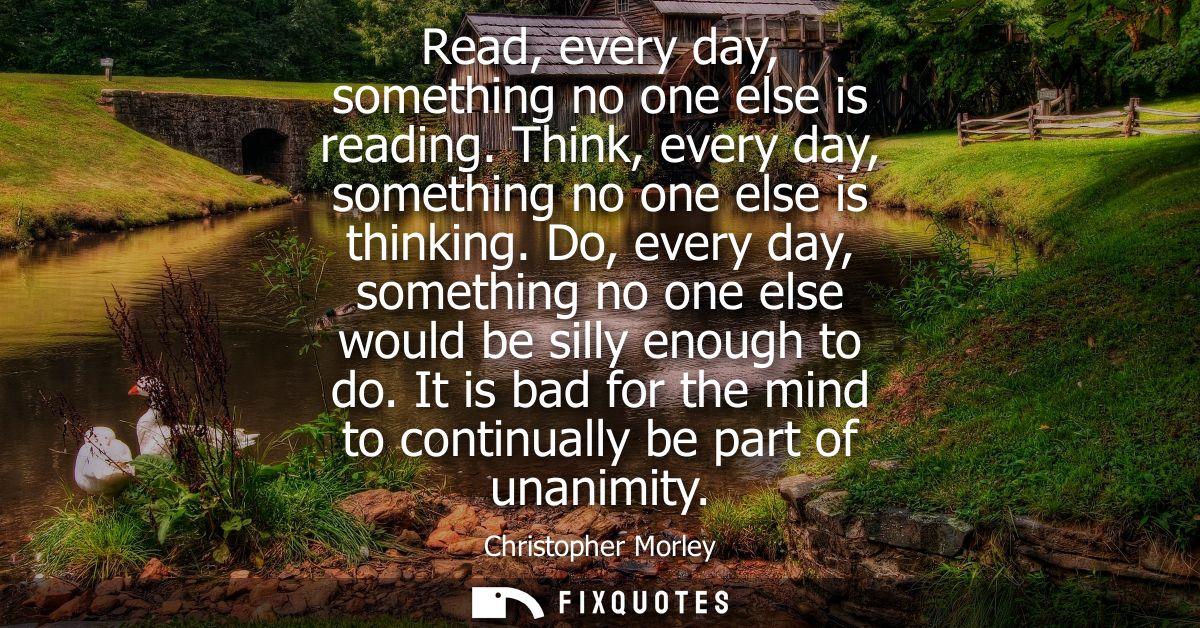
"Read, every day, something no one else is reading. Think, every day, something no one else is thinking. Do, every day, something no one else would be silly enough to do. It is bad for the mind to continually be part of unanimity"
About this Quote
The subtext is that unanimity feels good because it’s cognitively efficient. You get ready-made opinions, pre-approved tastes, and the social comfort of being “right” with company. Morley treats that comfort as mental atrophy. “Bad for the mind” lands like a mild health warning, which is part of the wit: he makes conformity sound less like a moral failing than like a boring, preventable illness. His sharpest move is the phrase “silly enough.” He’s not romanticizing the lone genius; he’s advocating small, strategic embarrassments - choices that look slightly irrational to the crowd. That’s where genuine independence lives, in acts that can’t be immediately justified by trend or consensus.
Contextually, Morley wrote in an era when mass circulation newspapers, radio, advertising, and standardized schooling were tightening the loop of shared attention. “Unanimity” wasn’t just peer pressure; it was the emerging machinery of mass culture. The advice reads like an early antidote to algorithmic sameness: diversify inputs, resist prefab takes, and practice doing one thing that breaks the spell of group approval. It’s not anti-social. It’s anti-hive-mind.
Quote Details
| Topic | Wisdom |
|---|---|
| Source | Help us find the source |
| Cite |
Citation Formats
APA Style (7th ed.)
Morley, Christopher. (2026, January 17). Read, every day, something no one else is reading. Think, every day, something no one else is thinking. Do, every day, something no one else would be silly enough to do. It is bad for the mind to continually be part of unanimity. FixQuotes. https://fixquotes.com/quotes/read-every-day-something-no-one-else-is-reading-40815/
Chicago Style
Morley, Christopher. "Read, every day, something no one else is reading. Think, every day, something no one else is thinking. Do, every day, something no one else would be silly enough to do. It is bad for the mind to continually be part of unanimity." FixQuotes. January 17, 2026. https://fixquotes.com/quotes/read-every-day-something-no-one-else-is-reading-40815/.
MLA Style (9th ed.)
"Read, every day, something no one else is reading. Think, every day, something no one else is thinking. Do, every day, something no one else would be silly enough to do. It is bad for the mind to continually be part of unanimity." FixQuotes, 17 Jan. 2026, https://fixquotes.com/quotes/read-every-day-something-no-one-else-is-reading-40815/. Accessed 1 Apr. 2026.