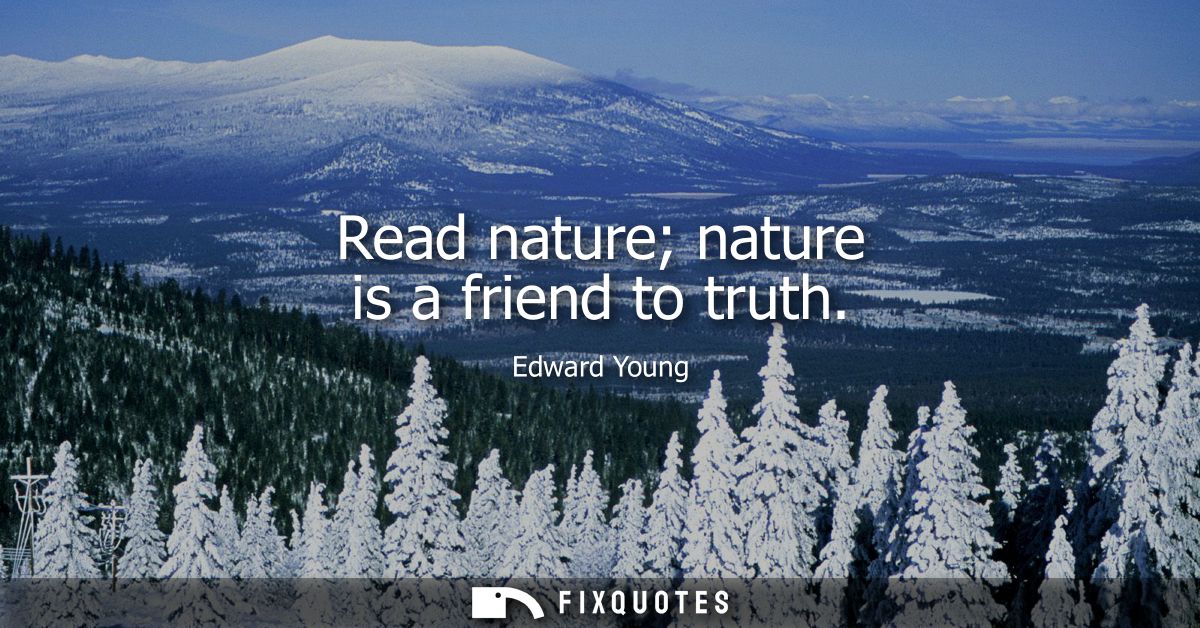
"Read nature; nature is a friend to truth"
About this Quote
“Read nature; nature is a friend to truth” is an Enlightenment-era mic drop dressed up as pastoral advice. Young isn’t merely recommending a walk outside; he’s proposing an epistemology. The verb “read” matters: nature becomes a text more reliable than the noisy, self-serving documents of society. In a culture where authority often arrived pre-packaged from pulpit, court, or inherited tradition, Young shifts credibility outward, to something not written by men with careers to protect.
The line works because it flatters two impulses at once. It appeals to the rational temper of the age - observe, infer, verify - while also keeping a poet’s reverence for the sublime. “Friend” is the sly word here. Nature isn’t an impartial judge; it’s an ally, a companion who wants you to arrive at truth if you’ll stop lying to yourself. That intimacy softens what could be a chilly empiricist command. It suggests that truth isn’t just correct; it’s restorative.
Subtextually, it’s also a critique of urban sophistication and fashionable cynicism. Young wrote in a world of salons, patronage, and moral performance, where “truth” could be transactional. Nature, by contrast, doesn’t negotiate. Seasons turn, bodies age, death arrives. Young, famous for meditations on mortality, likely hears in nature’s “friendship” a stern kindness: it tells the truth because it can’t do otherwise.
The context is a moment when science, deism, and devotional poetry were in tense conversation. Young offers a bridge: study the world honestly, and it won’t unseat meaning - it will expose the pretenses that keep you from it.
The line works because it flatters two impulses at once. It appeals to the rational temper of the age - observe, infer, verify - while also keeping a poet’s reverence for the sublime. “Friend” is the sly word here. Nature isn’t an impartial judge; it’s an ally, a companion who wants you to arrive at truth if you’ll stop lying to yourself. That intimacy softens what could be a chilly empiricist command. It suggests that truth isn’t just correct; it’s restorative.
Subtextually, it’s also a critique of urban sophistication and fashionable cynicism. Young wrote in a world of salons, patronage, and moral performance, where “truth” could be transactional. Nature, by contrast, doesn’t negotiate. Seasons turn, bodies age, death arrives. Young, famous for meditations on mortality, likely hears in nature’s “friendship” a stern kindness: it tells the truth because it can’t do otherwise.
The context is a moment when science, deism, and devotional poetry were in tense conversation. Young offers a bridge: study the world honestly, and it won’t unseat meaning - it will expose the pretenses that keep you from it.
Quote Details
| Topic | Truth |
|---|---|
| Source | Help us find the source |
| Cite |
Citation Formats
APA Style (7th ed.)
Young, Edward. (2026, January 17). Read nature; nature is a friend to truth. FixQuotes. https://fixquotes.com/quotes/read-nature-nature-is-a-friend-to-truth-35071/
Chicago Style
Young, Edward. "Read nature; nature is a friend to truth." FixQuotes. January 17, 2026. https://fixquotes.com/quotes/read-nature-nature-is-a-friend-to-truth-35071/.
MLA Style (9th ed.)
"Read nature; nature is a friend to truth." FixQuotes, 17 Jan. 2026, https://fixquotes.com/quotes/read-nature-nature-is-a-friend-to-truth-35071/. Accessed 29 Mar. 2026.
More Quotes by Edward
Add to List