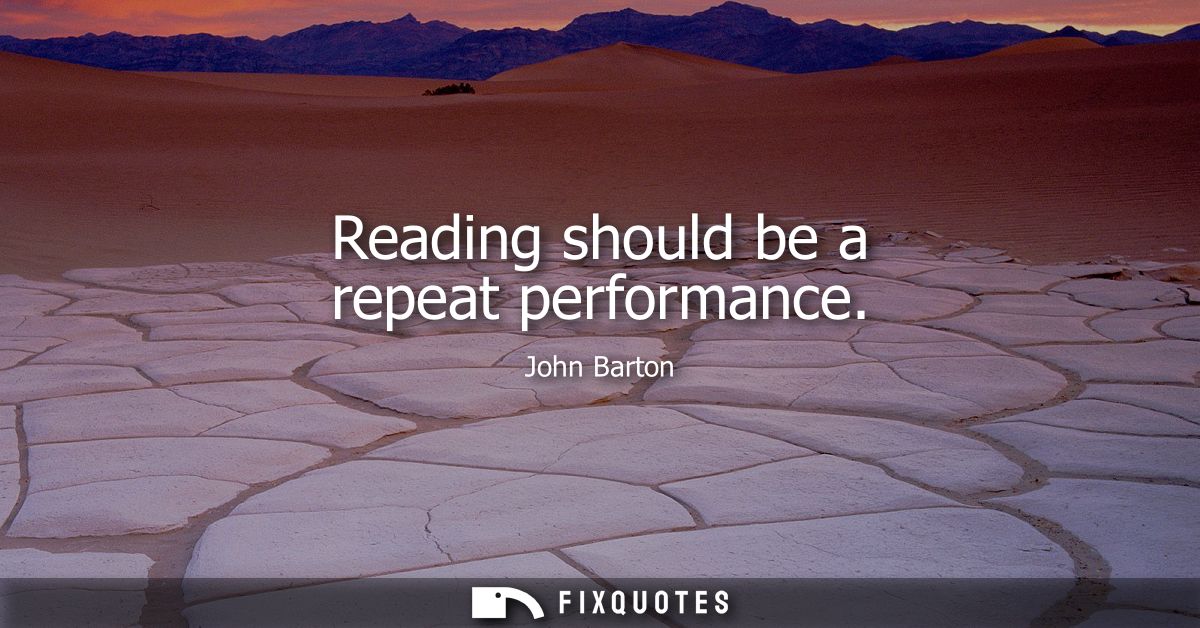
"Reading should be a repeat performance"
About this Quote
Reading, for Barton, isn’t a hike to a scenic overlook where you snap a photo and move on; it’s theater. “Repeat performance” sneaks in an argument about what literature is for: not consumption, but return. A poem or novel isn’t a one-and-done delivery system for “meaning.” It’s a score you re-enter, where rhythm, image, and implication change depending on your attention, your mood, your age, your private weather.
The phrase borrows prestige from the performing arts and quietly rebukes the modern pressure to be efficient. In an era trained by feeds, summaries, and speed-reading apps, Barton’s line feels like a small act of resistance. If reading is a performance, then the reader is not a passive recipient but a co-creator, responsible for pacing, emphasis, even silence. Re-reading becomes less like reviewing and more like rehearsal: each pass reveals different stresses, different jokes, different wounds. That’s especially true in poetry, where the surface can feel “understood” long before the machinery underneath has been heard.
There’s also a subtle ethical claim: returning to a text models humility. You admit you missed things, or that you’ve changed. Barton, writing as a contemporary poet, lands in a tradition that treats language as layered and unstable rather than purely referential. The line flatters the serious reader, sure, but it also challenges them: if you only read once, you’re treating art like news. Repeat it, and it starts behaving like art.
The phrase borrows prestige from the performing arts and quietly rebukes the modern pressure to be efficient. In an era trained by feeds, summaries, and speed-reading apps, Barton’s line feels like a small act of resistance. If reading is a performance, then the reader is not a passive recipient but a co-creator, responsible for pacing, emphasis, even silence. Re-reading becomes less like reviewing and more like rehearsal: each pass reveals different stresses, different jokes, different wounds. That’s especially true in poetry, where the surface can feel “understood” long before the machinery underneath has been heard.
There’s also a subtle ethical claim: returning to a text models humility. You admit you missed things, or that you’ve changed. Barton, writing as a contemporary poet, lands in a tradition that treats language as layered and unstable rather than purely referential. The line flatters the serious reader, sure, but it also challenges them: if you only read once, you’re treating art like news. Repeat it, and it starts behaving like art.
Quote Details
| Topic | Book |
|---|---|
| Source | Help us find the source |
| Cite |
Citation Formats
APA Style (7th ed.)
Barton, John. (2026, January 17). Reading should be a repeat performance. FixQuotes. https://fixquotes.com/quotes/reading-should-be-a-repeat-performance-71239/
Chicago Style
Barton, John. "Reading should be a repeat performance." FixQuotes. January 17, 2026. https://fixquotes.com/quotes/reading-should-be-a-repeat-performance-71239/.
MLA Style (9th ed.)
"Reading should be a repeat performance." FixQuotes, 17 Jan. 2026, https://fixquotes.com/quotes/reading-should-be-a-repeat-performance-71239/. Accessed 26 Mar. 2026.
More Quotes by John
Add to List