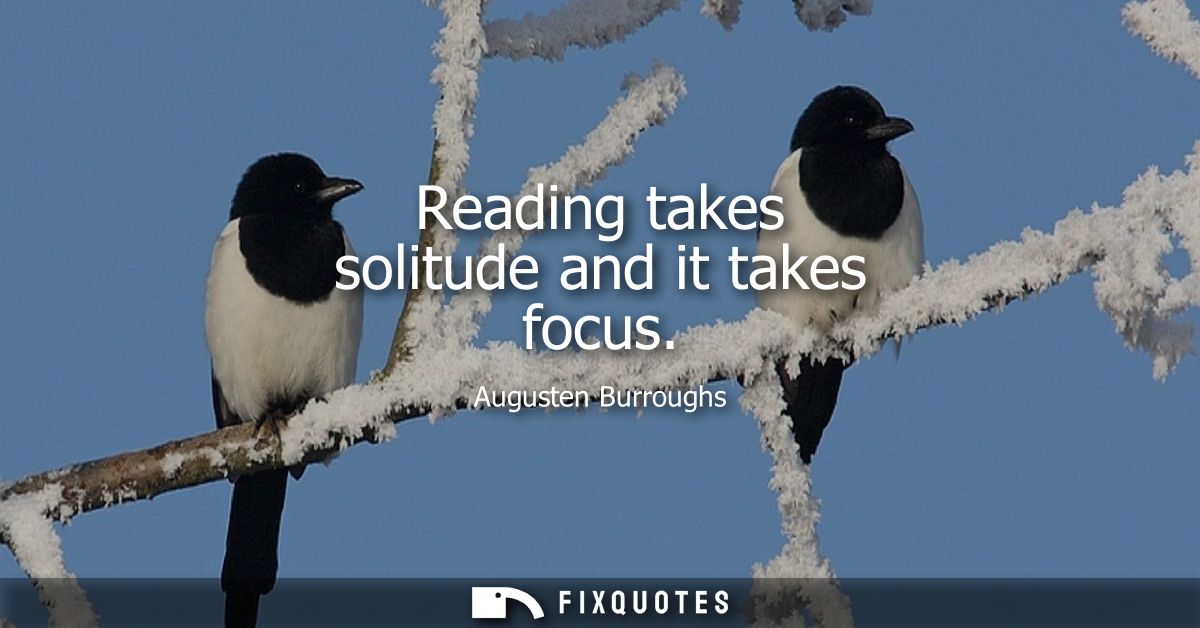
"Reading takes solitude and it takes focus"
About this Quote
Reading, Burroughs reminds us, isn’t just a hobby you can stack alongside errands and notifications; it’s a small act of refusal. “Solitude” and “focus” are plain words, almost stern, but they land like a critique of the way modern life trains us to be perpetually reachable. The line doesn’t romanticize books as self-improvement. It frames reading as a condition: you don’t merely choose a text, you choose an environment and a mental posture that makes the text possible.
The subtext is that reading is incompatible with performance. You can be seen scrolling; you can be applauded for “keeping up.” Reading, done seriously, disappears from the social feed. Solitude isn’t loneliness here, it’s privacy from interruption and from the subtle pressure to curate yourself in real time. Focus isn’t a productivity buzzword, it’s the muscle of sustained attention, the kind that digital platforms monetize away in fragments.
Burroughs, a memoirist with a sharp eye for the messy interiors of family and self, has always traded in intimate detail and long emotional arcs. That sensibility matters: his work asks for immersion, not sampling. So the quote reads like a practical truth and a cultural complaint. It suggests that the problem isn’t that people don’t “like” books; it’s that we’ve built a world where the prerequisites for reading feel indulgent, even antisocial. Burroughs flips that guilt: the indulgence is constant interruption, not the quiet that makes thought possible.
The subtext is that reading is incompatible with performance. You can be seen scrolling; you can be applauded for “keeping up.” Reading, done seriously, disappears from the social feed. Solitude isn’t loneliness here, it’s privacy from interruption and from the subtle pressure to curate yourself in real time. Focus isn’t a productivity buzzword, it’s the muscle of sustained attention, the kind that digital platforms monetize away in fragments.
Burroughs, a memoirist with a sharp eye for the messy interiors of family and self, has always traded in intimate detail and long emotional arcs. That sensibility matters: his work asks for immersion, not sampling. So the quote reads like a practical truth and a cultural complaint. It suggests that the problem isn’t that people don’t “like” books; it’s that we’ve built a world where the prerequisites for reading feel indulgent, even antisocial. Burroughs flips that guilt: the indulgence is constant interruption, not the quiet that makes thought possible.
Quote Details
| Topic | Book |
|---|---|
| Source | Help us find the source |
| Cite |
Citation Formats
APA Style (7th ed.)
Burroughs, Augusten. (2026, January 17). Reading takes solitude and it takes focus. FixQuotes. https://fixquotes.com/quotes/reading-takes-solitude-and-it-takes-focus-74833/
Chicago Style
Burroughs, Augusten. "Reading takes solitude and it takes focus." FixQuotes. January 17, 2026. https://fixquotes.com/quotes/reading-takes-solitude-and-it-takes-focus-74833/.
MLA Style (9th ed.)
"Reading takes solitude and it takes focus." FixQuotes, 17 Jan. 2026, https://fixquotes.com/quotes/reading-takes-solitude-and-it-takes-focus-74833/. Accessed 12 Feb. 2026.
More Quotes by Augusten
Add to List