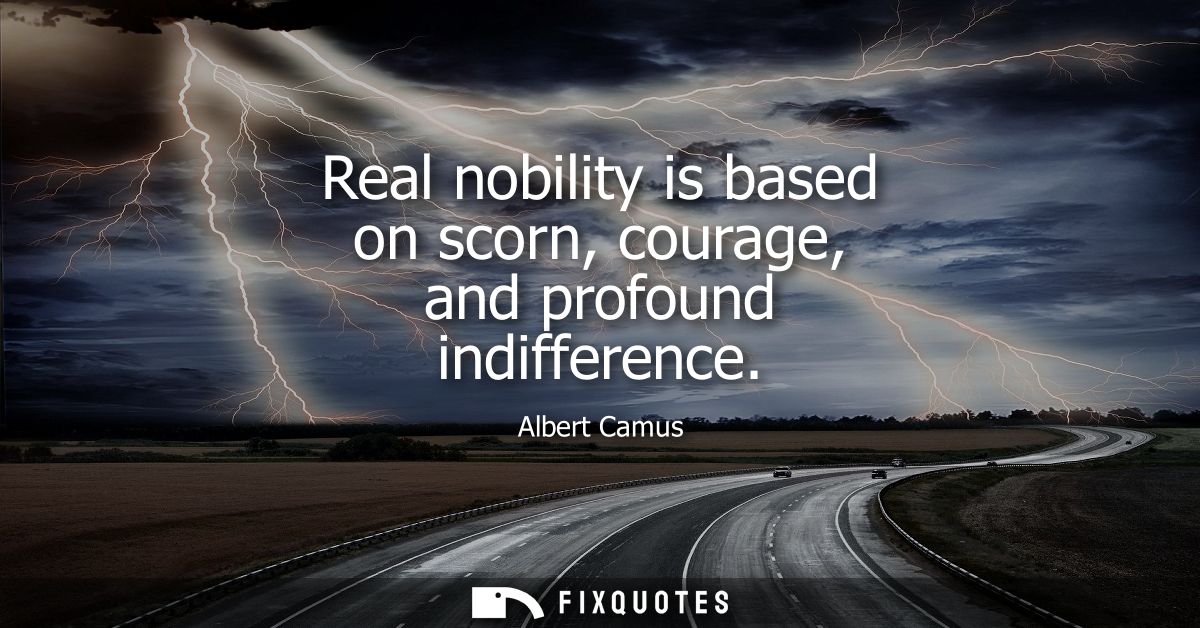
"Real nobility is based on scorn, courage, and profound indifference"
About this Quote
Nobility, for Camus, is not a medal pinned on good behavior; it is a posture taken in a universe that refuses to hand you meaning on official stationery. The provocation is in the ingredients: scorn, courage, indifference. Each one sounds like a vice until you hear the target of the scorn. Camus is scorning consolation frauds - the cheap metaphysics, the moral accounting systems, the insistence that suffering must be “for” something. That contempt is less sneer than self-defense: a refusal to be emotionally blackmailed by false hope.
Courage follows as the muscular, unglamorous virtue of staying present anyway. In The Myth of Sisyphus, Camus frames the absurd as the clash between our hunger for order and the world’s silence. Courage is living inside that clash without escaping into nihilism or religion, without aestheticizing despair. It’s the will to keep pushing the rock even after you understand the joke.
“Profound indifference” is the line that cuts deepest, because it’s not apathy; it’s nonattachment. The noble person stops bargaining with fate, stops auditioning for cosmic approval. Indifference becomes a kind of freedom: if the universe won’t validate you, it also can’t veto you. In the shadow of war, occupation, and ideological crusades that demanded total belief, Camus is sketching an ethic for people allergic to slogans: dignity as lucid resistance, carried out without illusions and without needing the world to clap.
Courage follows as the muscular, unglamorous virtue of staying present anyway. In The Myth of Sisyphus, Camus frames the absurd as the clash between our hunger for order and the world’s silence. Courage is living inside that clash without escaping into nihilism or religion, without aestheticizing despair. It’s the will to keep pushing the rock even after you understand the joke.
“Profound indifference” is the line that cuts deepest, because it’s not apathy; it’s nonattachment. The noble person stops bargaining with fate, stops auditioning for cosmic approval. Indifference becomes a kind of freedom: if the universe won’t validate you, it also can’t veto you. In the shadow of war, occupation, and ideological crusades that demanded total belief, Camus is sketching an ethic for people allergic to slogans: dignity as lucid resistance, carried out without illusions and without needing the world to clap.
Quote Details
| Topic | Wisdom |
|---|---|
| Source | Help us find the source |
| Cite |
Citation Formats
APA Style (7th ed.)
Camus, Albert. (2026, January 14). Real nobility is based on scorn, courage, and profound indifference. FixQuotes. https://fixquotes.com/quotes/real-nobility-is-based-on-scorn-courage-and-34575/
Chicago Style
Camus, Albert. "Real nobility is based on scorn, courage, and profound indifference." FixQuotes. January 14, 2026. https://fixquotes.com/quotes/real-nobility-is-based-on-scorn-courage-and-34575/.
MLA Style (9th ed.)
"Real nobility is based on scorn, courage, and profound indifference." FixQuotes, 14 Jan. 2026, https://fixquotes.com/quotes/real-nobility-is-based-on-scorn-courage-and-34575/. Accessed 19 Mar. 2026.
More Quotes by Albert
Add to List