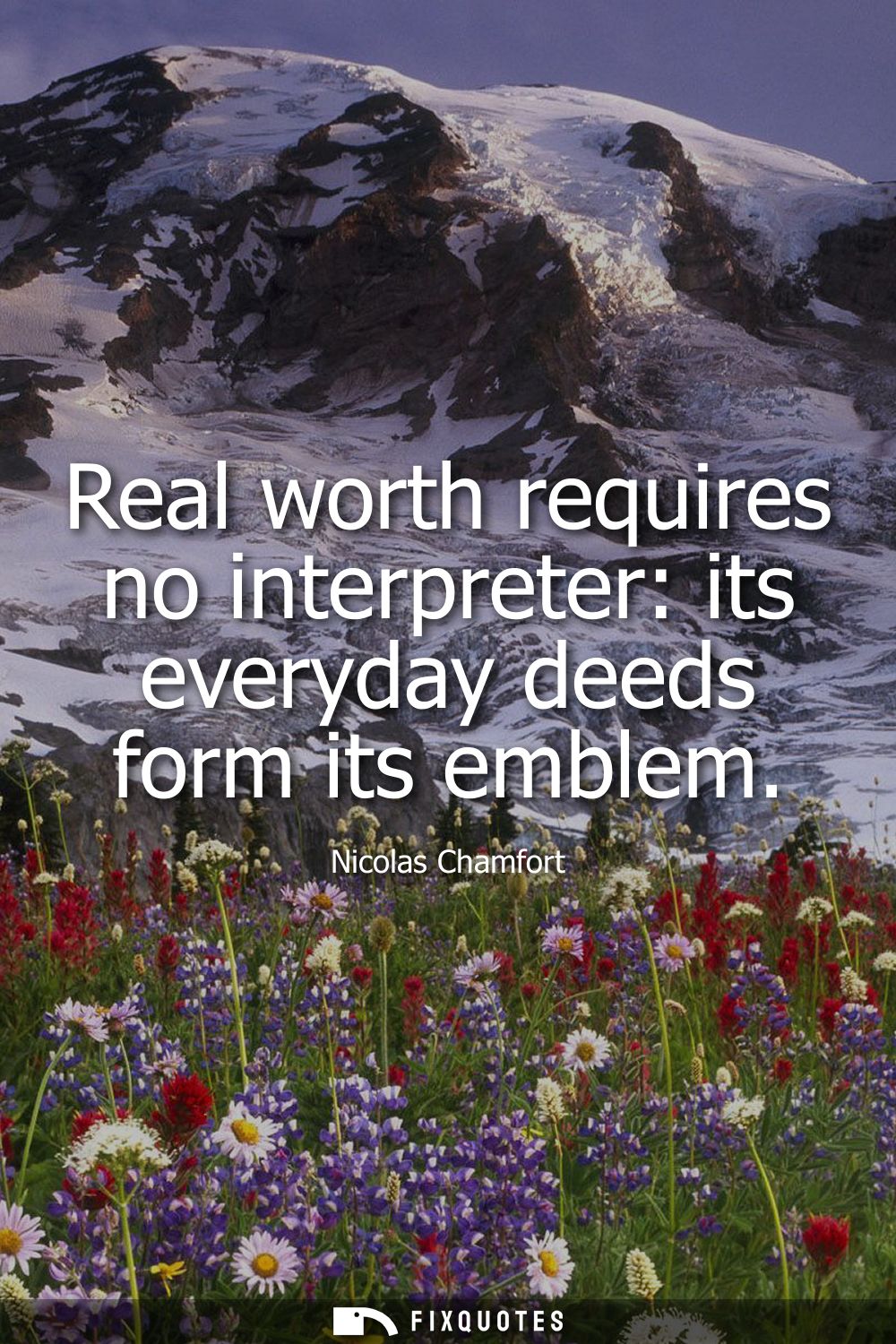
"Real worth requires no interpreter: its everyday deeds form its emblem"
About this Quote
The subtext is cynical in a very Enlightenment way: when virtue needs a press agent, it’s probably not virtue. Chamfort knew the world of moral performance intimately, moving through pre-Revolutionary France where status was manufactured by wit, patronage, and appearances. In that environment, the “interpreter” is both literal (the courtier, the critic, the gossip) and ideological (the rationalizations people invent to make their self-interest sound principled). Chamfort refuses that mediation. He suggests a brutally democratic standard: watch what someone does when no one’s applauding.
There’s also a warning embedded in the elegance. If deeds are the emblem, then the emblem is always being stitched, daily. Worth isn’t a single heroic act; it’s the accumulation that leaves no plausible deniability. In an era obsessed with grand declarations - political, philosophical, personal - Chamfort insists that the only proof that survives is conduct.
Quote Details
| Topic | Honesty & Integrity |
|---|---|
| Source | Help us find the source |
| Cite |
Citation Formats
APA Style (7th ed.)
Chamfort, Nicolas. (2026, January 18). Real worth requires no interpreter: its everyday deeds form its emblem. FixQuotes. https://fixquotes.com/quotes/real-worth-requires-no-interpreter-its-everyday-16188/
Chicago Style
Chamfort, Nicolas. "Real worth requires no interpreter: its everyday deeds form its emblem." FixQuotes. January 18, 2026. https://fixquotes.com/quotes/real-worth-requires-no-interpreter-its-everyday-16188/.
MLA Style (9th ed.)
"Real worth requires no interpreter: its everyday deeds form its emblem." FixQuotes, 18 Jan. 2026, https://fixquotes.com/quotes/real-worth-requires-no-interpreter-its-everyday-16188/. Accessed 30 Mar. 2026.