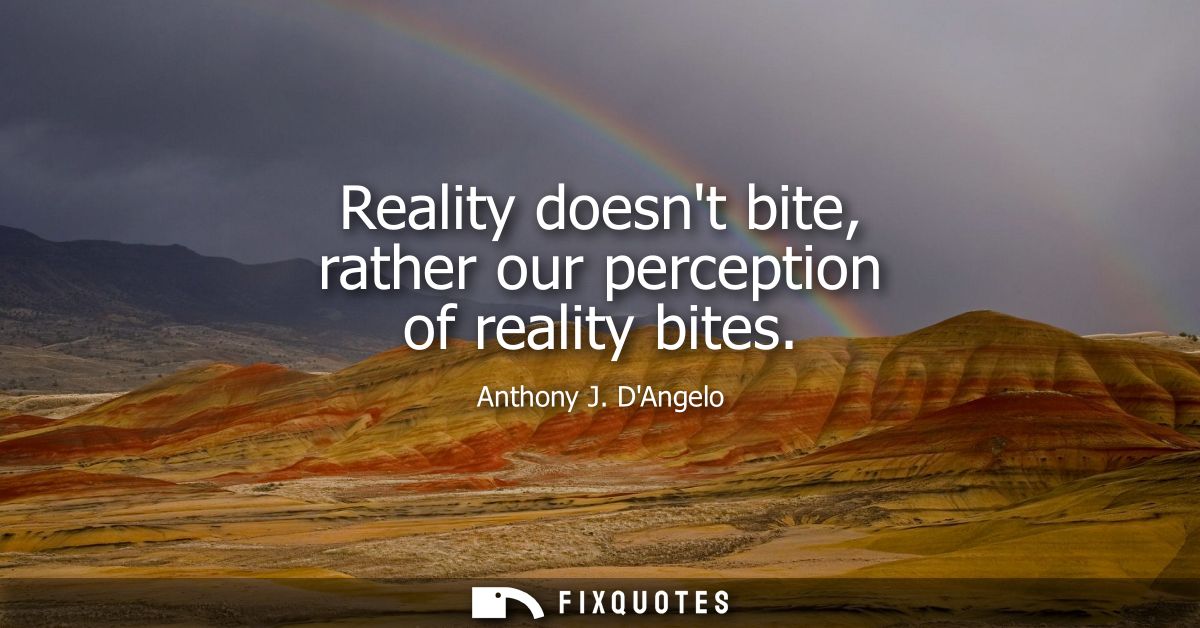
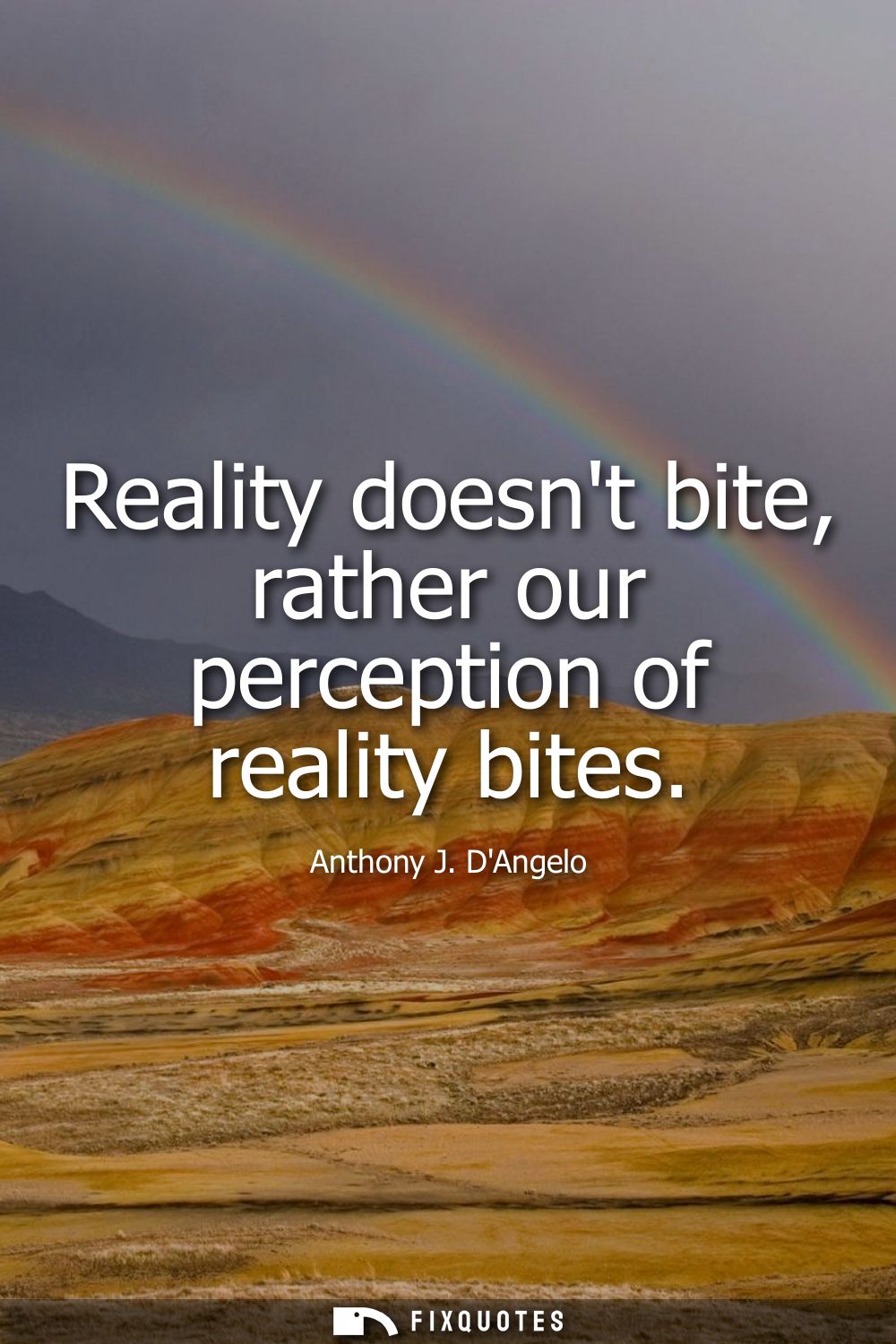
"Reality doesn't bite, rather our perception of reality bites"
About this Quote
The sting, D'Angelo implies, isn’t in the world itself but in the story we keep insisting the world must be. By personifying perception as the thing that “bites,” he flips a common complaint on its head: reality isn’t the predator; our interpretive machinery is. It’s a clean self-help maneuver with a subtle edge of accountability. If the wound is caused by perception, then the wound is also, at least partly, treatable.
The line works because it compresses a whole therapeutic worldview into a single, slightly abrasive image. “Reality doesn’t bite” is disarming, almost soothing; it rejects the melodrama of a hostile universe. Then the second clause turns: “rather our perception” carries the blame, but also the leverage. You can’t negotiate with reality, but you can renegotiate with your framing - the reflexive catastrophizing, the comparison trap, the assumption of intent where there’s only randomness.
The subtext is cognitive behavioral before it’s philosophical: events happen, meanings get assigned, emotions follow. D’Angelo’s phrasing nudges the reader away from grievance and toward self-audit. Not in a cold “it’s all in your head” way, but in a pragmatic “your head is where the pain gets amplified” way.
Context matters: a contemporary motivational author speaking into an era of ambient anxiety, algorithmic outrage, and constant social measurement. In that climate, perception isn’t just personal; it’s curated, monetized, and weaponized. The bite often comes from the mental overlays we’ve been trained to keep applying - faster than we can notice them.
The line works because it compresses a whole therapeutic worldview into a single, slightly abrasive image. “Reality doesn’t bite” is disarming, almost soothing; it rejects the melodrama of a hostile universe. Then the second clause turns: “rather our perception” carries the blame, but also the leverage. You can’t negotiate with reality, but you can renegotiate with your framing - the reflexive catastrophizing, the comparison trap, the assumption of intent where there’s only randomness.
The subtext is cognitive behavioral before it’s philosophical: events happen, meanings get assigned, emotions follow. D’Angelo’s phrasing nudges the reader away from grievance and toward self-audit. Not in a cold “it’s all in your head” way, but in a pragmatic “your head is where the pain gets amplified” way.
Context matters: a contemporary motivational author speaking into an era of ambient anxiety, algorithmic outrage, and constant social measurement. In that climate, perception isn’t just personal; it’s curated, monetized, and weaponized. The bite often comes from the mental overlays we’ve been trained to keep applying - faster than we can notice them.
Quote Details
| Topic | Wisdom |
|---|---|
| Source | Later attribution: Walking Tall In Tough Times (GREAT IGWE, 2019) modern compilationISBN: 9781733280327 · ID: fOGlDwAAQBAJ
Evidence:
... Reality doesn't bite , rather Our perception of reality bites . " - Anthony J. D'Angelo Of course , life will bring many challenges , and it's not easy to embrace them when we're suffering and wishing those things would have never ... |
| Cite |
Citation Formats
APA Style (7th ed.)
D'Angelo, Anthony J. (2026, February 8). Reality doesn't bite, rather our perception of reality bites. FixQuotes. https://fixquotes.com/quotes/reality-doesnt-bite-rather-our-perception-of-122774/
Chicago Style
D'Angelo, Anthony J. "Reality doesn't bite, rather our perception of reality bites." FixQuotes. February 8, 2026. https://fixquotes.com/quotes/reality-doesnt-bite-rather-our-perception-of-122774/.
MLA Style (9th ed.)
"Reality doesn't bite, rather our perception of reality bites." FixQuotes, 8 Feb. 2026, https://fixquotes.com/quotes/reality-doesnt-bite-rather-our-perception-of-122774/. Accessed 29 Mar. 2026.
More Quotes by Anthony
Add to List