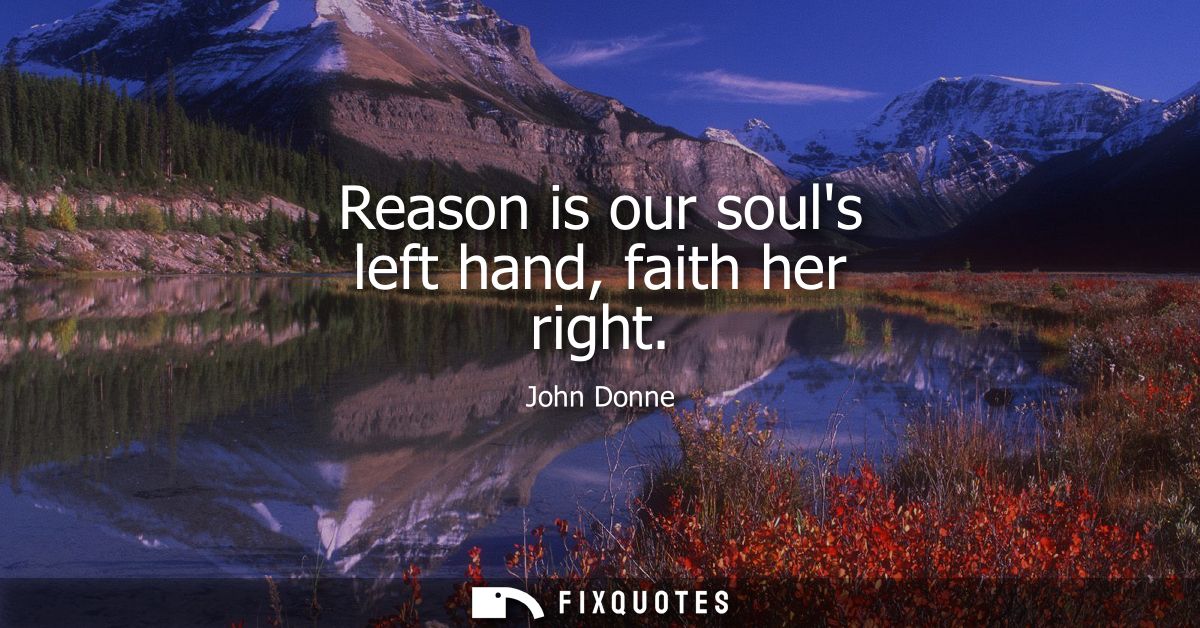
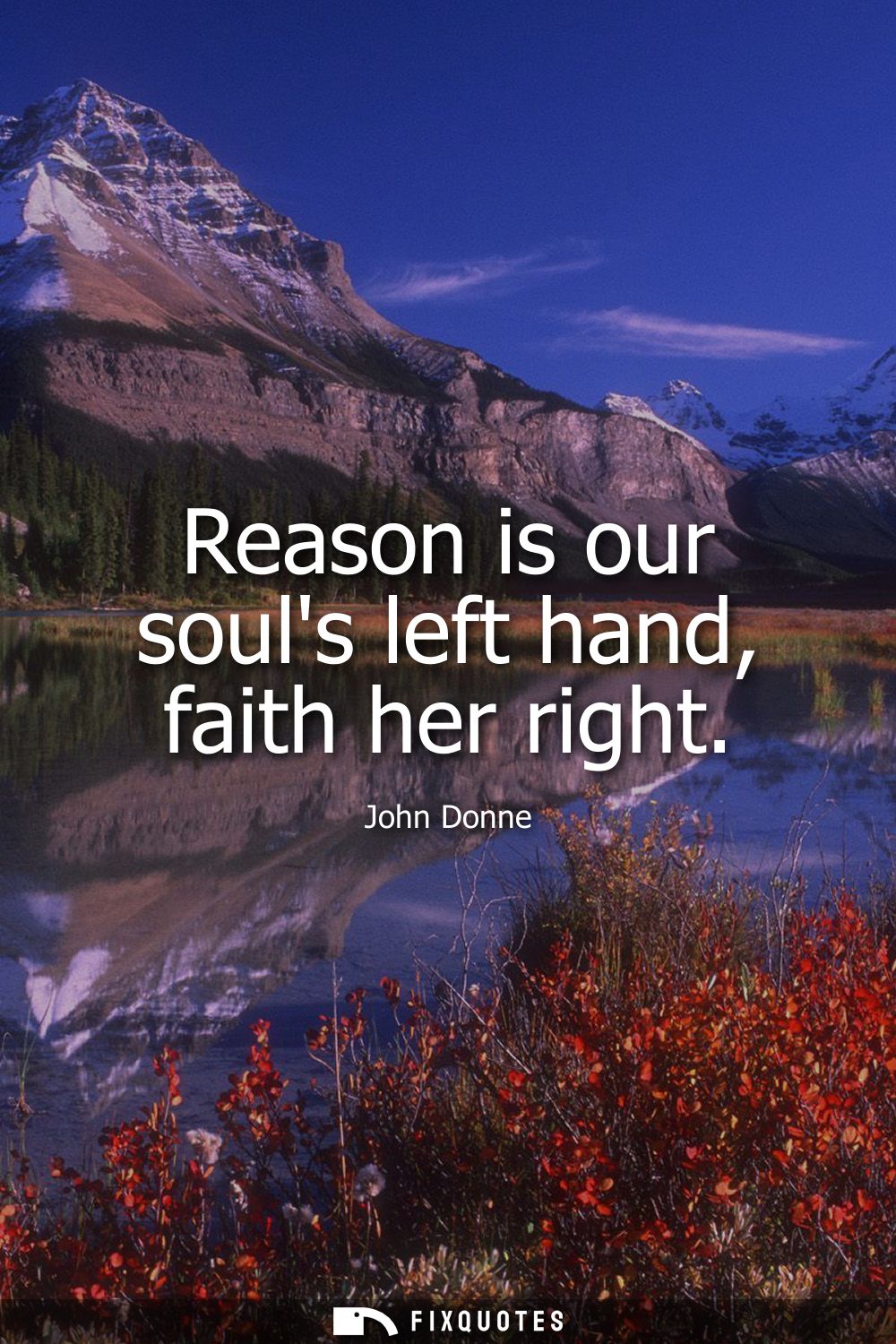
"Reason is our soul's left hand, faith her right"
About this Quote
Donne’s line works because it refuses to let the era’s favorite binaries stay neat. In a culture sliding from medieval certainty into early modern skepticism, “Reason is our soul’s left hand, faith her right” isn’t a peace treaty between intellect and belief so much as a power move: it claims both as native instruments of the same inner person. The soul is figured as a body with agency, not a passive vessel. She has hands. She acts.
The left/right split is doing quiet rhetorical labor. “Right” carries long-standing associations with authority, blessing, and skill; to place faith there grants it honor without declaring reason useless. “Left” isn’t simply lesser, though it hints at the awkward, the secondary, the hand you use when the other is occupied. Donne gives reason an indispensable but subordinate role: capable, necessary, not sovereign. That hierarchy flatters the thinking reader while steering them back toward submission.
Context matters: Donne lived the consequences of England’s religious whiplash, born into a Catholic family under Protestant rule, later conforming and becoming an Anglican cleric. His poetry is full of that pressure - the educated mind that can argue itself into doubt, and the devout longing that wants an end to argument. The metaphor’s subtext is psychological as much as theological: you can’t pray your way out of intelligence, and you can’t think your way into grace. By making them paired limbs, Donne turns spiritual life into coordination rather than conquest - the soul moving forward only when both hands work together, even if one leads.
The left/right split is doing quiet rhetorical labor. “Right” carries long-standing associations with authority, blessing, and skill; to place faith there grants it honor without declaring reason useless. “Left” isn’t simply lesser, though it hints at the awkward, the secondary, the hand you use when the other is occupied. Donne gives reason an indispensable but subordinate role: capable, necessary, not sovereign. That hierarchy flatters the thinking reader while steering them back toward submission.
Context matters: Donne lived the consequences of England’s religious whiplash, born into a Catholic family under Protestant rule, later conforming and becoming an Anglican cleric. His poetry is full of that pressure - the educated mind that can argue itself into doubt, and the devout longing that wants an end to argument. The metaphor’s subtext is psychological as much as theological: you can’t pray your way out of intelligence, and you can’t think your way into grace. By making them paired limbs, Donne turns spiritual life into coordination rather than conquest - the soul moving forward only when both hands work together, even if one leads.
Quote Details
| Topic | Faith |
|---|---|
| Source | Help us find the source |
| Cite |
Citation Formats
APA Style (7th ed.)
Donne, John. (2026, January 18). Reason is our soul's left hand, faith her right. FixQuotes. https://fixquotes.com/quotes/reason-is-our-souls-left-hand-faith-her-right-17335/
Chicago Style
Donne, John. "Reason is our soul's left hand, faith her right." FixQuotes. January 18, 2026. https://fixquotes.com/quotes/reason-is-our-souls-left-hand-faith-her-right-17335/.
MLA Style (9th ed.)
"Reason is our soul's left hand, faith her right." FixQuotes, 18 Jan. 2026, https://fixquotes.com/quotes/reason-is-our-souls-left-hand-faith-her-right-17335/. Accessed 24 Mar. 2026.
More Quotes by John
Add to List