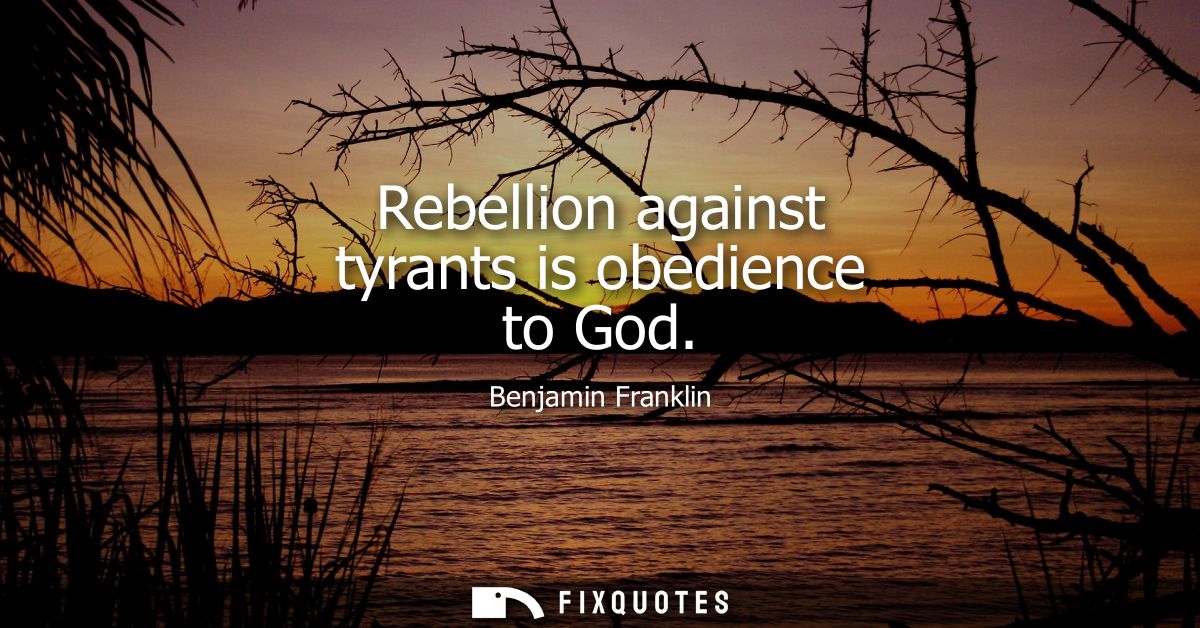
"Rebellion against tyrants is obedience to God"
About this Quote
Franklin’s line turns the usual moral furniture of politics upside down: obedience, the dutiful virtue preached from pulpits and demanded by kings, gets reassigned to the act most authorities fear. In a single sentence, rebellion stops being a crime and becomes a kind of sacred housekeeping.
The intent is brutally practical. In the revolutionary moment, the colonies didn’t just need muskets; they needed permission structures. “Tyrants” is doing heavy work here: it narrows the target so resistance looks principled, not anarchic. And “God” is the master key. By placing divine authority above earthly rule, Franklin offers a legitimacy that British law can’t touch and moderate conscience can’t easily refuse. It’s also a rhetorical trap: if you oppose rebellion, you risk sounding like you’re opposing God.
The subtext is Franklin at his most strategic. He wasn’t a theologian so much as a master of civic psychology. The phrase borrows the emotional voltage of religion without getting bogged down in doctrine. It recruits believers, but it also reassures skeptics by framing revolt as moral order restored, not order destroyed. “Obedience” is the sly pivot: the rebel isn’t rejecting authority; he’s choosing the higher one.
Context matters. Eighteenth-century political arguments were steeped in sermons, providence, and the language of moral duty. Franklin’s genius is translating Enlightenment resistance theory into a bumper-sticker creed for a public accustomed to hearing that submission is righteous. It’s not piety; it’s political jujitsu.
The intent is brutally practical. In the revolutionary moment, the colonies didn’t just need muskets; they needed permission structures. “Tyrants” is doing heavy work here: it narrows the target so resistance looks principled, not anarchic. And “God” is the master key. By placing divine authority above earthly rule, Franklin offers a legitimacy that British law can’t touch and moderate conscience can’t easily refuse. It’s also a rhetorical trap: if you oppose rebellion, you risk sounding like you’re opposing God.
The subtext is Franklin at his most strategic. He wasn’t a theologian so much as a master of civic psychology. The phrase borrows the emotional voltage of religion without getting bogged down in doctrine. It recruits believers, but it also reassures skeptics by framing revolt as moral order restored, not order destroyed. “Obedience” is the sly pivot: the rebel isn’t rejecting authority; he’s choosing the higher one.
Context matters. Eighteenth-century political arguments were steeped in sermons, providence, and the language of moral duty. Franklin’s genius is translating Enlightenment resistance theory into a bumper-sticker creed for a public accustomed to hearing that submission is righteous. It’s not piety; it’s political jujitsu.
Quote Details
| Topic | Freedom |
|---|---|
| Source | Later attribution: Conciliation Act of 1941. Hearings Before a Subcommittee.... (United States. U.S. Congress. Senate...., 1941) modern compilationID: _hfNnnIdMBcC
Evidence: ... Benjamin Franklin said that " rebellion against tyrants is obedience to God . " I want to say here that I am quoting from Mr. Capizzi's statement and attributing this to Benjamin Franklin is incorrect because that is a quotation that ... Other candidates (1) The Papers of Benjamin Franklin, Vol. 22 (1775–1776) (Benjamin Franklin, 1982)50.0% THAT REBELLION TO TYRANTS IS OBEDIENCE TO GOD. (pp. 303–304). This is the earliest *verifiable* appearance in a prima... |
| Cite |
Citation Formats
APA Style (7th ed.)
Franklin, Benjamin. (2026, February 9). Rebellion against tyrants is obedience to God. FixQuotes. https://fixquotes.com/quotes/rebellion-against-tyrants-is-obedience-to-god-25524/
Chicago Style
Franklin, Benjamin. "Rebellion against tyrants is obedience to God." FixQuotes. February 9, 2026. https://fixquotes.com/quotes/rebellion-against-tyrants-is-obedience-to-god-25524/.
MLA Style (9th ed.)
"Rebellion against tyrants is obedience to God." FixQuotes, 9 Feb. 2026, https://fixquotes.com/quotes/rebellion-against-tyrants-is-obedience-to-god-25524/. Accessed 30 Mar. 2026.
More Quotes by Benjamin
Add to List