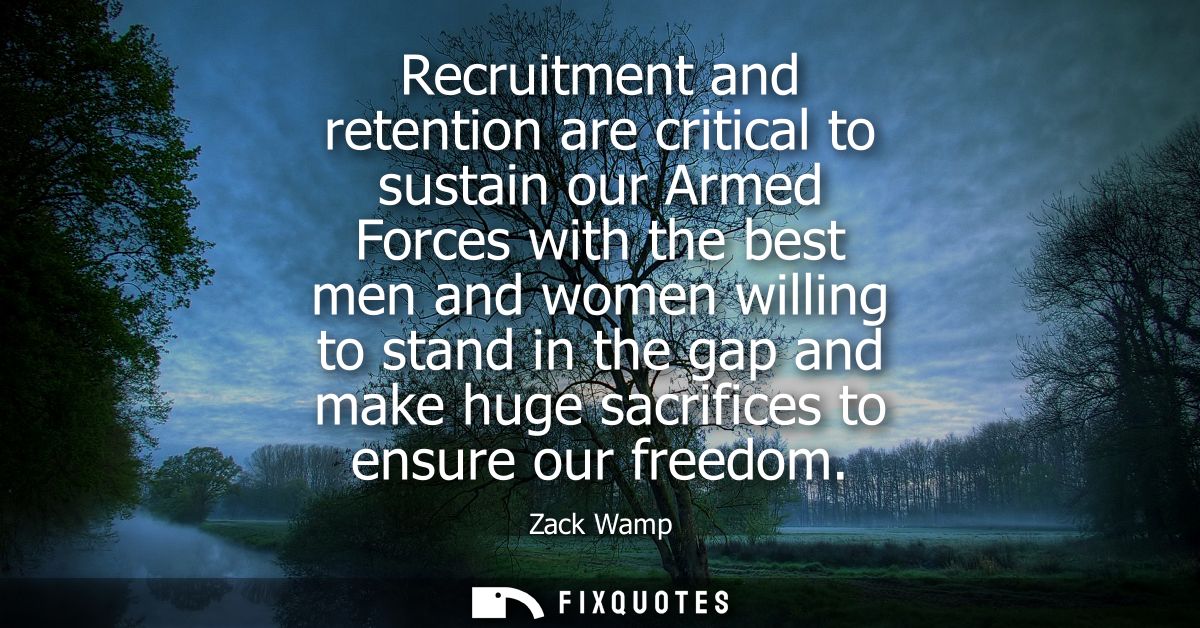
"Recruitment and retention are critical to sustain our Armed Forces, with the best men and women willing to stand in the gap and make huge sacrifices to ensure our freedom"
About this Quote
“Recruitment and retention” is HR speak, and Wamp pairs it with “huge sacrifices” and “ensure our freedom” to fuse two registers: bureaucracy and consecration. That fusion matters. It lets a politician argue for pragmatic incentives (pay, benefits, family support, healthcare, education) while keeping the conversation safely above politics, as if the nation’s obligations are self-evident and beyond debate. The subtext is: if you question the costs, you’re not just questioning a program, you’re questioning freedom itself.
Contextually, this kind of line typically surfaces when the volunteer force is under strain - a tough recruiting environment, long deployments, post-9/11 fatigue, or a widening civil-military gap where fewer families have direct connection to service. “Best men and women” flatters the institution and narrows the moral frame: the military becomes the repository of national character, while civilians are implicitly beneficiaries rather than participants.
It’s effective because it offers a clean emotional contract: they sacrifice, we owe. It’s also a political shield, smuggling policy arguments inside a vow of gratitude.
Quote Details
| Topic | Military & Soldier |
|---|---|
| Source | Help us find the source |
| Cite |
Citation Formats
APA Style (7th ed.)
Wamp, Zack. (2026, February 16). Recruitment and retention are critical to sustain our Armed Forces, with the best men and women willing to stand in the gap and make huge sacrifices to ensure our freedom. FixQuotes. https://fixquotes.com/quotes/recruitment-and-retention-are-critical-to-sustain-59324/
Chicago Style
Wamp, Zack. "Recruitment and retention are critical to sustain our Armed Forces, with the best men and women willing to stand in the gap and make huge sacrifices to ensure our freedom." FixQuotes. February 16, 2026. https://fixquotes.com/quotes/recruitment-and-retention-are-critical-to-sustain-59324/.
MLA Style (9th ed.)
"Recruitment and retention are critical to sustain our Armed Forces, with the best men and women willing to stand in the gap and make huge sacrifices to ensure our freedom." FixQuotes, 16 Feb. 2026, https://fixquotes.com/quotes/recruitment-and-retention-are-critical-to-sustain-59324/. Accessed 10 Mar. 2026.