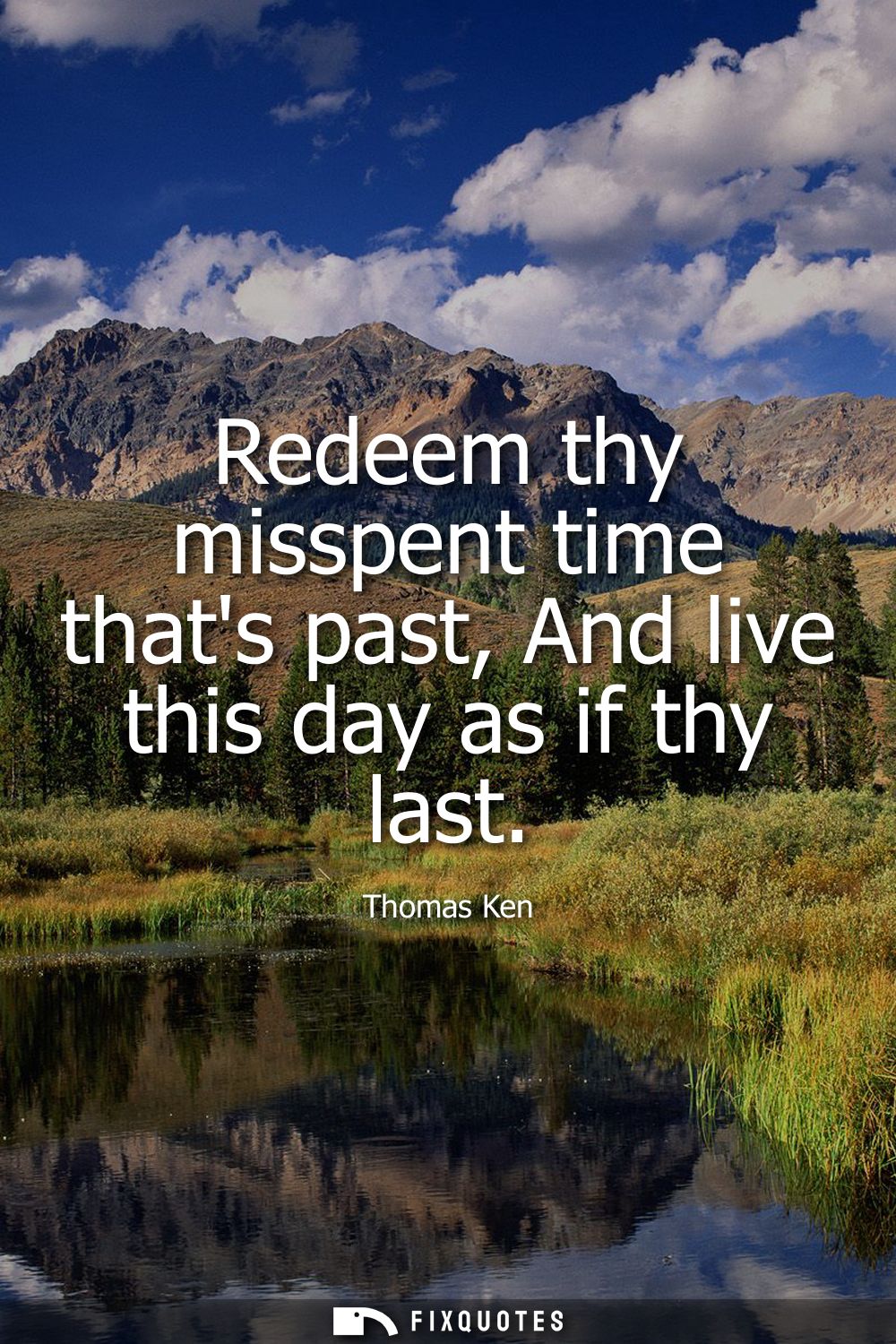
"Redeem thy misspent time that's past, And live this day as if thy last"
About this Quote
Ken writes in a late-17th-century England where spiritual routine was a technology of survival: morning and evening prayer, self-examination, the constant rehearsal of mortality. “Redeem” echoes explicitly Christian logic - repentance as purchase, grace as restoration. The past is not erased; it’s reclaimed through action now. That’s why the poem doesn’t sentimentalize regret. It weaponizes it.
Then the second clause tightens the noose: “live this day as if thy last.” It’s a memento mori without gothic theatrics, more practical than poetic. The subtext is pastoral triage. Death might arrive suddenly (illness, accident, plague memory), and spiritual procrastination is the most dangerous kind because it disguises itself as tomorrow. Ken’s brilliance is rhythm and balance: the backward glance (“time that’s past”) immediately converts into a forward command (“this day”). The couplet makes mortality feel like a deadline with teeth, insisting that redemption is not an abstract belief but a daily schedule.
Quote Details
| Topic | Live in the Moment |
|---|---|
| Source | Thomas Ken, "Awake, My Soul, and with the Sun" (Morning Hymn) — contains the lines "Redeem thy misspent time that's past, And live this day as if thy last". |
| Cite |
Citation Formats
APA Style (7th ed.)
Ken, Thomas. (2026, January 16). Redeem thy misspent time that's past, And live this day as if thy last. FixQuotes. https://fixquotes.com/quotes/redeem-thy-misspent-time-thats-past-and-live-this-129498/
Chicago Style
Ken, Thomas. "Redeem thy misspent time that's past, And live this day as if thy last." FixQuotes. January 16, 2026. https://fixquotes.com/quotes/redeem-thy-misspent-time-thats-past-and-live-this-129498/.
MLA Style (9th ed.)
"Redeem thy misspent time that's past, And live this day as if thy last." FixQuotes, 16 Jan. 2026, https://fixquotes.com/quotes/redeem-thy-misspent-time-thats-past-and-live-this-129498/. Accessed 28 Mar. 2026.