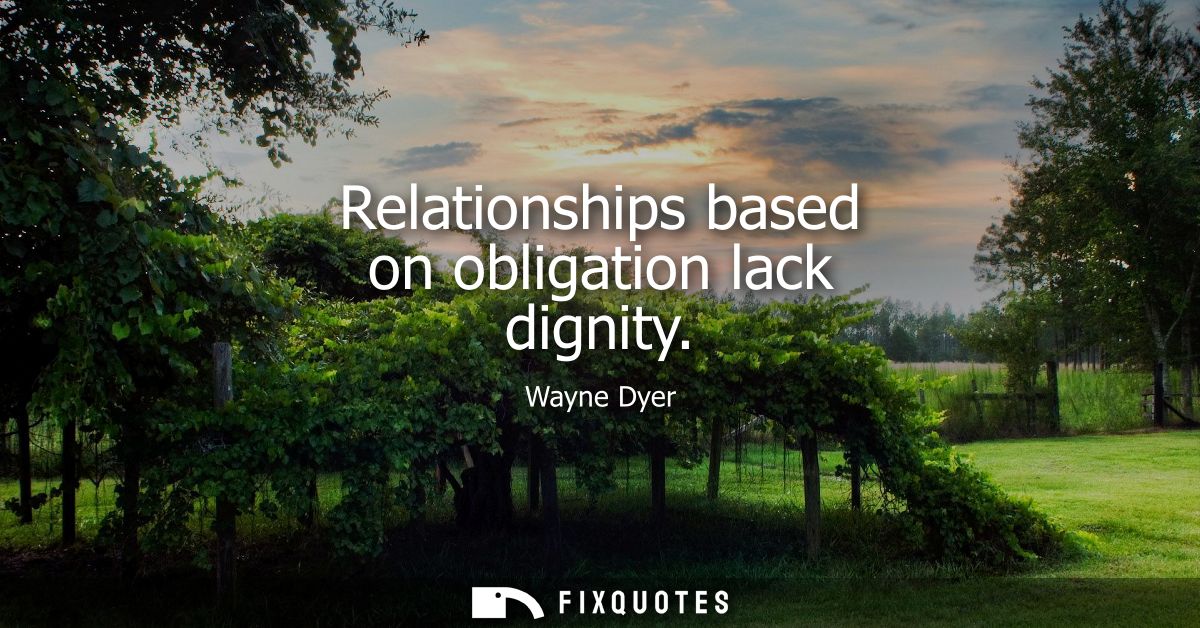
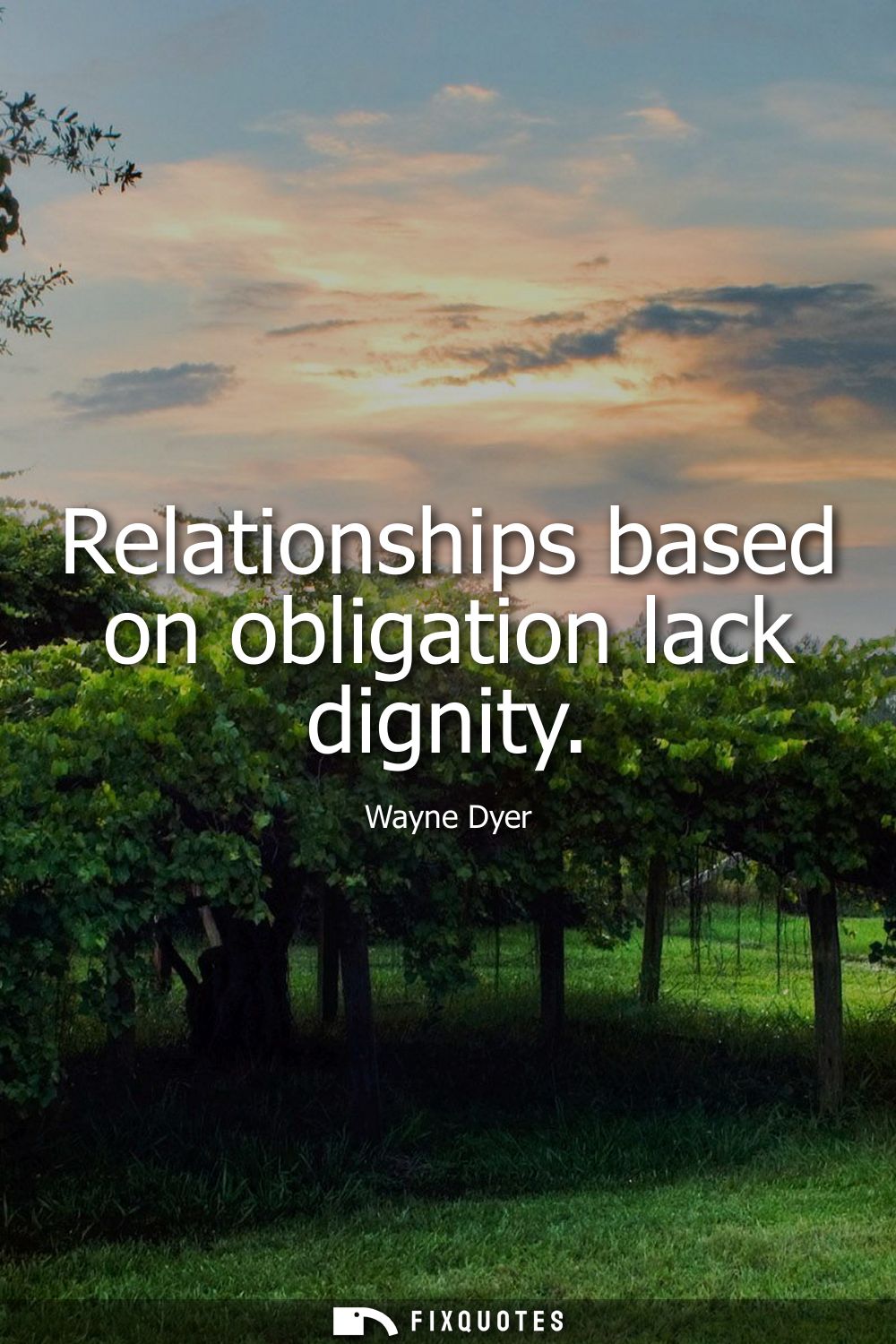
"Relationships based on obligation lack dignity"
About this Quote
Dyer’s line lands like a polite slap at the whole architecture of duty-bound intimacy: the marriage you “should” stay in, the parent you “owe,” the friend you keep out of guilt. As a psychologist-turned-self-help sage, he’s not making a legal argument about responsibility; he’s making a psychological one about consent. Obligation, in his framing, isn’t commitment’s noble cousin. It’s coercion in softer clothing.
The intent is corrective and liberating. Dyer is talking to the kind of person who performs loyalty as penance and calls it love. “Lack dignity” is the key phrase: he’s not saying these relationships are merely unhappy or inefficient, but that they strip both parties of personhood. The obligated giver becomes a service role, a walking IOU. The obligated receiver becomes infantilized, kept in a permanent state of neediness or leverage. Nobody gets to stand upright.
The subtext is a challenge to moral economies that treat affection like debt. Obligation implies a ledger, and ledgers demand repayment, which quietly breeds resentment. Dyer’s humanistic-leaning psychology (and his broader spiritual self-reliance brand) favors relationships chosen freely, renewed continuously, not maintained by fear of punishment or social disapproval.
Context matters: late-20th-century therapeutic culture was busy translating older communal scripts into individual agency. Dyer’s quote is a pocket-sized manifesto from that shift. It’s persuasive because it doesn’t argue against caring for others; it argues against caring as self-erasure. The dignity he’s defending is mutual: a relationship should be a “yes,” not a sentence.
The intent is corrective and liberating. Dyer is talking to the kind of person who performs loyalty as penance and calls it love. “Lack dignity” is the key phrase: he’s not saying these relationships are merely unhappy or inefficient, but that they strip both parties of personhood. The obligated giver becomes a service role, a walking IOU. The obligated receiver becomes infantilized, kept in a permanent state of neediness or leverage. Nobody gets to stand upright.
The subtext is a challenge to moral economies that treat affection like debt. Obligation implies a ledger, and ledgers demand repayment, which quietly breeds resentment. Dyer’s humanistic-leaning psychology (and his broader spiritual self-reliance brand) favors relationships chosen freely, renewed continuously, not maintained by fear of punishment or social disapproval.
Context matters: late-20th-century therapeutic culture was busy translating older communal scripts into individual agency. Dyer’s quote is a pocket-sized manifesto from that shift. It’s persuasive because it doesn’t argue against caring for others; it argues against caring as self-erasure. The dignity he’s defending is mutual: a relationship should be a “yes,” not a sentence.
Quote Details
| Topic | Relationship |
|---|---|
| Source | Help us find the source |
| Cite |
Citation Formats
APA Style (7th ed.)
Dyer, Wayne. (2026, January 16). Relationships based on obligation lack dignity. FixQuotes. https://fixquotes.com/quotes/relationships-based-on-obligation-lack-dignity-137825/
Chicago Style
Dyer, Wayne. "Relationships based on obligation lack dignity." FixQuotes. January 16, 2026. https://fixquotes.com/quotes/relationships-based-on-obligation-lack-dignity-137825/.
MLA Style (9th ed.)
"Relationships based on obligation lack dignity." FixQuotes, 16 Jan. 2026, https://fixquotes.com/quotes/relationships-based-on-obligation-lack-dignity-137825/. Accessed 24 Mar. 2026.
More Quotes by Wayne
Add to List