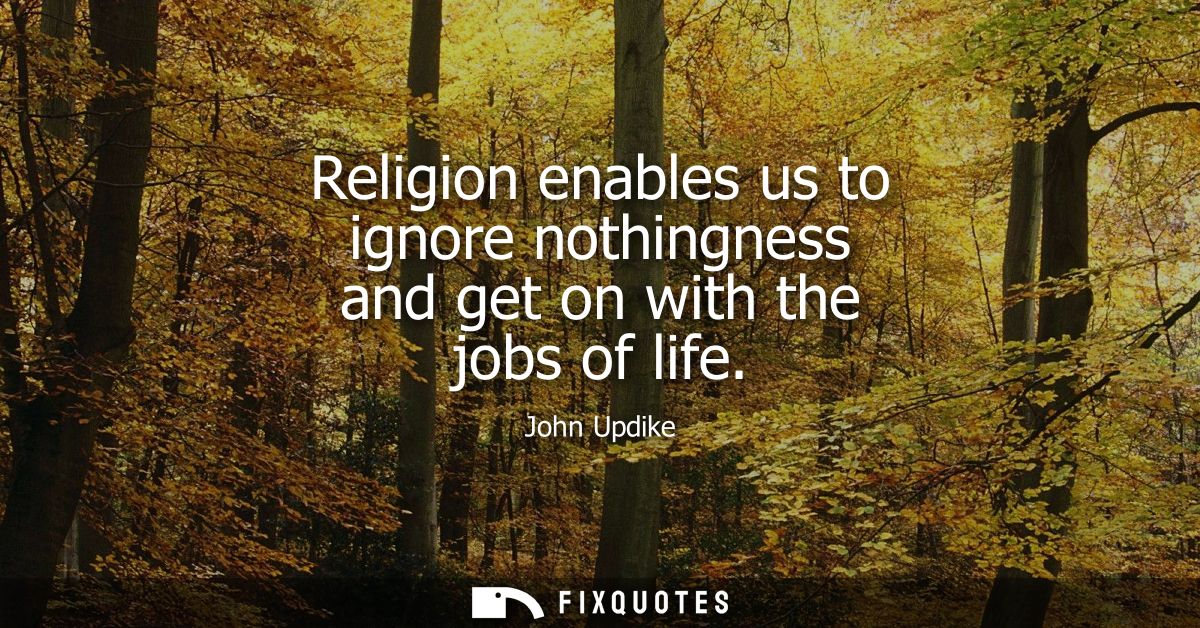
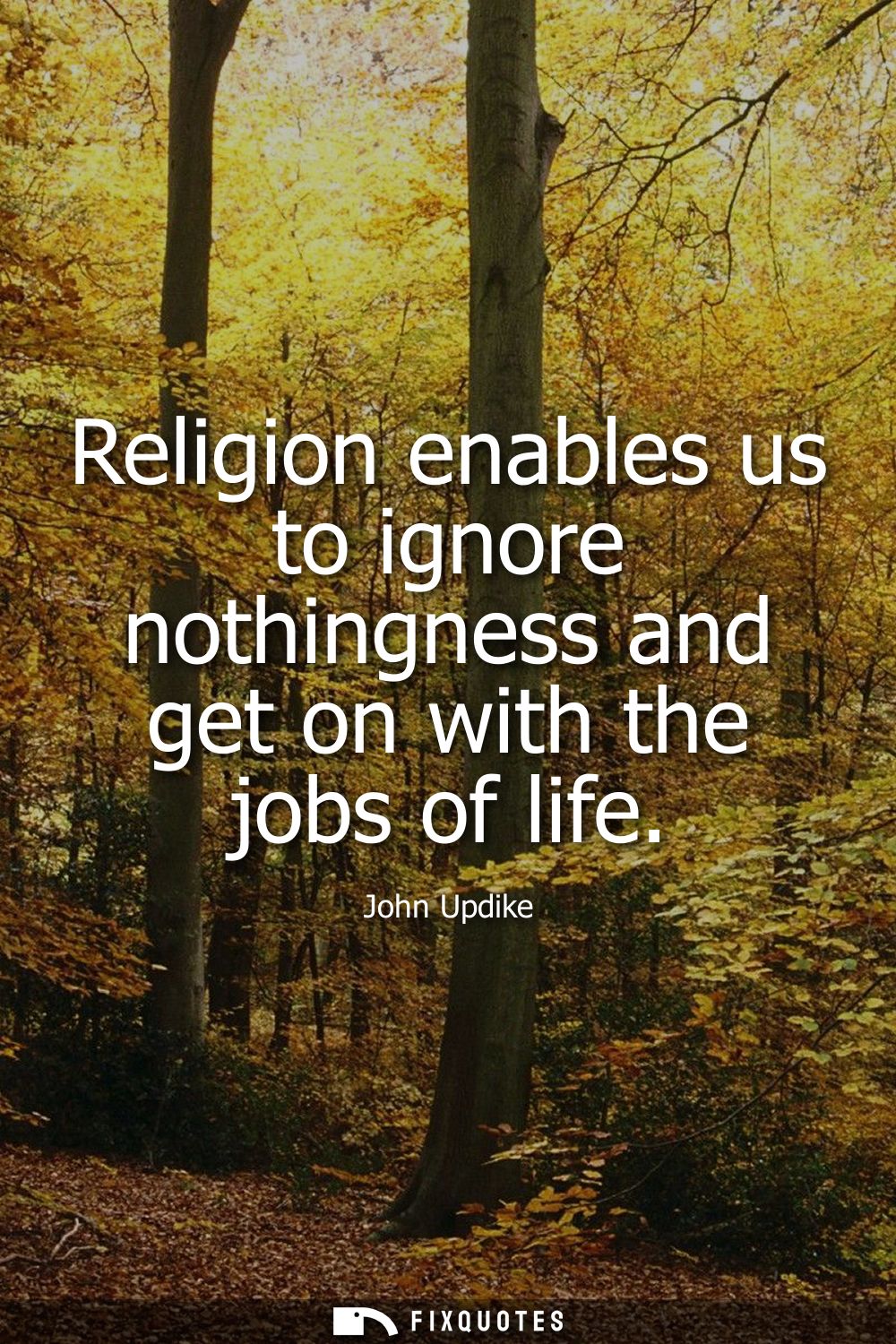
"Religion enables us to ignore nothingness and get on with the jobs of life"
About this Quote
The verb choice matters. “Enables” is managerial, almost bureaucratic, suggesting utility over revelation. And “ignore” is the tell: not answer, not defeat, not transfigure. Ignore. Updike grants the void its existence and then describes faith as the sanctioned act of looking away so you can pay the bills, raise kids, write novels, endure cancer scares, and pretend the calendar isn’t a countdown. It’s an unusually candid apology for belief from a writer often associated with suburban surfaces and the metaphysical itch underneath them.
Contextually, Updike belongs to a postwar American cohort whose prosperity didn’t cancel dread; it merely gave dread better furniture. Mid-century affluence made “the jobs of life” multiply - careers, mortgages, reputations - while secular modernity made “nothingness” harder to dodge. The subtext is both compassionate and faintly chastening: humans may be too cognitively and emotionally limited to stare at the abyss for long without losing function. Religion becomes a culturally inherited coping mechanism that keeps civilization running, not because it proves God, but because it keeps Monday possible.
Quote Details
| Topic | Faith |
|---|---|
| Source | Help us find the source |
| Cite |
Citation Formats
APA Style (7th ed.)
Updike, John. (2026, January 18). Religion enables us to ignore nothingness and get on with the jobs of life. FixQuotes. https://fixquotes.com/quotes/religion-enables-us-to-ignore-nothingness-and-get-10521/
Chicago Style
Updike, John. "Religion enables us to ignore nothingness and get on with the jobs of life." FixQuotes. January 18, 2026. https://fixquotes.com/quotes/religion-enables-us-to-ignore-nothingness-and-get-10521/.
MLA Style (9th ed.)
"Religion enables us to ignore nothingness and get on with the jobs of life." FixQuotes, 18 Jan. 2026, https://fixquotes.com/quotes/religion-enables-us-to-ignore-nothingness-and-get-10521/. Accessed 3 Apr. 2026.