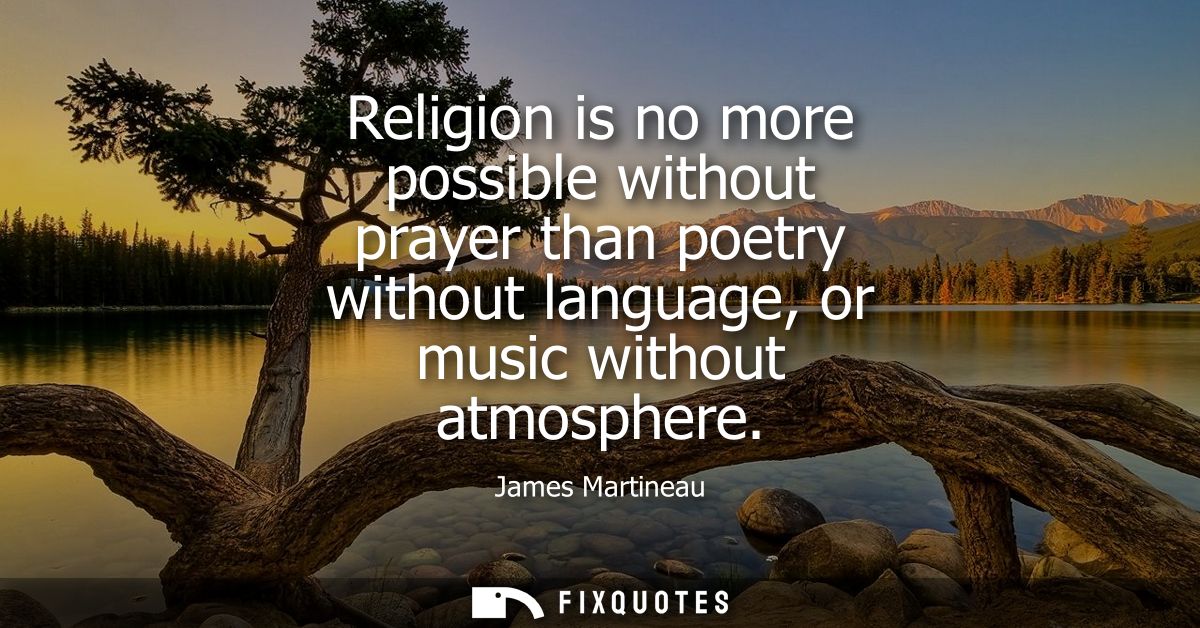
"Religion is no more possible without prayer than poetry without language, or music without atmosphere"
About this Quote
Martineau’s line is a carefully aimed rebuke at any version of religion that wants the benefits of faith without the bother of devotion. By pairing prayer with language and atmosphere, he makes prayer feel less like a religious add-on and more like the medium religion breathes in. Poetry doesn’t merely use language; it is made of it. Music doesn’t merely occur in atmosphere; it depends on a surrounding element that carries vibration. The analogy quietly demotes doctrine, institutions, and even moral codes from religion’s core to its outward architecture. What’s essential is the interior act: attention, address, receptivity.
The subtext is also a defense of lived religious experience against the 19th-century pressure to treat religion as an ethical system or a set of propositions to be proved. Martineau, a liberal theologian and philosopher in Victorian Britain, is speaking into an age of scientific confidence, biblical criticism, and denominational argument. Prayer becomes his way of protecting religion from being flattened into sociology or metaphysics. You can debate creeds endlessly, he implies, and still miss the thing itself.
Rhetorically, the sentence works because it’s not preachy; it’s aesthetic. He recruits the prestige of art to dignify piety, suggesting prayer is not superstition but a disciplined form of human expression, a practice that shapes consciousness the way language shapes thought. It’s an invitation and a warning: remove prayer, and “religion” may keep its name, but it loses its element.
The subtext is also a defense of lived religious experience against the 19th-century pressure to treat religion as an ethical system or a set of propositions to be proved. Martineau, a liberal theologian and philosopher in Victorian Britain, is speaking into an age of scientific confidence, biblical criticism, and denominational argument. Prayer becomes his way of protecting religion from being flattened into sociology or metaphysics. You can debate creeds endlessly, he implies, and still miss the thing itself.
Rhetorically, the sentence works because it’s not preachy; it’s aesthetic. He recruits the prestige of art to dignify piety, suggesting prayer is not superstition but a disciplined form of human expression, a practice that shapes consciousness the way language shapes thought. It’s an invitation and a warning: remove prayer, and “religion” may keep its name, but it loses its element.
Quote Details
| Topic | Prayer |
|---|
More Quotes by James
Add to List