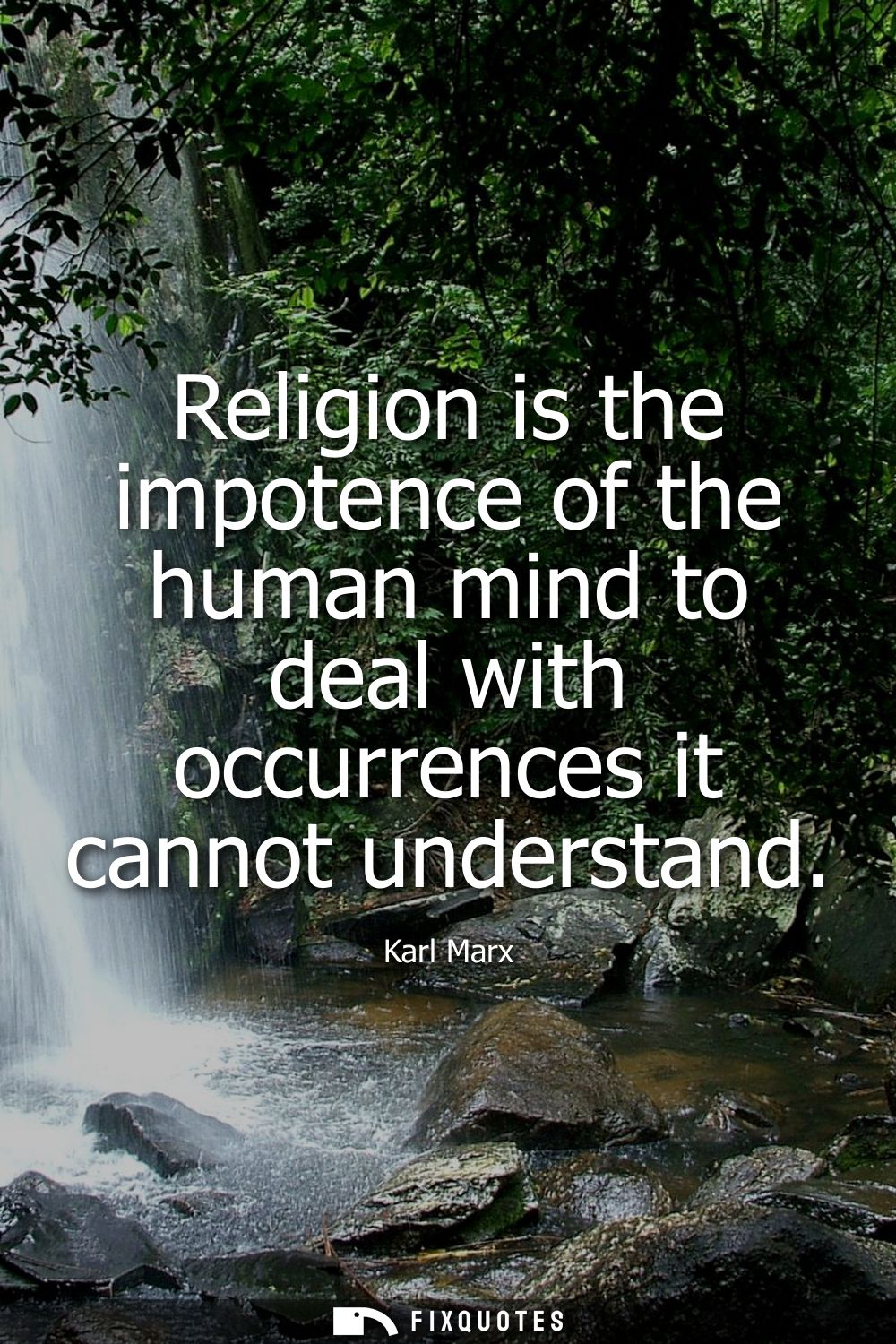
"Religion is the impotence of the human mind to deal with occurrences it cannot understand"
About this Quote
The intent is polemical but also strategic. Marx isn’t arguing that religious people are stupid; he’s arguing that their social conditions are intolerable. That’s why the line pairs so cleanly with his more famous “opium” formulation: not a cheap insult, but a claim that religion numbs pain while quietly preserving the structures that cause it. If suffering is interpreted as fate, sin, or divine plan, it becomes morally meaningful - and politically static. The system gets to keep running.
Context matters. Marx is writing in a 19th-century Europe where industrial capitalism is remaking life at street level: long hours, precarious wages, urban misery, a thin social safety net. In that world, religion can function as both consolation and governance, offering a metaphysical explanation that doubles as social discipline. The subtext is blunt: if you want less religion, don’t just mock belief. Change the material conditions that make belief necessary.
Quote Details
| Topic | Reason & Logic |
|---|---|
| Source | Help us find the source |
| Cite | Cite this Quote |
Citation Formats
APA Style (7th ed.)
Marx, Karl. (n.d.). Religion is the impotence of the human mind to deal with occurrences it cannot understand. FixQuotes. https://fixquotes.com/quotes/religion-is-the-impotence-of-the-human-mind-to-35446/
Chicago Style
Marx, Karl. "Religion is the impotence of the human mind to deal with occurrences it cannot understand." FixQuotes. Accessed February 3, 2026. https://fixquotes.com/quotes/religion-is-the-impotence-of-the-human-mind-to-35446/.
MLA Style (9th ed.)
"Religion is the impotence of the human mind to deal with occurrences it cannot understand." FixQuotes, https://fixquotes.com/quotes/religion-is-the-impotence-of-the-human-mind-to-35446/. Accessed 3 Feb. 2026.