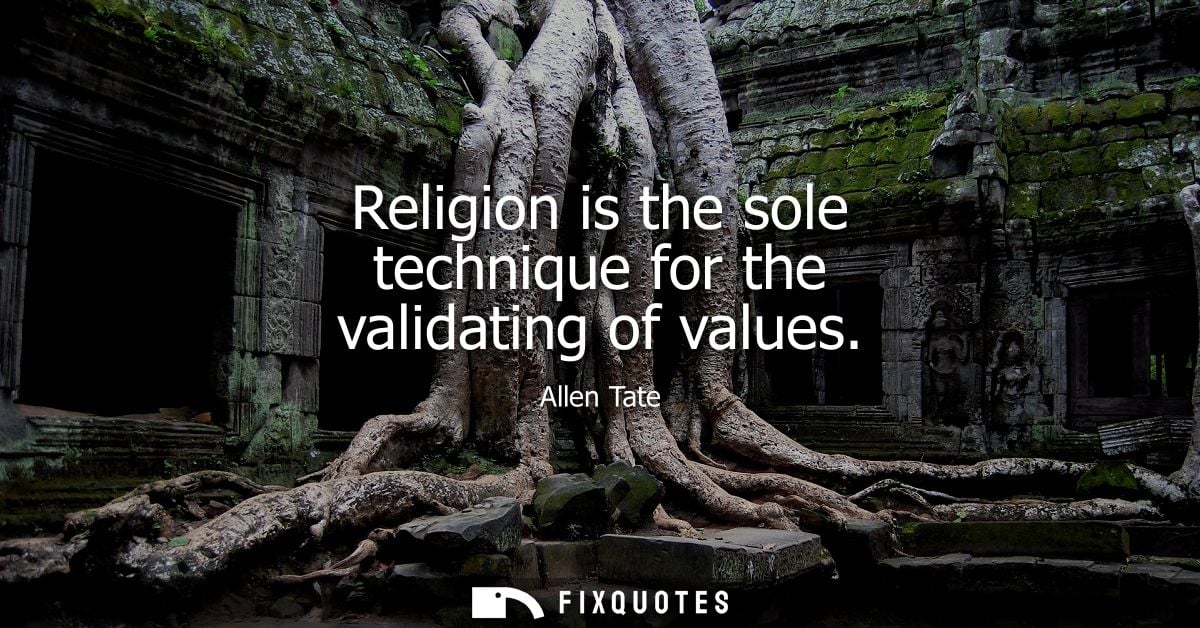
"Religion is the sole technique for the validating of values"
About this Quote
A spare, almost bureaucratic sentence that hides a provocation: if you want your values to be more than preferences, you need religion. Tate’s word choice does the heavy lifting. “Technique” sounds cold, engineered, closer to a tool than a revelation. That’s not an accident. Writing as a Southern Agrarian turned Catholic modernist, Tate was trying to rescue moral seriousness from a culture he saw sliding into what he called “the angelic imagination” of modernity: abstraction, ideology, and moral talk unmoored from any lived metaphysical order.
“Sole” is the dare. It’s less a devotional claim than an indictment of the alternatives. Liberal rationalism can describe values, psychology can explain them, economics can incentivize them, politics can enforce them. None of these, in Tate’s view, can finally “validate” them - give them an authority that binds when it’s inconvenient, costly, or socially unpopular. Without transcendence, values become taste dressed up as principle, and the loudest institutions get to certify what counts as “good.”
The subtext is anxiety about modern pluralism. In a world of competing moral languages, “validation” starts to look like marketing or consensus. Tate’s line is a defensive maneuver: it insists that meaning requires a thicker soil than argument alone, a community and ritual life that makes values feel real rather than merely asserted.
It also reveals the poet’s sensibility. Tate isn’t offering a proof of God; he’s diagnosing a problem of credibility. Religion, for him, isn’t just belief - it’s the social and imaginative infrastructure that makes a value more than a slogan.
“Sole” is the dare. It’s less a devotional claim than an indictment of the alternatives. Liberal rationalism can describe values, psychology can explain them, economics can incentivize them, politics can enforce them. None of these, in Tate’s view, can finally “validate” them - give them an authority that binds when it’s inconvenient, costly, or socially unpopular. Without transcendence, values become taste dressed up as principle, and the loudest institutions get to certify what counts as “good.”
The subtext is anxiety about modern pluralism. In a world of competing moral languages, “validation” starts to look like marketing or consensus. Tate’s line is a defensive maneuver: it insists that meaning requires a thicker soil than argument alone, a community and ritual life that makes values feel real rather than merely asserted.
It also reveals the poet’s sensibility. Tate isn’t offering a proof of God; he’s diagnosing a problem of credibility. Religion, for him, isn’t just belief - it’s the social and imaginative infrastructure that makes a value more than a slogan.
Quote Details
| Topic | Ethics & Morality |
|---|---|
| Source | Help us find the source |
| Cite |
Citation Formats
APA Style (7th ed.)
Tate, Allen. (2026, January 17). Religion is the sole technique for the validating of values. FixQuotes. https://fixquotes.com/quotes/religion-is-the-sole-technique-for-the-validating-35850/
Chicago Style
Tate, Allen. "Religion is the sole technique for the validating of values." FixQuotes. January 17, 2026. https://fixquotes.com/quotes/religion-is-the-sole-technique-for-the-validating-35850/.
MLA Style (9th ed.)
"Religion is the sole technique for the validating of values." FixQuotes, 17 Jan. 2026, https://fixquotes.com/quotes/religion-is-the-sole-technique-for-the-validating-35850/. Accessed 4 Mar. 2026.
More Quotes by Allen
Add to List