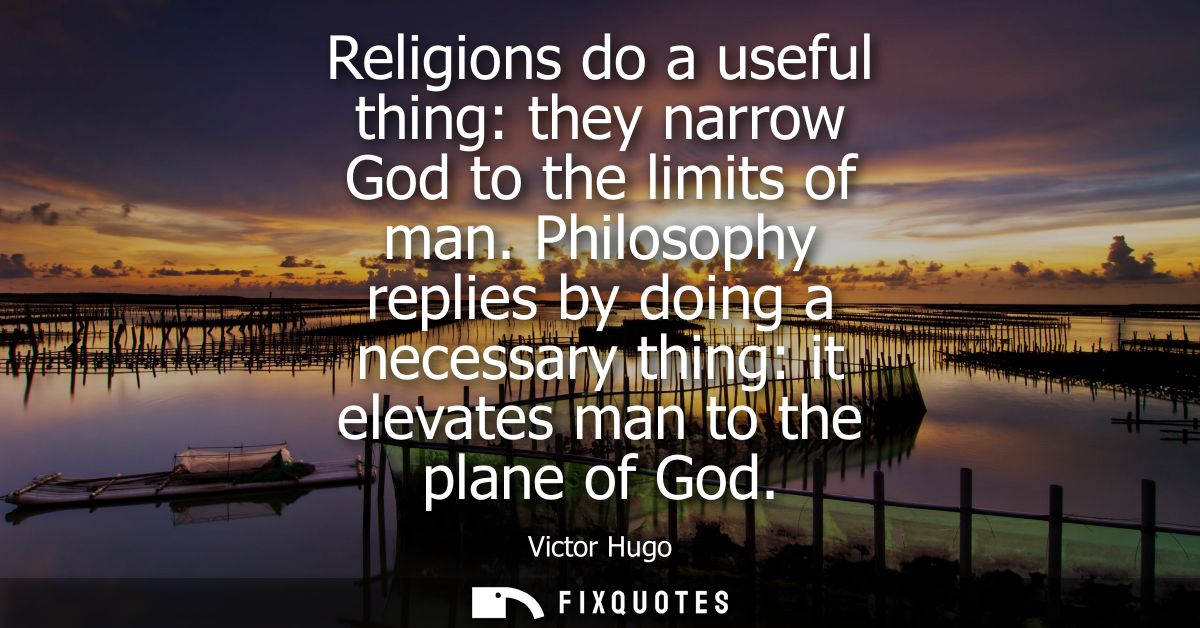
"Religions do a useful thing: they narrow God to the limits of man. Philosophy replies by doing a necessary thing: it elevates man to the plane of God"
About this Quote
Hugo’s line is a sleight of hand: it praises religion while quietly indicting it, then crowns philosophy with the kind of grandeur nineteenth-century France loved to argue about. “Religions do a useful thing” sounds generous, almost pastoral, until the verb turns. To “narrow God” is to domesticate the infinite, to make the ungraspable fit inside human institutions, language, ritual, and moral bookkeeping. Useful, yes: people need a God they can picture, petition, and police. Hugo’s subtext is that usefulness comes at a cost. The divine gets resized to match the anxieties and power structures of the human world.
Then philosophy enters as the counterforce, not merely “useful” but “necessary.” That upgrade matters. Where religion translates God down into human terms, philosophy translates humanity up, insisting we can approach the divine through reason, ethics, and imagination. Hugo isn’t claiming philosophers become gods; he’s staging a Romantic-era faith in human enlargement - the idea that dignity is an ascent, not a submission.
Context sharpens the edge. Hugo wrote in an age of anticlerical politics and post-revolutionary upheaval, when the Church’s authority was both culturally dominant and increasingly contested. The quote plays that tension: it concedes religion’s social function while reserving transcendence for the mind’s work. It’s also strategic: by framing philosophy as “necessary,” Hugo makes spiritual ambition compatible with modernity. The real target isn’t belief; it’s the institutional habit of shrinking mystery into doctrine, when the more radical move is to expand the human capacity to meet it.
Then philosophy enters as the counterforce, not merely “useful” but “necessary.” That upgrade matters. Where religion translates God down into human terms, philosophy translates humanity up, insisting we can approach the divine through reason, ethics, and imagination. Hugo isn’t claiming philosophers become gods; he’s staging a Romantic-era faith in human enlargement - the idea that dignity is an ascent, not a submission.
Context sharpens the edge. Hugo wrote in an age of anticlerical politics and post-revolutionary upheaval, when the Church’s authority was both culturally dominant and increasingly contested. The quote plays that tension: it concedes religion’s social function while reserving transcendence for the mind’s work. It’s also strategic: by framing philosophy as “necessary,” Hugo makes spiritual ambition compatible with modernity. The real target isn’t belief; it’s the institutional habit of shrinking mystery into doctrine, when the more radical move is to expand the human capacity to meet it.
Quote Details
| Topic | Wisdom |
|---|
More Quotes by Victor
Add to List