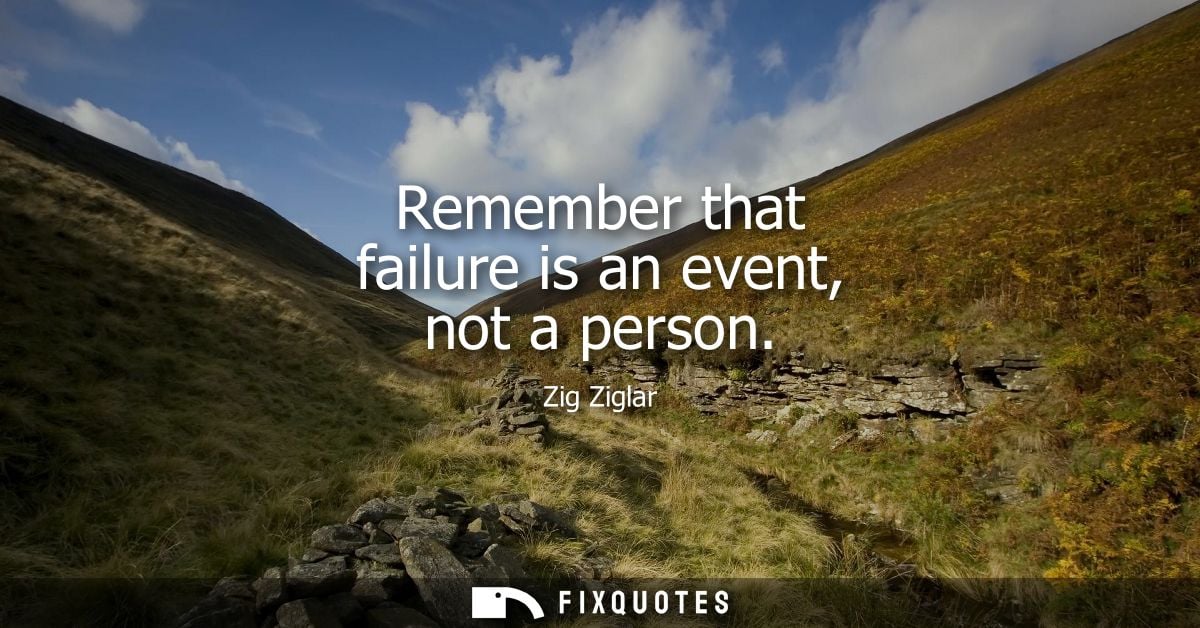
"Remember that failure is an event, not a person"
About this Quote
Zig Ziglar is doing a little rhetorical sleight of hand here: he shrinks “failure” down to its proper size. By calling it an event, he frames it as something that happens in time, with edges and an ending, not a permanent identity you have to live inside. It’s a simple grammatical swap that lands because most people don’t actually fear a botched presentation or a missed goal; they fear what it will “prove” about them. Ziglar’s line attacks that quieter, stickier dread: the shame story that turns a bad outcome into a bad self.
The intent is classic motivational pragmatism. Ziglar isn’t offering a philosophical treatise on selfhood; he’s trying to keep you in motion. If failure is episodic, you can review it, learn from it, and move on. If it’s personal, you’ll start organizing your whole life around avoiding exposure. That’s the real enemy in his worldview: paralysis disguised as self-knowledge.
The subtext is also cultural. Ziglar wrote for an America steeped in performance metrics and moralized success, where careers, masculinity, and respectability could feel like a scoreboard. In that environment, “I failed” easily becomes “I am a failure,” a sentence that doesn’t just describe a moment but forecloses a future. By separating the deed from the doer, Ziglar offers a portable form of dignity: you can own the result without becoming it. That’s why the line persists; it’s not comforting fluff so much as a tool for resisting the identity trap.
The intent is classic motivational pragmatism. Ziglar isn’t offering a philosophical treatise on selfhood; he’s trying to keep you in motion. If failure is episodic, you can review it, learn from it, and move on. If it’s personal, you’ll start organizing your whole life around avoiding exposure. That’s the real enemy in his worldview: paralysis disguised as self-knowledge.
The subtext is also cultural. Ziglar wrote for an America steeped in performance metrics and moralized success, where careers, masculinity, and respectability could feel like a scoreboard. In that environment, “I failed” easily becomes “I am a failure,” a sentence that doesn’t just describe a moment but forecloses a future. By separating the deed from the doer, Ziglar offers a portable form of dignity: you can own the result without becoming it. That’s why the line persists; it’s not comforting fluff so much as a tool for resisting the identity trap.
Quote Details
| Topic | Failure |
|---|---|
| Source | Help us find the source |
| Cite |
Citation Formats
APA Style (7th ed.)
Ziglar, Zig. (2026, January 17). Remember that failure is an event, not a person. FixQuotes. https://fixquotes.com/quotes/remember-that-failure-is-an-event-not-a-person-28807/
Chicago Style
Ziglar, Zig. "Remember that failure is an event, not a person." FixQuotes. January 17, 2026. https://fixquotes.com/quotes/remember-that-failure-is-an-event-not-a-person-28807/.
MLA Style (9th ed.)
"Remember that failure is an event, not a person." FixQuotes, 17 Jan. 2026, https://fixquotes.com/quotes/remember-that-failure-is-an-event-not-a-person-28807/. Accessed 12 Feb. 2026.
More Quotes by Zig
Add to List