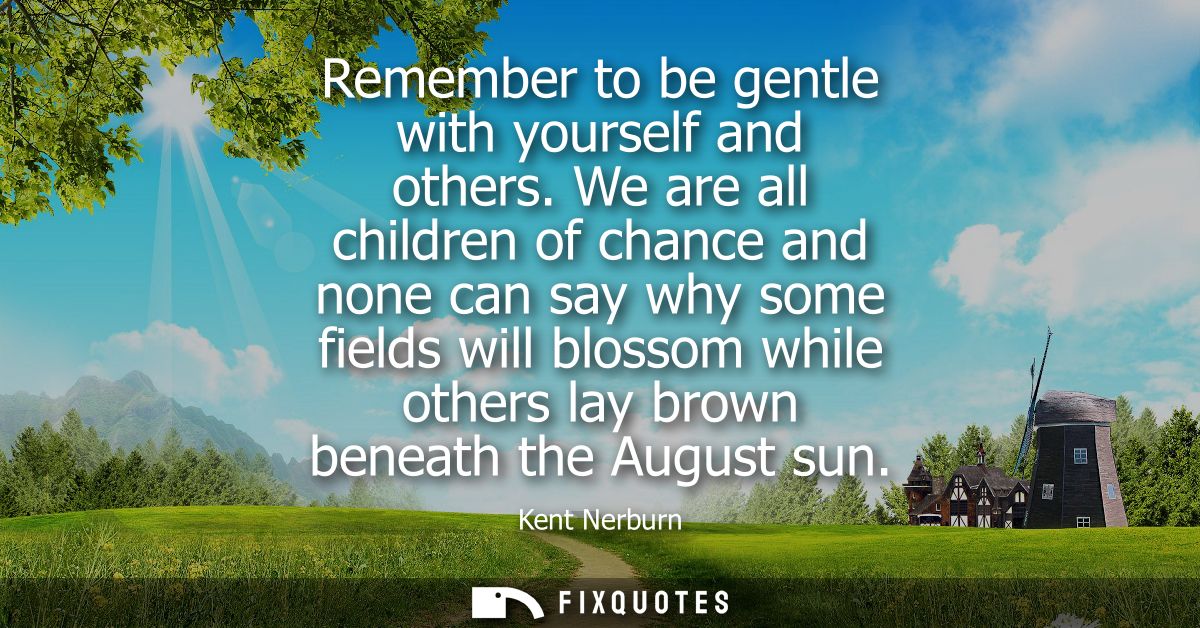
"Remember to be gentle with yourself and others. We are all children of chance, and none can say why some fields will blossom while others lay brown beneath the August sun"
About this Quote
The image of fields “blossom[ing]” or lying “brown beneath the August sun” does a lot of subtextual work. It avoids the tidy metaphor of seasons (which implies eventual renewal) and chooses late-summer heat: a moment when time feels heavy, when damage looks final. August is when you can’t pretend the crop will come in. That specificity turns compassion into something practical rather than sentimental: you don’t judge a scorched field for failing to be green.
The intent is also preventive. Nerburn is warning against the kind of moral accounting that treats success as proof of virtue and struggle as personal defect. Gentleness becomes an ethic of interpretation: don’t overread someone’s surface conditions as their true character. Read your own life that way, too.
Contextually, Nerburn’s work often sits close to spiritual reflection and human vulnerability, where the goal isn’t to win an argument but to widen the space for grace. The quote’s power is that it refuses a culprit. It asks for mercy not because everyone is innocent, but because no one is omniscient about the weather that made them.
Quote Details
| Topic | Kindness |
|---|---|
| Source | Help us find the source |
| Cite |
Citation Formats
APA Style (7th ed.)
Nerburn, Kent. (2026, February 17). Remember to be gentle with yourself and others. We are all children of chance, and none can say why some fields will blossom while others lay brown beneath the August sun. FixQuotes. https://fixquotes.com/quotes/remember-to-be-gentle-with-yourself-and-others-we-133226/
Chicago Style
Nerburn, Kent. "Remember to be gentle with yourself and others. We are all children of chance, and none can say why some fields will blossom while others lay brown beneath the August sun." FixQuotes. February 17, 2026. https://fixquotes.com/quotes/remember-to-be-gentle-with-yourself-and-others-we-133226/.
MLA Style (9th ed.)
"Remember to be gentle with yourself and others. We are all children of chance, and none can say why some fields will blossom while others lay brown beneath the August sun." FixQuotes, 17 Feb. 2026, https://fixquotes.com/quotes/remember-to-be-gentle-with-yourself-and-others-we-133226/. Accessed 21 Mar. 2026.