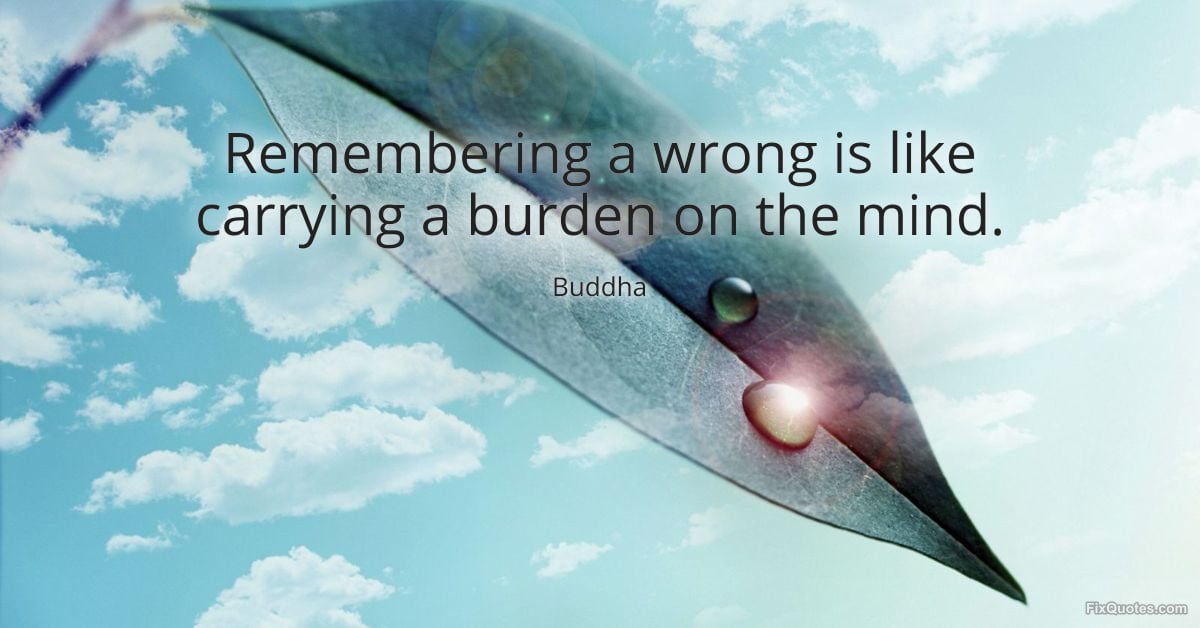
"Remembering a wrong is like carrying a burden on the mind"
About this Quote
What gives this line its staying power is its refusal to dramatize injury while still taking its cost seriously. Buddha does not deny that a wrong happened. He shifts attention to the afterlife of harm: the way grievance settles into the mind and begins to function like weight. That metaphor is simple, but it is also ruthless. A burden does not just exist; it slows you, reshapes your posture, drains your energy. The insult or betrayal may be past, yet the remembering keeps it physically present.
The subtext is not moral softness. It is strategic clarity. In Buddhist thought, suffering is often sustained not only by painful events but by attachment, fixation, and repetition. To keep nursing a wrong is to cooperate with it, to let it occupy psychic space long after the original moment has ended. The line quietly transfers power back to the injured person: release is not approval, and letting go is not forgetting in any naive sense. It is refusing to make your consciousness into storage for someone else's offense.
As a historical leader and spiritual teacher, Buddha's intent is practical before it is poetic. He is offering discipline, not sentiment. In a culture shaped by cycles of retaliation, status, and injury, this is a radical intervention. The mind is presented as a site of governance. Rule it badly, and every wound becomes a permanent tax. Rule it well, and memory no longer has to mean captivity. That is why the line still lands: it treats resentment not as justice, but as self-imposed labor.
The subtext is not moral softness. It is strategic clarity. In Buddhist thought, suffering is often sustained not only by painful events but by attachment, fixation, and repetition. To keep nursing a wrong is to cooperate with it, to let it occupy psychic space long after the original moment has ended. The line quietly transfers power back to the injured person: release is not approval, and letting go is not forgetting in any naive sense. It is refusing to make your consciousness into storage for someone else's offense.
As a historical leader and spiritual teacher, Buddha's intent is practical before it is poetic. He is offering discipline, not sentiment. In a culture shaped by cycles of retaliation, status, and injury, this is a radical intervention. The mind is presented as a site of governance. Rule it badly, and every wound becomes a permanent tax. Rule it well, and memory no longer has to mean captivity. That is why the line still lands: it treats resentment not as justice, but as self-imposed labor.
Quote Details
| Topic | Forgiveness |
|---|---|
| Source | Help us find the source |
| Cite |
Citation Formats
APA Style (7th ed.)
Buddha. (2026, March 10). Remembering a wrong is like carrying a burden on the mind. FixQuotes. https://fixquotes.com/quotes/remembering-a-wrong-is-like-carrying-a-burden-on-185928/
Chicago Style
Buddha. "Remembering a wrong is like carrying a burden on the mind." FixQuotes. March 10, 2026. https://fixquotes.com/quotes/remembering-a-wrong-is-like-carrying-a-burden-on-185928/.
MLA Style (9th ed.)
"Remembering a wrong is like carrying a burden on the mind." FixQuotes, 10 Mar. 2026, https://fixquotes.com/quotes/remembering-a-wrong-is-like-carrying-a-burden-on-185928/. Accessed 8 Apr. 2026.
More Quotes by Buddha
Add to List