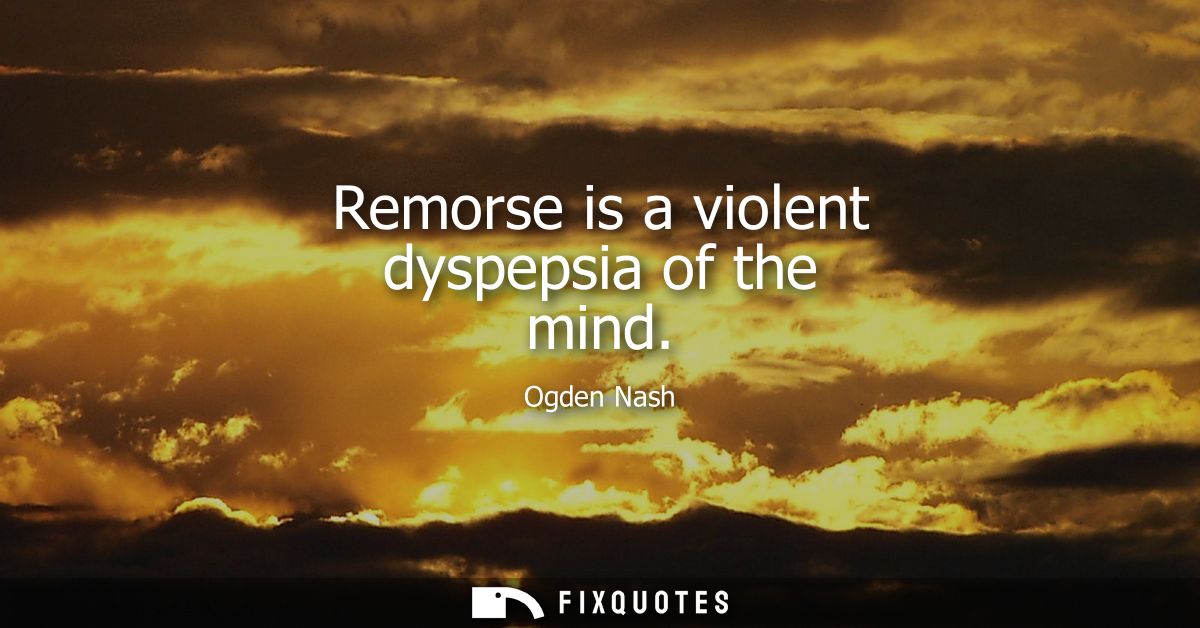
"Remorse is a violent dyspepsia of the mind"
About this Quote
Remorse, in Nash's hands, isn't a solemn moral reckoning; it's indigestion. By calling it "a violent dyspepsia of the mind", he yanks guilt out of the chapel and drops it into the gut, where it churns, burns, and refuses to be ignored. The wit is surgical: dyspepsia is petty, bodily, faintly comic, and yet "violent" makes it urgent. That tension is the engine of the line. Remorse can feel ridiculous in retrospect and unbearable in the moment, and Nash nails that double register with one ugly, perfect word.
The subtext is a quiet demotion of grand ethical drama. Remorse isn't presented as noble suffering that purifies the soul; it's the brain's sour stomach, a symptom of something you ate, said, did. That metaphor matters because symptoms demand remedies, not speeches. You don't debate indigestion; you squirm, you regret the menu, you swear off the thing that caused it. Nash suggests remorse is less about abstract morality than about consequence and self-management: the mind, like the body, punishes excess.
Contextually, Nash's light verse often smuggled hard truths through breezy phrasing, a mid-century antidote to inflated seriousness. In an era that prized composure and common sense, he gives readers permission to treat inner torment as both real and faintly absurd. It's a joke that doesn't cancel the pain; it explains its mechanics. Remorse isn't lofty. It's invasive, physical, and embarrassingly hard to conceal.
The subtext is a quiet demotion of grand ethical drama. Remorse isn't presented as noble suffering that purifies the soul; it's the brain's sour stomach, a symptom of something you ate, said, did. That metaphor matters because symptoms demand remedies, not speeches. You don't debate indigestion; you squirm, you regret the menu, you swear off the thing that caused it. Nash suggests remorse is less about abstract morality than about consequence and self-management: the mind, like the body, punishes excess.
Contextually, Nash's light verse often smuggled hard truths through breezy phrasing, a mid-century antidote to inflated seriousness. In an era that prized composure and common sense, he gives readers permission to treat inner torment as both real and faintly absurd. It's a joke that doesn't cancel the pain; it explains its mechanics. Remorse isn't lofty. It's invasive, physical, and embarrassingly hard to conceal.
Quote Details
| Topic | Witty One-Liners |
|---|---|
| Source | Help us find the source |
| Cite |
Citation Formats
APA Style (7th ed.)
Nash, Ogden. (2026, January 15). Remorse is a violent dyspepsia of the mind. FixQuotes. https://fixquotes.com/quotes/remorse-is-a-violent-dyspepsia-of-the-mind-29018/
Chicago Style
Nash, Ogden. "Remorse is a violent dyspepsia of the mind." FixQuotes. January 15, 2026. https://fixquotes.com/quotes/remorse-is-a-violent-dyspepsia-of-the-mind-29018/.
MLA Style (9th ed.)
"Remorse is a violent dyspepsia of the mind." FixQuotes, 15 Jan. 2026, https://fixquotes.com/quotes/remorse-is-a-violent-dyspepsia-of-the-mind-29018/. Accessed 5 Apr. 2026.
More Quotes by Ogden
Add to List