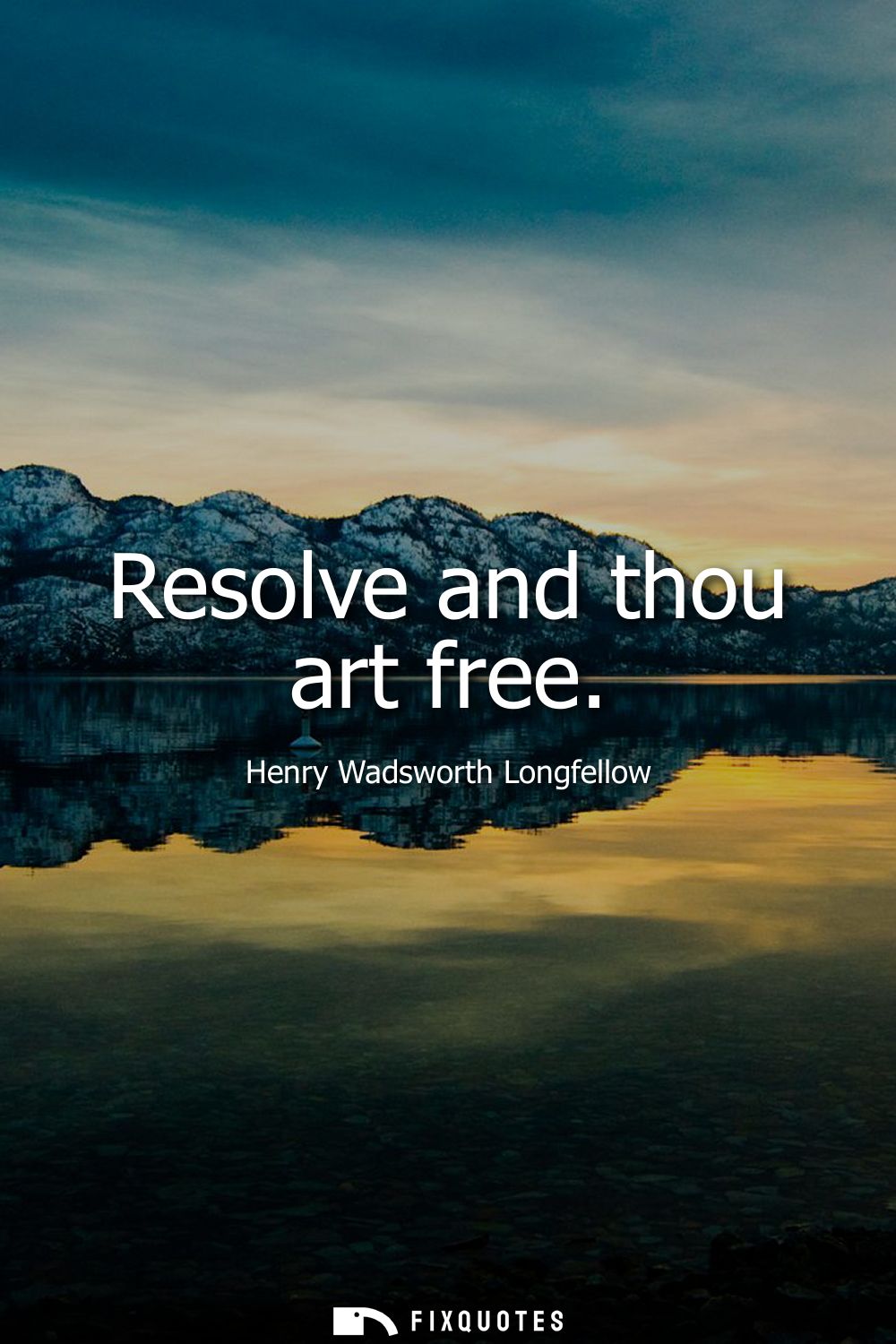
"Resolve and thou art free"
About this Quote
Freedom, for Longfellow, isn’t a flag you wave or a right you’re handed; it’s a psychological state you earn by tightening your grip on yourself. “Resolve and thou art free” compresses an entire moral philosophy into five words, with the old-fashioned “thou” giving it the ring of scripture. That’s not accidental. Longfellow is borrowing the cadence of religious commandment to sell a secular, self-help proposition: discipline as deliverance.
The line’s trick is its austerity. “Resolve” is not “wish,” “hope,” or even “decide.” It implies a hardening, a clarifying, a refusal to bargain with your own weakness. In that framing, the real prison isn’t law or fate but drift: the constant negotiating with comfort, fear, and delay. Resolve becomes an inner emancipation proclamation, swapping politics for conscience, institutions for intention.
Longfellow wrote in a 19th-century America intoxicated with progress talk and haunted by moral crisis. His work often tries to reconcile lofty ideals with daily conduct, and this aphorism fits a culture that prized self-reliance, Protestant self-scrutiny, and the belief that character could be built like infrastructure. The subtext is both empowering and demanding: if freedom is available through resolve, then captivity can look suspiciously like a personal failure.
That tension is why the line endures. It flatters the reader with agency, then quietly raises the stakes: your liberation has a price, and it’s paid in unwavering will.
The line’s trick is its austerity. “Resolve” is not “wish,” “hope,” or even “decide.” It implies a hardening, a clarifying, a refusal to bargain with your own weakness. In that framing, the real prison isn’t law or fate but drift: the constant negotiating with comfort, fear, and delay. Resolve becomes an inner emancipation proclamation, swapping politics for conscience, institutions for intention.
Longfellow wrote in a 19th-century America intoxicated with progress talk and haunted by moral crisis. His work often tries to reconcile lofty ideals with daily conduct, and this aphorism fits a culture that prized self-reliance, Protestant self-scrutiny, and the belief that character could be built like infrastructure. The subtext is both empowering and demanding: if freedom is available through resolve, then captivity can look suspiciously like a personal failure.
That tension is why the line endures. It flatters the reader with agency, then quietly raises the stakes: your liberation has a price, and it’s paid in unwavering will.
Quote Details
| Topic | Self-Discipline |
|---|
More Quotes by Henry
Add to List