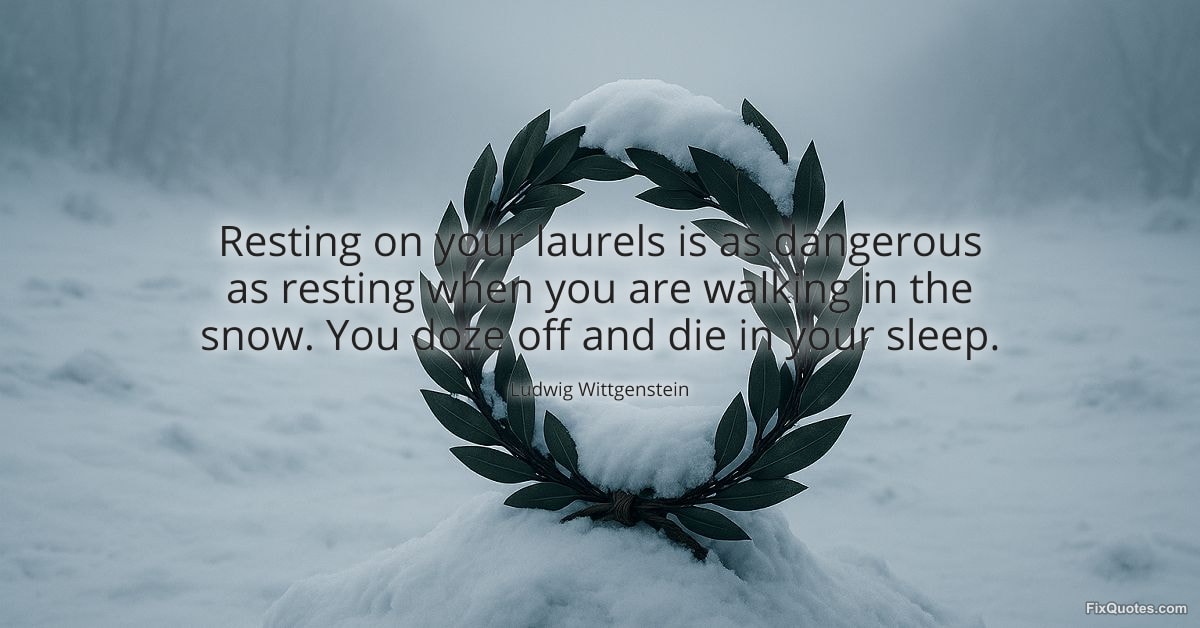
"Resting on your laurels is as dangerous as resting when you are walking in the snow. You doze off and die in your sleep"
About this Quote
Wittgenstein turns a cozy idiom into a survival warning. "Laurels" are the old emblem of earned glory, but he treats them like fresh snow: soft, flattering, and lethal if you mistake comfort for safety. The line works because it refuses the usual moral about ambition. It is not "keep striving" in a self-help sense; it's "stay awake", cognitively and ethically, because the mind has a talent for falling asleep inside its own victories.
The snow image is doing quiet philosophical labor. Walking in snow suggests effort without clear landmarks, a landscape that looks uniform until it kills you. That is Wittgenstein's terrain: language and thought feel familiar, even homely, right up to the moment they numb you. Dozing off is the slide into automaticity: repeating inherited phrases, leaning on established methods, letting earlier insights harden into doctrine. For a philosopher who spent his career attacking the spell of language and his own temptation to system-build, "rest" is not leisure; it's capitulation to illusion.
Context sharpens the threat. Wittgenstein distrusted academic prestige and treated philosophy less as a body of results than as continuous self-correction. He revised, withdrew, restarted, and suspected that yesterday's clarity becomes today's obstacle. The subtext is almost autobiographical: any triumph, even a brilliant one, can become a sedative. In his world, the enemy isn't error so much as complacent certainty - the moment you think you're done thinking, the cold moves in.
The snow image is doing quiet philosophical labor. Walking in snow suggests effort without clear landmarks, a landscape that looks uniform until it kills you. That is Wittgenstein's terrain: language and thought feel familiar, even homely, right up to the moment they numb you. Dozing off is the slide into automaticity: repeating inherited phrases, leaning on established methods, letting earlier insights harden into doctrine. For a philosopher who spent his career attacking the spell of language and his own temptation to system-build, "rest" is not leisure; it's capitulation to illusion.
Context sharpens the threat. Wittgenstein distrusted academic prestige and treated philosophy less as a body of results than as continuous self-correction. He revised, withdrew, restarted, and suspected that yesterday's clarity becomes today's obstacle. The subtext is almost autobiographical: any triumph, even a brilliant one, can become a sedative. In his world, the enemy isn't error so much as complacent certainty - the moment you think you're done thinking, the cold moves in.
Quote Details
| Topic | Motivational |
|---|---|
| Source | Help us find the source |
More Quotes by Ludwig
Add to List