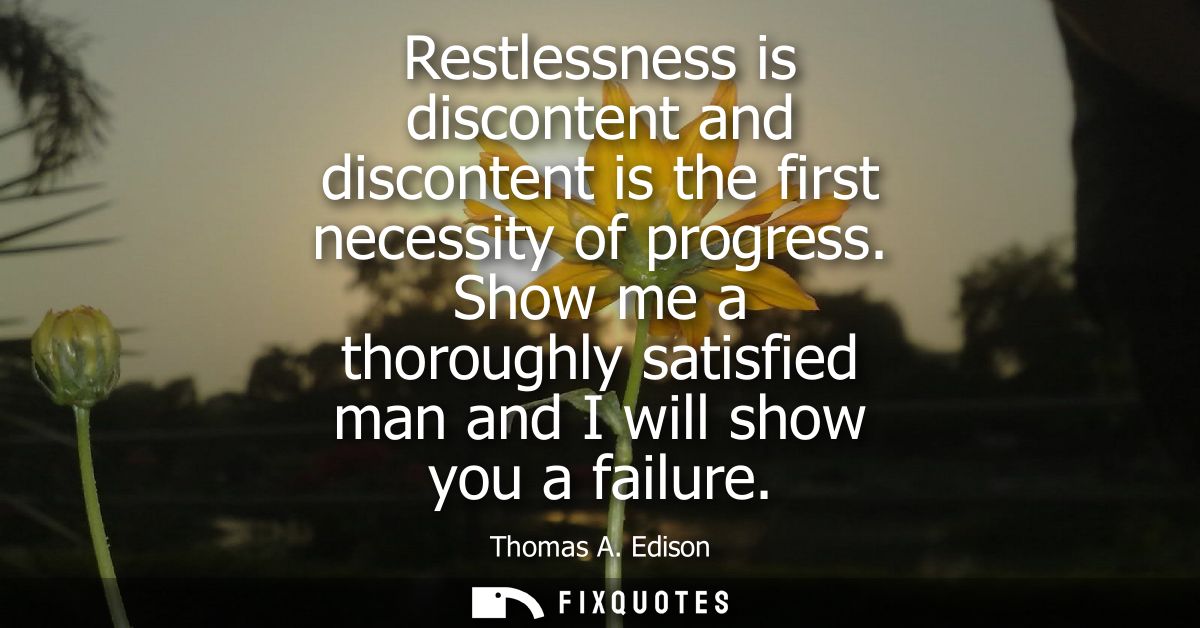
"Restlessness is discontent and discontent is the first necessity of progress. Show me a thoroughly satisfied man and I will show you a failure"
About this Quote
The subtext is classic Edison: impatience as a moral credential. This is the inventor’s hustle ethic before “hustle” had branding - a worldview where comfort signals complacency and complacency is indistinguishable from defeat. It also smuggles in a distinctly American industrial logic: progress isn’t contemplation or stability; it’s churn. If you’re content, you’re not only idle, you’re obstructing the forward march.
Context matters because Edison wasn’t a lone tinkerer in a romantic garret. He ran labs, managed teams, cultivated patents, and competed in a brutal marketplace. Restlessness, for him, wasn’t just temperament; it was a business model. The line flatters the striver and shames the settled, which helps explain its longevity: it reads like permission to be dissatisfied with what exists.
There’s a darker edge, too. If dissatisfaction is a “necessity,” then peace becomes suspicious. Edison’s maxim energizes invention, but it also justifies endless optimization - a culture that struggles to admit when “enough” is enough.
Quote Details
| Topic | Motivational |
|---|---|
| Source | Help us find the source |
| Cite |
Citation Formats
APA Style (7th ed.)
Edison, Thomas. (2026, January 15). Restlessness is discontent and discontent is the first necessity of progress. Show me a thoroughly satisfied man and I will show you a failure. FixQuotes. https://fixquotes.com/quotes/restlessness-is-discontent-and-discontent-is-the-10263/
Chicago Style
Edison, Thomas. "Restlessness is discontent and discontent is the first necessity of progress. Show me a thoroughly satisfied man and I will show you a failure." FixQuotes. January 15, 2026. https://fixquotes.com/quotes/restlessness-is-discontent-and-discontent-is-the-10263/.
MLA Style (9th ed.)
"Restlessness is discontent and discontent is the first necessity of progress. Show me a thoroughly satisfied man and I will show you a failure." FixQuotes, 15 Jan. 2026, https://fixquotes.com/quotes/restlessness-is-discontent-and-discontent-is-the-10263/. Accessed 27 Mar. 2026.