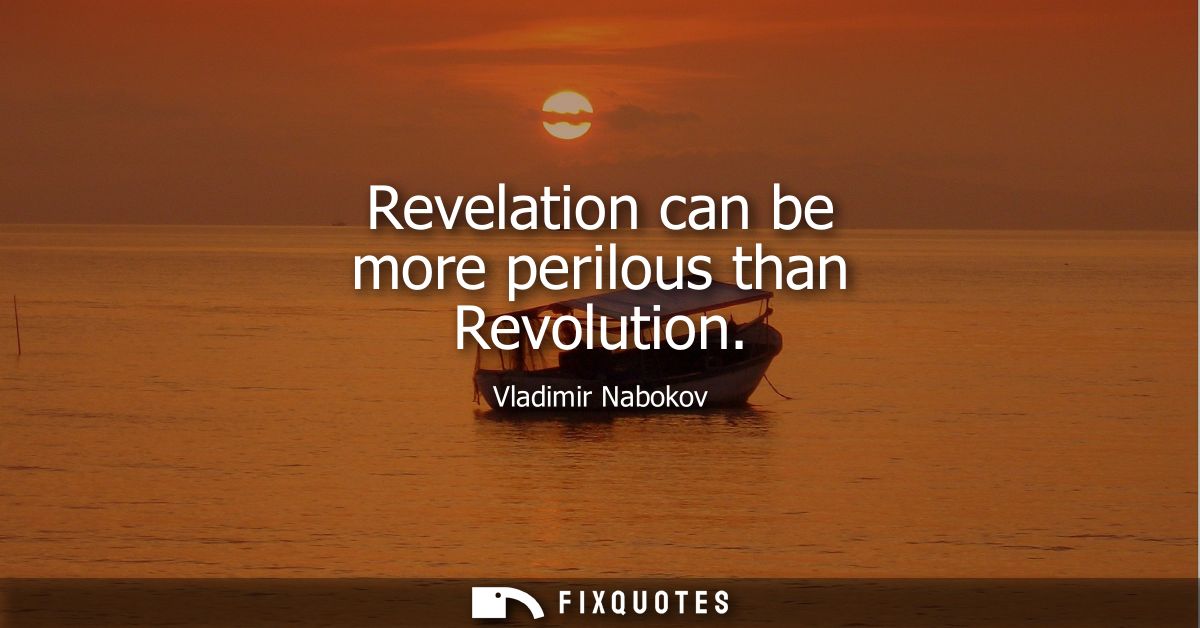
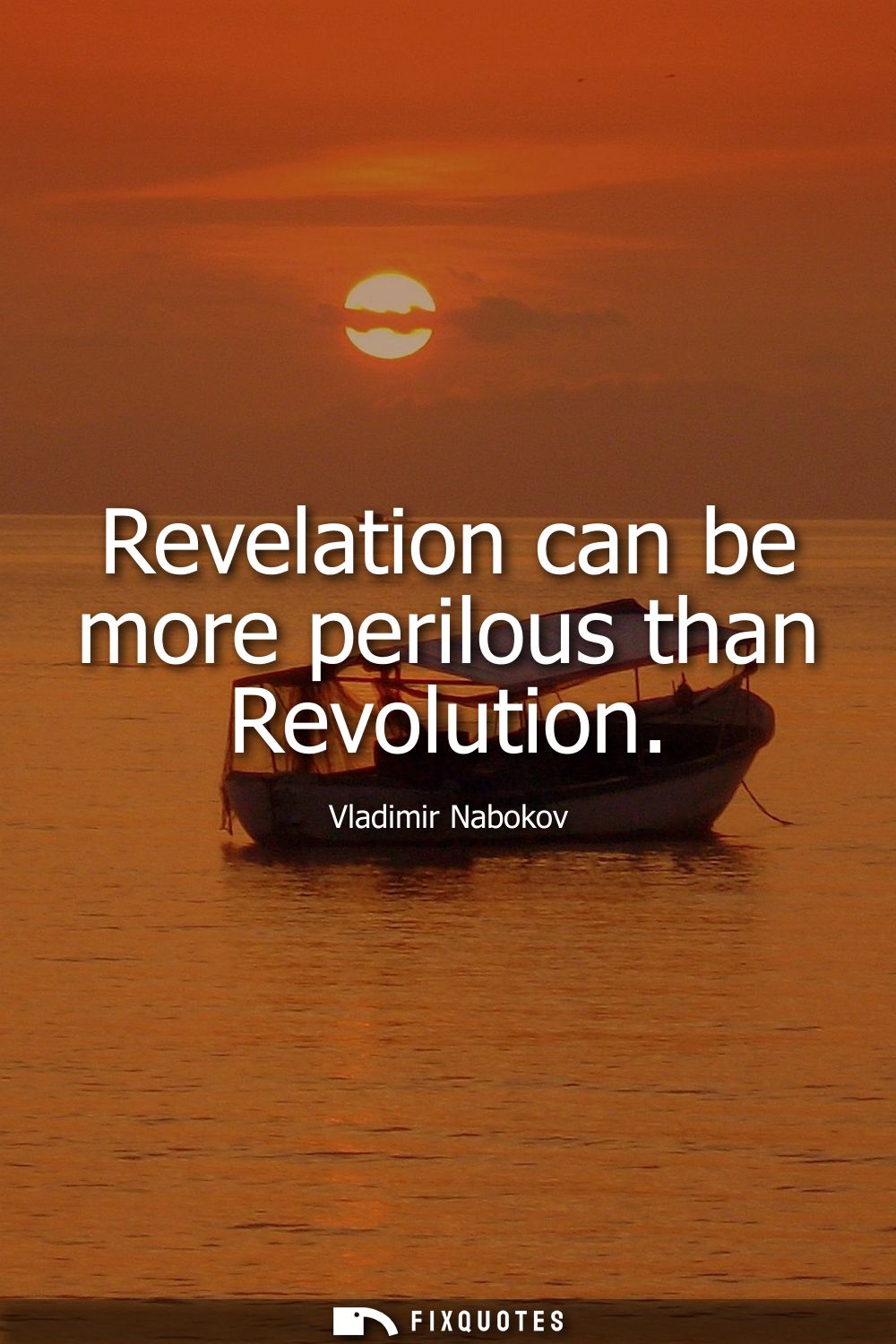
"Revelation can be more perilous than Revolution"
About this Quote
Nabokov’s line lands like a needle, not a slogan: the real danger isn’t the street-barricade drama of Revolution, it’s the quieter, more intimate violence of Revelation. Revolution is public, theatrical, even predictable in its rhythms of slogans, counter-slogans, and the churn of new orthodoxies. Revelation is personal and involuntary: the moment something true breaks through the story you’ve been living in, and you can’t un-know it. That’s peril because it rearranges the self, not just the state.
The subtext has Nabokov’s lifelong suspicion of systems - political, moral, aesthetic. A revolution can be resisted, joined, or outwaited; it offers roles. Revelation offers none. It strips away comforting narratives and exposes the mind’s complicity. For a writer obsessed with consciousness, memory, and the tricks perception plays, revelation is a psychological coup: it can topple the private regime of self-deception. That can be more destabilizing than any change of government.
Context matters. Nabokov was shaped by the Russian Revolution, exile, and the brutal simplifications of totalitarian thinking. He knew how revolutions sell certainty while producing new forms of coercion. Yet his art is also built on sudden illuminations - shocks of recognition, cruel clarities, epiphanies that reveal desire or guilt. The line turns that literary engine into a warning: the truths that free you can also wreck you. In Nabokov’s world, danger doesn’t always arrive with marching feet; sometimes it arrives as a sentence you finally understand.
The subtext has Nabokov’s lifelong suspicion of systems - political, moral, aesthetic. A revolution can be resisted, joined, or outwaited; it offers roles. Revelation offers none. It strips away comforting narratives and exposes the mind’s complicity. For a writer obsessed with consciousness, memory, and the tricks perception plays, revelation is a psychological coup: it can topple the private regime of self-deception. That can be more destabilizing than any change of government.
Context matters. Nabokov was shaped by the Russian Revolution, exile, and the brutal simplifications of totalitarian thinking. He knew how revolutions sell certainty while producing new forms of coercion. Yet his art is also built on sudden illuminations - shocks of recognition, cruel clarities, epiphanies that reveal desire or guilt. The line turns that literary engine into a warning: the truths that free you can also wreck you. In Nabokov’s world, danger doesn’t always arrive with marching feet; sometimes it arrives as a sentence you finally understand.
Quote Details
| Topic | Truth |
|---|---|
| Source | Help us find the source |
| Cite |
Citation Formats
APA Style (7th ed.)
Nabokov, Vladimir. (2026, January 18). Revelation can be more perilous than Revolution. FixQuotes. https://fixquotes.com/quotes/revelation-can-be-more-perilous-than-revolution-10617/
Chicago Style
Nabokov, Vladimir. "Revelation can be more perilous than Revolution." FixQuotes. January 18, 2026. https://fixquotes.com/quotes/revelation-can-be-more-perilous-than-revolution-10617/.
MLA Style (9th ed.)
"Revelation can be more perilous than Revolution." FixQuotes, 18 Jan. 2026, https://fixquotes.com/quotes/revelation-can-be-more-perilous-than-revolution-10617/. Accessed 12 Mar. 2026.
More Quotes by Vladimir
Add to List