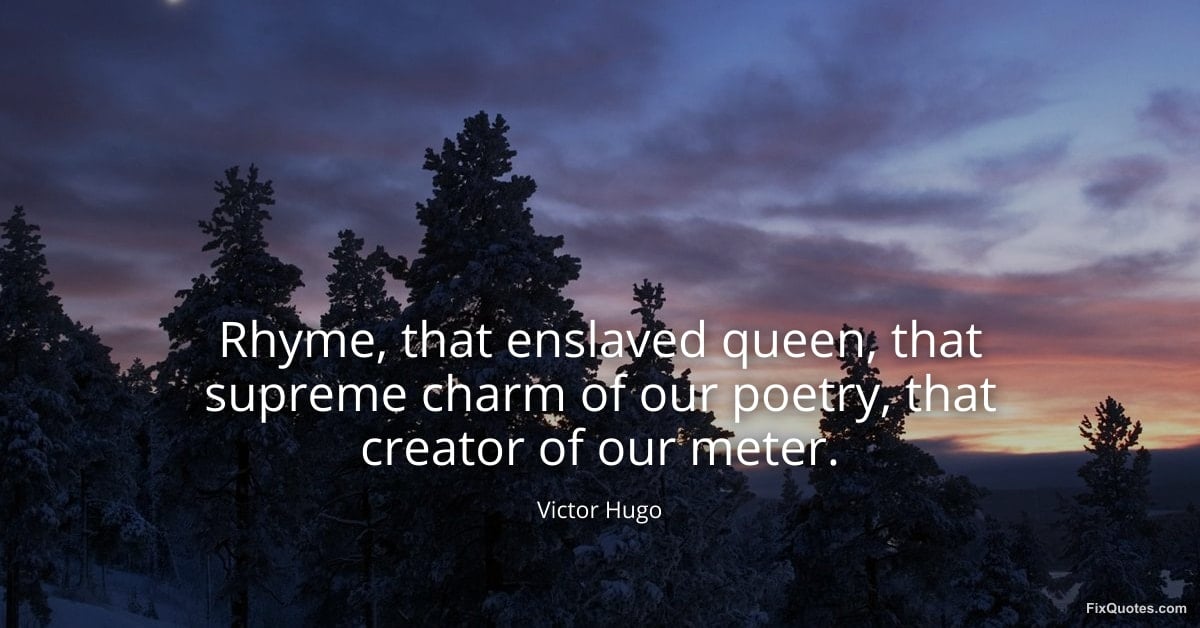
"Rhyme, that enslaved queen, that supreme charm of our poetry, that creator of our meter"
About this Quote
The phrase "supreme charm" acknowledges why poets keep returning to it. Rhyme is pleasure with a snap: it rewards the ear, it closes lines with a click that feels like certainty. Hugo understands that seduction can become dependency. Once you commit to rhyme, you risk letting sound dictate sense, choosing the obedient word over the truthful one. That is the subtext of "creator of our meter": rhyme doesn't merely decorate French verse; it organizes it, practically manufactures the poem's architecture.
Coming from Hugo, the statement reads less like conservative piety than a Romantic's double-edged homage. He helped expand what French verse could hold: slang, politics, the grotesque, the sublime. This line captures the tension at the heart of that project: to keep the magic of rhyme while refusing to let the magic set the limits.
Quote Details
| Topic | Poetry |
|---|---|
| Source | Help us find the source |
| Cite |
Citation Formats
APA Style (7th ed.)
Hugo, Victor. (2026, January 18). Rhyme, that enslaved queen, that supreme charm of our poetry, that creator of our meter. FixQuotes. https://fixquotes.com/quotes/rhyme-that-enslaved-queen-that-supreme-charm-of-10553/
Chicago Style
Hugo, Victor. "Rhyme, that enslaved queen, that supreme charm of our poetry, that creator of our meter." FixQuotes. January 18, 2026. https://fixquotes.com/quotes/rhyme-that-enslaved-queen-that-supreme-charm-of-10553/.
MLA Style (9th ed.)
"Rhyme, that enslaved queen, that supreme charm of our poetry, that creator of our meter." FixQuotes, 18 Jan. 2026, https://fixquotes.com/quotes/rhyme-that-enslaved-queen-that-supreme-charm-of-10553/. Accessed 10 Feb. 2026.