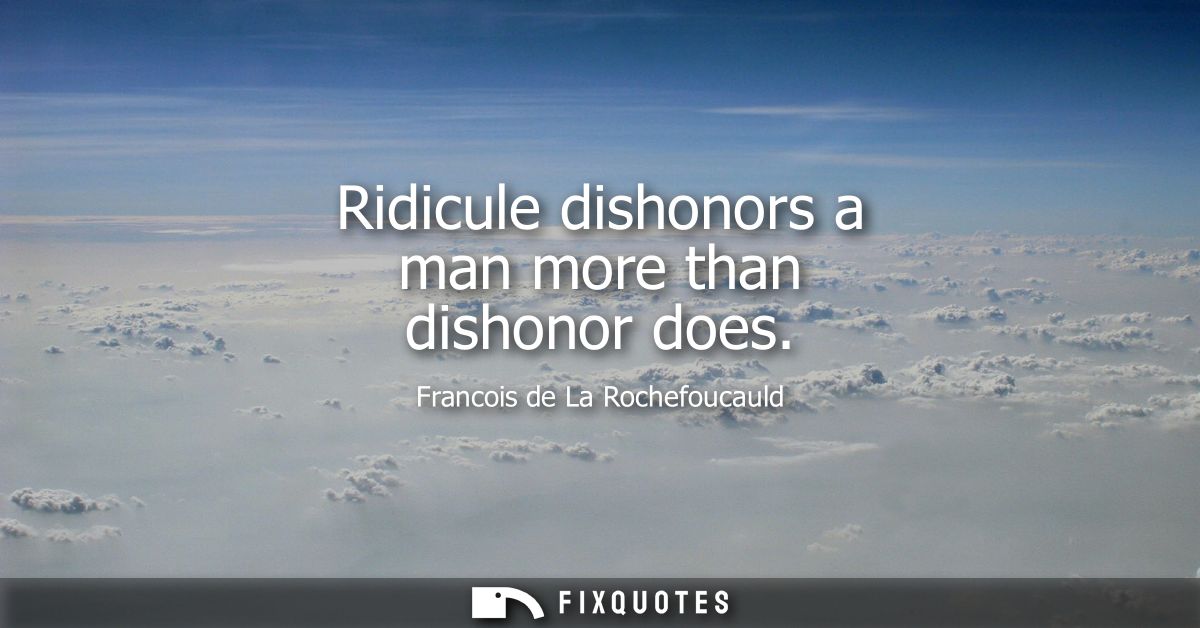
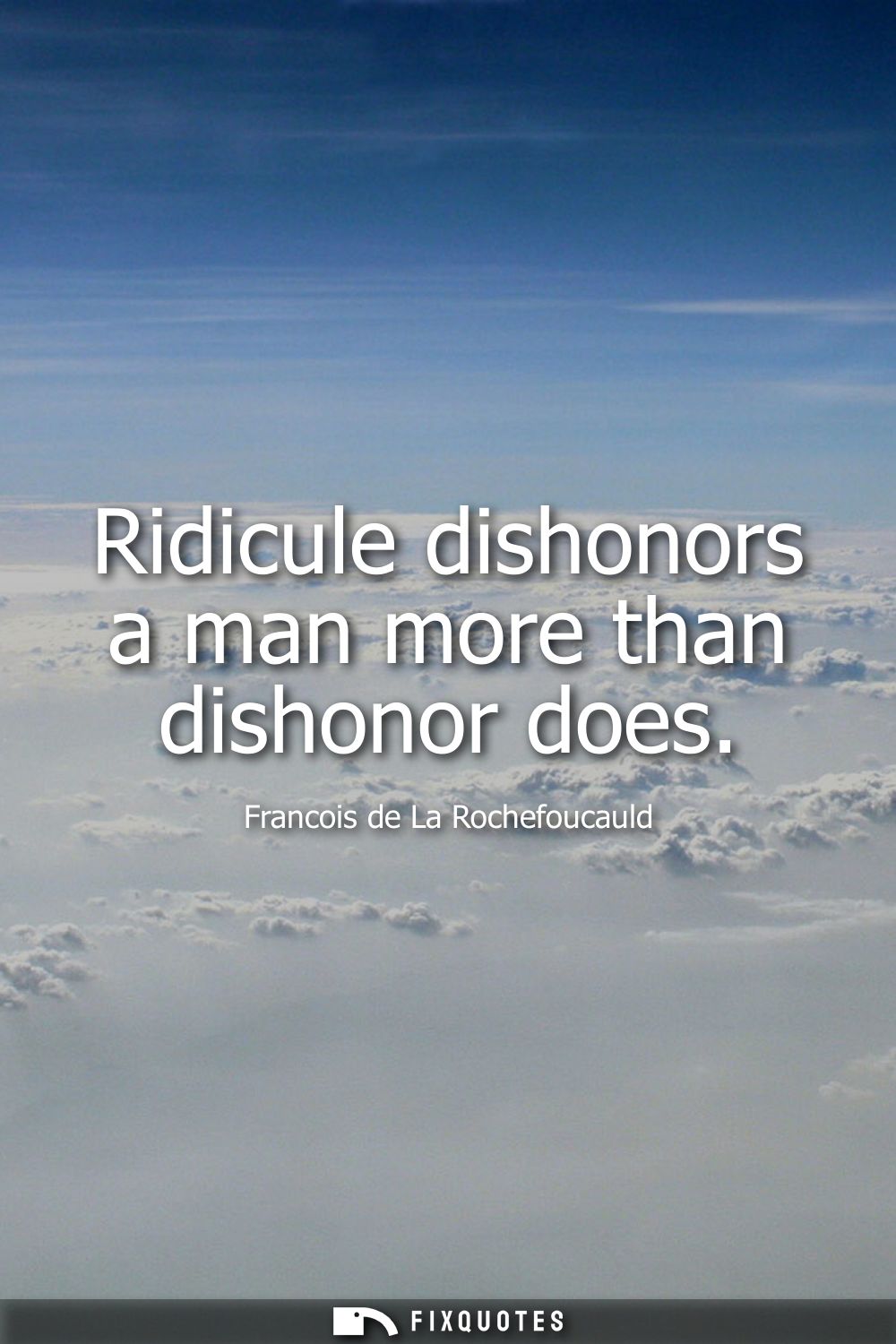
"Ridicule dishonors a man more than dishonor does"
About this Quote
Ridicule is the aristocrat's guillotine: clean, public, and impossible to appeal. La Rochefoucauld is less interested in moral wrongdoing than in social physics - the way reputation is made and unmade in a room. "Dishonor" can be processed as ethics, law, even martyrdom; it leaves room for a counterstory. A man can be disgraced yet still claim principle, bad luck, persecution, or the crookedness of the times. Ridicule forecloses all that. It turns a person into a punchline, and punchlines don't get rebuttals; they get repeated.
The intent is coldly diagnostic. In the salon culture of 17th-century France, status depended on performance: wit, restraint, the ability to read the code. Ridicule is not simply laughter but a signal that you've failed the code publicly. It doesn't just stain your character; it shrinks your scale. To be dishonored is to be accused; to be ridiculed is to be diminished. You can fight an accusation. You can't duel a smirk.
The subtext is a bleak view of human motivation that runs through La Rochefoucauld's maxims: we fear social contempt more than moral fault because our selfhood is largely outsourced to other people's eyes. Ridicule weaponizes the crowd's attention - it converts power into entertainment. And entertainment travels faster than judgment. That is why it "dishonors" more: it doesn't merely condemn what you did; it rewrites what you are.
The intent is coldly diagnostic. In the salon culture of 17th-century France, status depended on performance: wit, restraint, the ability to read the code. Ridicule is not simply laughter but a signal that you've failed the code publicly. It doesn't just stain your character; it shrinks your scale. To be dishonored is to be accused; to be ridiculed is to be diminished. You can fight an accusation. You can't duel a smirk.
The subtext is a bleak view of human motivation that runs through La Rochefoucauld's maxims: we fear social contempt more than moral fault because our selfhood is largely outsourced to other people's eyes. Ridicule weaponizes the crowd's attention - it converts power into entertainment. And entertainment travels faster than judgment. That is why it "dishonors" more: it doesn't merely condemn what you did; it rewrites what you are.
Quote Details
| Topic | Respect |
|---|---|
| Source | Help us find the source |
| Cite |
Citation Formats
APA Style (7th ed.)
Rochefoucauld, Francois de La. (2026, January 18). Ridicule dishonors a man more than dishonor does. FixQuotes. https://fixquotes.com/quotes/ridicule-dishonors-a-man-more-than-dishonor-does-13121/
Chicago Style
Rochefoucauld, Francois de La. "Ridicule dishonors a man more than dishonor does." FixQuotes. January 18, 2026. https://fixquotes.com/quotes/ridicule-dishonors-a-man-more-than-dishonor-does-13121/.
MLA Style (9th ed.)
"Ridicule dishonors a man more than dishonor does." FixQuotes, 18 Jan. 2026, https://fixquotes.com/quotes/ridicule-dishonors-a-man-more-than-dishonor-does-13121/. Accessed 30 Mar. 2026.
More Quotes by Francois
Add to List