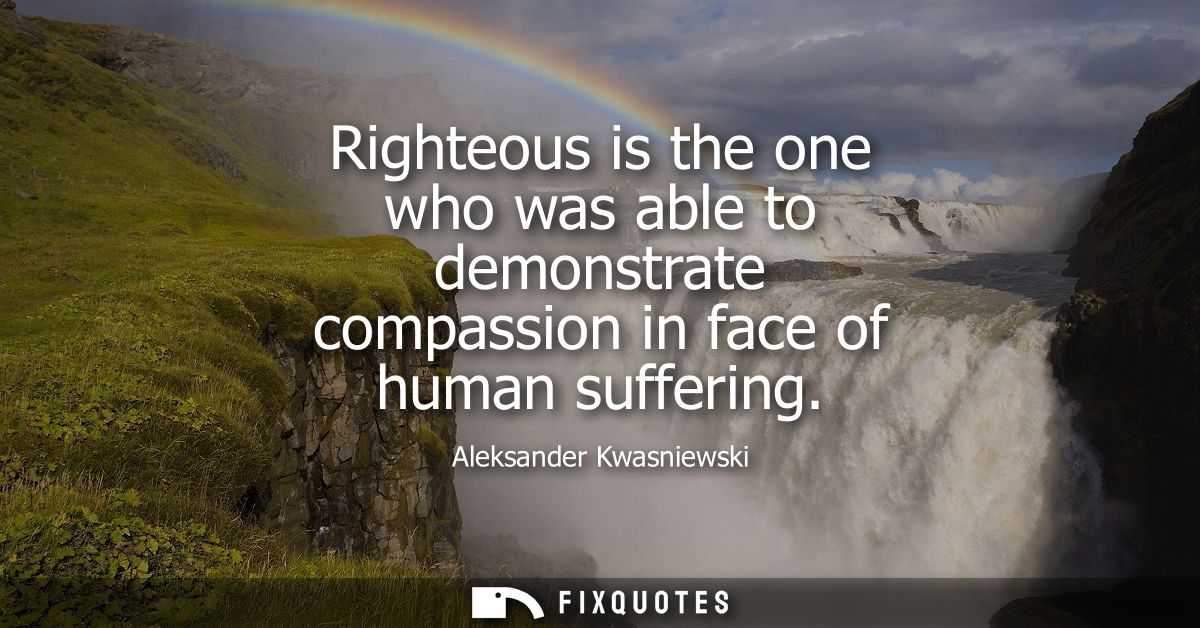
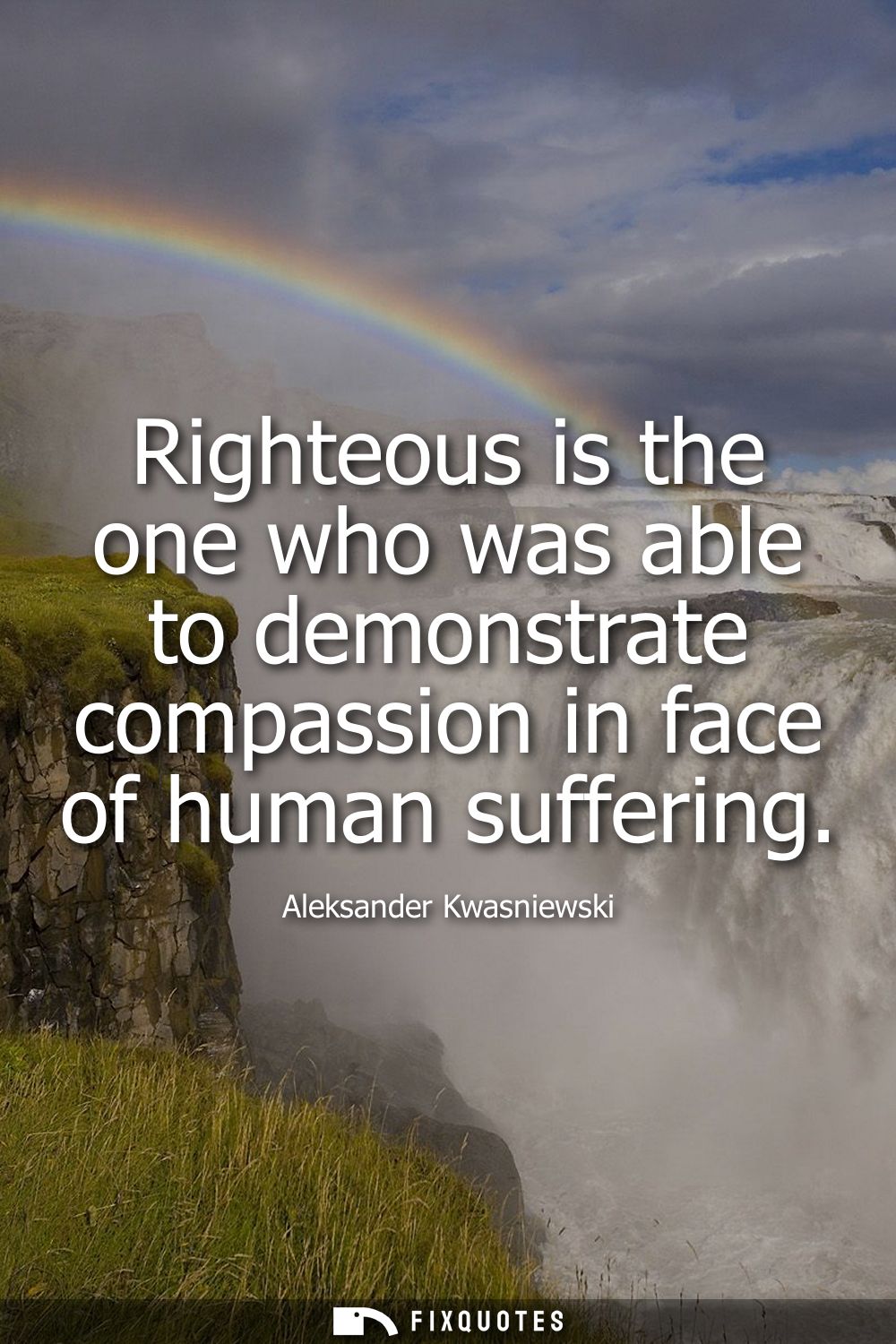
"Righteous is the one who was able to demonstrate compassion in face of human suffering"
About this Quote
The subtext is political in the most practical sense. A president from post-communist Poland, Kwasniewski came of age in a region where grand moral vocabularies were routinely weaponized: righteousness declared by parties, churches, states, and movements, often with real human casualties attached. By tying righteousness to compassion in the face of suffering, he offers a corrective to moral certainty that becomes cruelty. It’s a quiet rebuke to those who claim virtue while treating people as symbols, statistics, or enemies.
The sentence also flirts with a demanding standard: compassion is easy when the victim is sympathetic and the cost is low. “In face of human suffering” suggests immediacy and discomfort, the moment when politics turns into bodies, refugees, hospitals, funerals. In that frame, righteousness isn’t a banner; it’s restraint, attention, and the choice to see a person before a category.
Quote Details
| Topic | Kindness |
|---|---|
| Source | Help us find the source |
| Cite |
Citation Formats
APA Style (7th ed.)
Kwasniewski, Aleksander. (2026, January 16). Righteous is the one who was able to demonstrate compassion in face of human suffering. FixQuotes. https://fixquotes.com/quotes/righteous-is-the-one-who-was-able-to-demonstrate-135444/
Chicago Style
Kwasniewski, Aleksander. "Righteous is the one who was able to demonstrate compassion in face of human suffering." FixQuotes. January 16, 2026. https://fixquotes.com/quotes/righteous-is-the-one-who-was-able-to-demonstrate-135444/.
MLA Style (9th ed.)
"Righteous is the one who was able to demonstrate compassion in face of human suffering." FixQuotes, 16 Jan. 2026, https://fixquotes.com/quotes/righteous-is-the-one-who-was-able-to-demonstrate-135444/. Accessed 29 Mar. 2026.