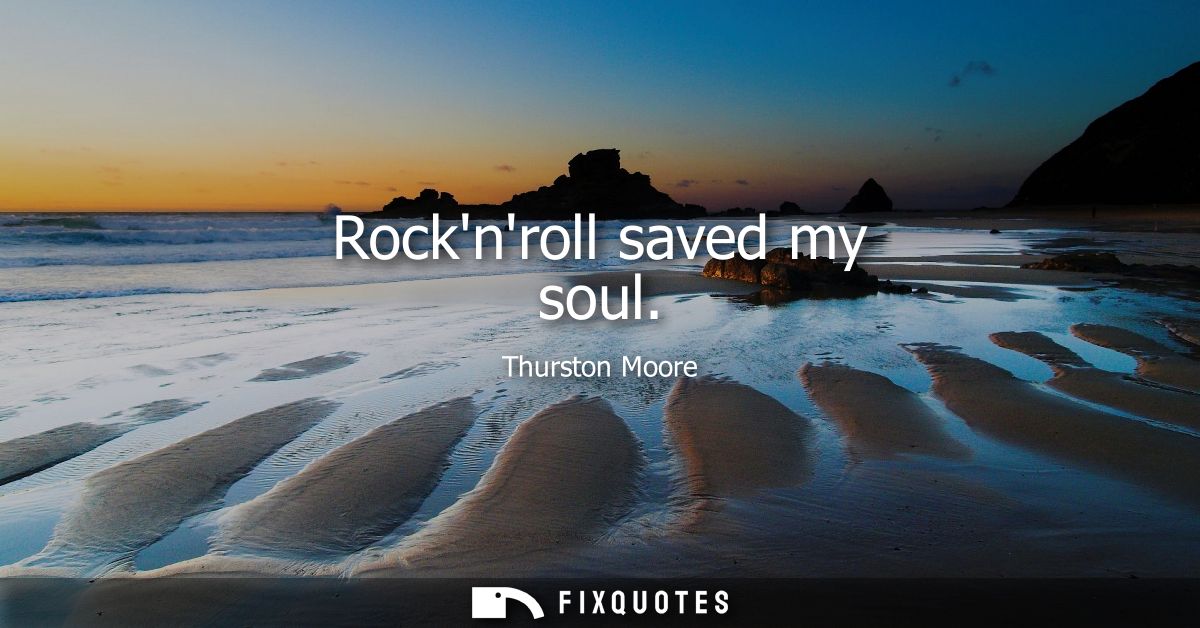
"Rock'n'roll saved my soul"
About this Quote
A line like "Rock'n'roll saved my soul" works because it dares you to take a genre as seriously as a religion, then shrugs like it’s obvious. Coming from Thurston Moore, it’s not the tidy, Hallmark version of being “saved.” It’s closer to a testimony from someone who grew up in the post-60s rubble, when faith in institutions was thinning out and subcultures became survival kits. Rock wasn’t just entertainment; it was an alternate citizenship.
The phrase “saved my soul” borrows the diction of conversion narratives, but Moore reroutes that intensity toward amplification, noise, and community. The subtext is that culture can be a life raft: a record can be a mentor, a band can be a family, a scene can be a reason to keep going. In the punk and no wave-adjacent ecosystems that fed Sonic Youth, “salvation” isn’t purity; it’s permission. Permission to be weird, to be loud, to refuse the polite scripts of adulthood.
There’s also a quiet flex in the claim. If rock saved him, then rock is bigger than the marketplace that sells it, bigger than the nostalgia machine that keeps trying to freeze it in amber. Moore’s career is basically a long argument that rock’s highest function is not hits but horizons: turning alienation into aesthetics, boredom into experimentation, loneliness into a feedback loop you can dance to. The line lands because it makes devotion sound practical, not poetic: this music didn’t improve his life; it gave him one.
The phrase “saved my soul” borrows the diction of conversion narratives, but Moore reroutes that intensity toward amplification, noise, and community. The subtext is that culture can be a life raft: a record can be a mentor, a band can be a family, a scene can be a reason to keep going. In the punk and no wave-adjacent ecosystems that fed Sonic Youth, “salvation” isn’t purity; it’s permission. Permission to be weird, to be loud, to refuse the polite scripts of adulthood.
There’s also a quiet flex in the claim. If rock saved him, then rock is bigger than the marketplace that sells it, bigger than the nostalgia machine that keeps trying to freeze it in amber. Moore’s career is basically a long argument that rock’s highest function is not hits but horizons: turning alienation into aesthetics, boredom into experimentation, loneliness into a feedback loop you can dance to. The line lands because it makes devotion sound practical, not poetic: this music didn’t improve his life; it gave him one.
Quote Details
| Topic | Music |
|---|---|
| Source | Help us find the source |
| Cite |
Citation Formats
APA Style (7th ed.)
Moore, Thurston. (2026, January 16). Rock'n'roll saved my soul. FixQuotes. https://fixquotes.com/quotes/rocknroll-saved-my-soul-131094/
Chicago Style
Moore, Thurston. "Rock'n'roll saved my soul." FixQuotes. January 16, 2026. https://fixquotes.com/quotes/rocknroll-saved-my-soul-131094/.
MLA Style (9th ed.)
"Rock'n'roll saved my soul." FixQuotes, 16 Jan. 2026, https://fixquotes.com/quotes/rocknroll-saved-my-soul-131094/. Accessed 27 Mar. 2026.
More Quotes by Thurston
Add to List