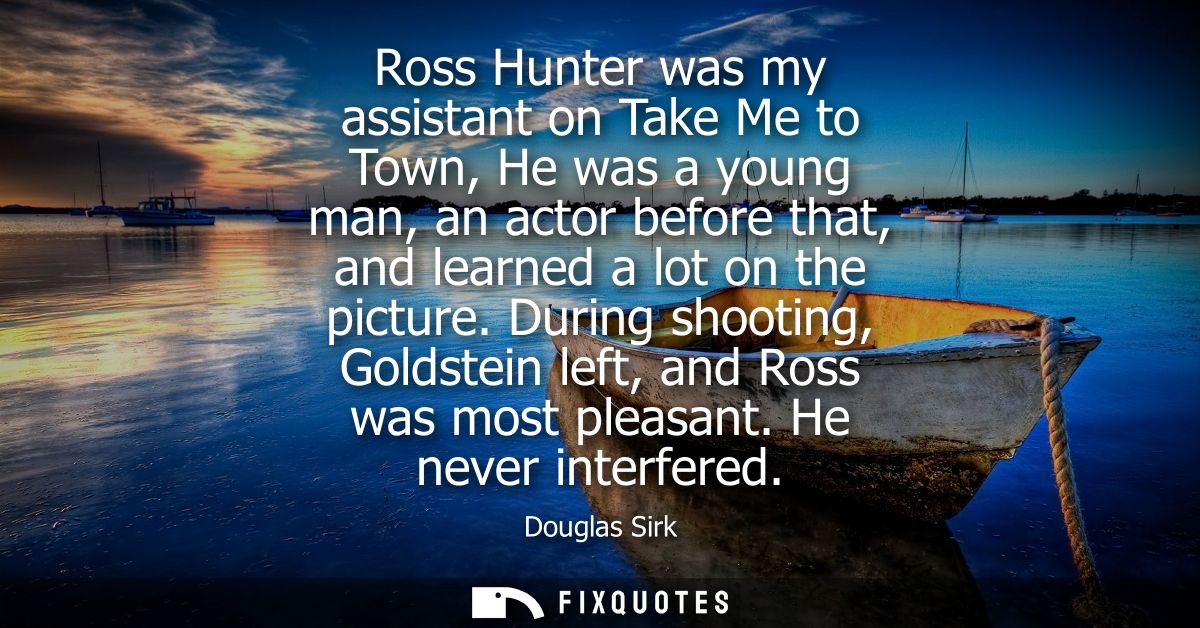
"Ross Hunter was my assistant on Take Me to Town, He was a young man, an actor before that, and learned a lot on the picture. During shooting, Goldstein left, and Ross was most pleasant. He never interfered"
About this Quote
Sirk’s praise lands with the softness of diplomacy and the sharpness of a knife. On the surface, it’s a tidy memory of an assistant who was “most pleasant.” Underneath, it’s a small portrait of how power actually moves on a movie set: quietly, through absence, through restraint, through who chooses not to meddle.
Naming names matters here. “During shooting, Goldstein left” is delivered like a weather report, but it’s really the turning point. In the studio era, departures weren’t just logistical; they signaled shifts in authority and protection. When a supervising figure exits midstream, a director can either be squeezed by replacements or briefly liberated. Ross Hunter’s virtue, in Sirk’s telling, isn’t genius or boldness. It’s negative capability: “He never interfered.” That’s an aesthetic statement as much as a managerial one. Sirk, the master of controlled surfaces and buried critique, valued an environment where his orchestration could remain intact.
There’s also career subtext. Hunter “was a young man… an actor before that,” a detail that reads like Sirk clocking ambition and reinvention. Hunter would go on to become a major producer of glossy melodramas - the very terrain Sirk elevated into art. This is Sirk spotting a future player and defining the most important lesson he learned on set: not how to command, but when to step aside.
The quote doubles as a veiled commentary on Hollywood’s machinery. The best ally, Sirk implies, isn’t the loud fixer or the panicked executive. It’s the person who understands that interference is its own kind of authorship - and that sometimes the most decisive act is leaving the director alone.
Naming names matters here. “During shooting, Goldstein left” is delivered like a weather report, but it’s really the turning point. In the studio era, departures weren’t just logistical; they signaled shifts in authority and protection. When a supervising figure exits midstream, a director can either be squeezed by replacements or briefly liberated. Ross Hunter’s virtue, in Sirk’s telling, isn’t genius or boldness. It’s negative capability: “He never interfered.” That’s an aesthetic statement as much as a managerial one. Sirk, the master of controlled surfaces and buried critique, valued an environment where his orchestration could remain intact.
There’s also career subtext. Hunter “was a young man… an actor before that,” a detail that reads like Sirk clocking ambition and reinvention. Hunter would go on to become a major producer of glossy melodramas - the very terrain Sirk elevated into art. This is Sirk spotting a future player and defining the most important lesson he learned on set: not how to command, but when to step aside.
The quote doubles as a veiled commentary on Hollywood’s machinery. The best ally, Sirk implies, isn’t the loud fixer or the panicked executive. It’s the person who understands that interference is its own kind of authorship - and that sometimes the most decisive act is leaving the director alone.
Quote Details
| Topic | Career |
|---|
More Quotes by Douglas
Add to List