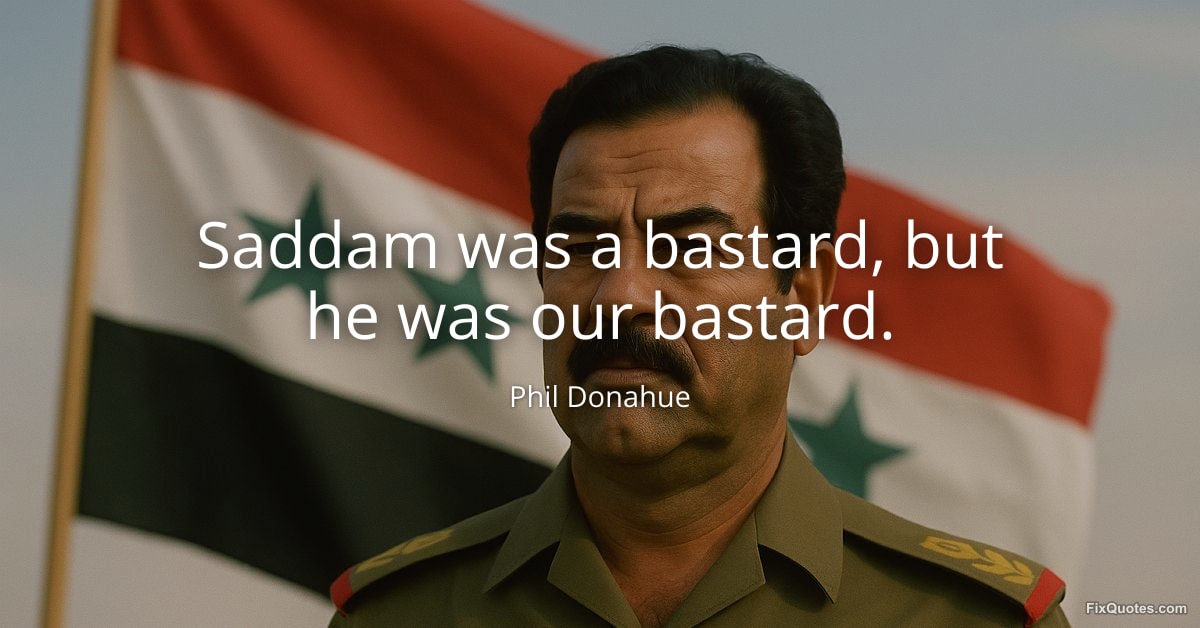
"Saddam was a bastard, but he was our bastard"
About this Quote
It lands like a punchline with blood on it: crude, quotable, and morally clarifying. Donahue’s line borrows the blunt vernacular of realpolitik to expose the bargain at the heart of American foreign policy - the way “values” get treated as a press release while alliances are negotiated in the language of usefulness. Calling Saddam “a bastard” grants the audience the expected moral verdict. The sting is the possessive: “our.” One syllable that turns condemnation into complicity.
As an entertainer-turned-public moralist, Donahue isn’t trying to sound like a policy memo; he’s trying to make viewers feel the nausea of the trade-off. The phrase telescopes decades of U.S. entanglement in the Middle East, especially the periods when Saddam’s Iraq was tolerated, courted, or strategically enabled because it served a larger aim - countering Iran, stabilizing oil politics, projecting power. “Our bastard” implies not just knowing hypocrisy but ownership of it: if you help empower a strongman, you don’t get to act shocked when he behaves like one.
The subtext also skewers the convenient amnesia that often accompanies regime-change narratives. It challenges the clean storyline where yesterday’s partner becomes today’s monster only when he stops being useful. Donahue’s intent is less to litigate Saddam’s crimes than to puncture the moral self-image that lets a superpower outsource brutality and then disavow it on camera. The line works because it’s ugly on purpose: it makes the audience sit with the idea that geopolitical “pragmatism” is often just intimacy with a villain, dressed up as strategy.
As an entertainer-turned-public moralist, Donahue isn’t trying to sound like a policy memo; he’s trying to make viewers feel the nausea of the trade-off. The phrase telescopes decades of U.S. entanglement in the Middle East, especially the periods when Saddam’s Iraq was tolerated, courted, or strategically enabled because it served a larger aim - countering Iran, stabilizing oil politics, projecting power. “Our bastard” implies not just knowing hypocrisy but ownership of it: if you help empower a strongman, you don’t get to act shocked when he behaves like one.
The subtext also skewers the convenient amnesia that often accompanies regime-change narratives. It challenges the clean storyline where yesterday’s partner becomes today’s monster only when he stops being useful. Donahue’s intent is less to litigate Saddam’s crimes than to puncture the moral self-image that lets a superpower outsource brutality and then disavow it on camera. The line works because it’s ugly on purpose: it makes the audience sit with the idea that geopolitical “pragmatism” is often just intimacy with a villain, dressed up as strategy.
Quote Details
| Topic | War |
|---|---|
| Source | Unverified source: Fox News: O'Reilly vs. Donahue in the No Spin Zone (Phil Donahue, 2005)
Evidence: Fox News published a (edited) transcript of "The O'Reilly Factor" dated September 23, 2005. In the transcript Donahue says: "Saddam , Saddam was a bastard. But he was our bastard." This is the earliest primary-source instance I was able to verify via web search in this session. Other candidates (1) Phil Donahue (Phil Donahue) compilation30.0% s an american media personality writer and film producer best known as the creat |
| Cite |
Citation Formats
APA Style (7th ed.)
Donahue, Phil. (2026, January 13). Saddam was a bastard, but he was our bastard. FixQuotes. https://fixquotes.com/quotes/saddam-was-a-bastard-but-he-was-our-bastard-89235/
Chicago Style
Donahue, Phil. "Saddam was a bastard, but he was our bastard." FixQuotes. January 13, 2026. https://fixquotes.com/quotes/saddam-was-a-bastard-but-he-was-our-bastard-89235/.
MLA Style (9th ed.)
"Saddam was a bastard, but he was our bastard." FixQuotes, 13 Jan. 2026, https://fixquotes.com/quotes/saddam-was-a-bastard-but-he-was-our-bastard-89235/. Accessed 1 Apr. 2026.
More Quotes by Phil
Add to List