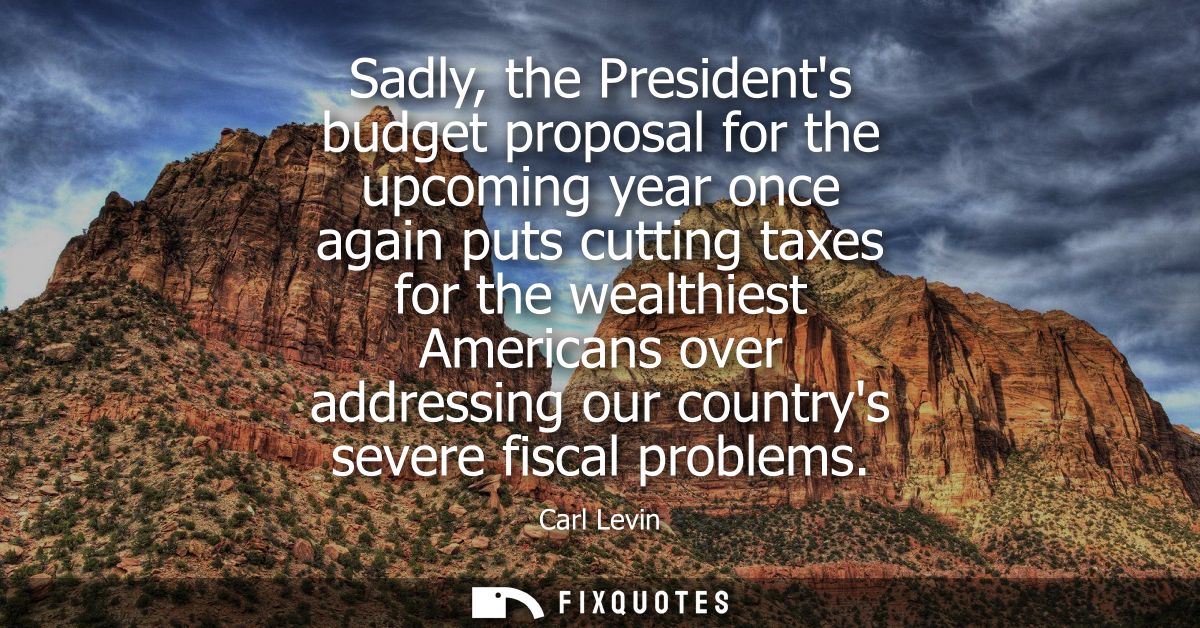
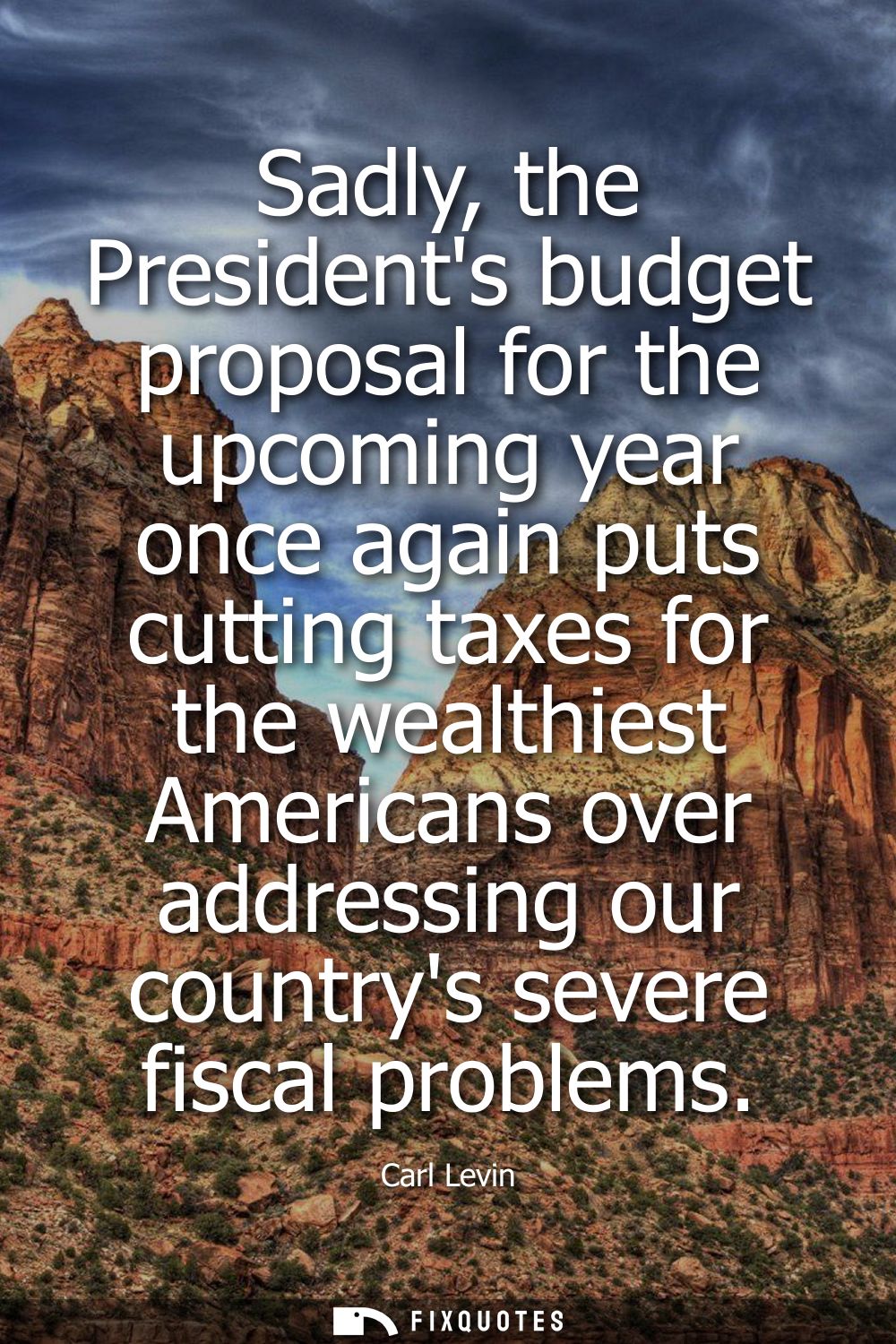
"Sadly, the President's budget proposal for the upcoming year once again puts cutting taxes for the wealthiest Americans over addressing our country's severe fiscal problems"
About this Quote
As a politician, Levin isn’t chasing poetic ambiguity. He’s aiming for a clean contrast that travels well: “cutting taxes for the wealthiest Americans” versus “addressing our country’s severe fiscal problems.” Notice the asymmetry. One side is specific, almost visual (the wealthy getting a break). The other is expansive and ominous (“severe fiscal problems”), inviting listeners to fill in the stakes: deficits, debt, future cuts, national vulnerability. The subtext is that the White House is pretending to be fiscally responsible while actively undercutting the revenue needed to be responsible.
Contextually, this kind of line sits squarely in the post-2000 budget wars, when “tax cuts” were sold as growth engines and critics argued they were expensive gifts wrapped in supply-side rhetoric. Levin’s move is to reclaim the language of seriousness: if you care about “fiscal problems,” you don’t start by shrinking the tax base at the top. The sadness isn’t sentimental; it’s a cue to see repetition as negligence.
Quote Details
| Topic | Wealth |
|---|---|
| Source | Help us find the source |
| Cite |
Citation Formats
APA Style (7th ed.)
Levin, Carl. (2026, January 17). Sadly, the President's budget proposal for the upcoming year once again puts cutting taxes for the wealthiest Americans over addressing our country's severe fiscal problems. FixQuotes. https://fixquotes.com/quotes/sadly-the-presidents-budget-proposal-for-the-40359/
Chicago Style
Levin, Carl. "Sadly, the President's budget proposal for the upcoming year once again puts cutting taxes for the wealthiest Americans over addressing our country's severe fiscal problems." FixQuotes. January 17, 2026. https://fixquotes.com/quotes/sadly-the-presidents-budget-proposal-for-the-40359/.
MLA Style (9th ed.)
"Sadly, the President's budget proposal for the upcoming year once again puts cutting taxes for the wealthiest Americans over addressing our country's severe fiscal problems." FixQuotes, 17 Jan. 2026, https://fixquotes.com/quotes/sadly-the-presidents-budget-proposal-for-the-40359/. Accessed 9 Mar. 2026.