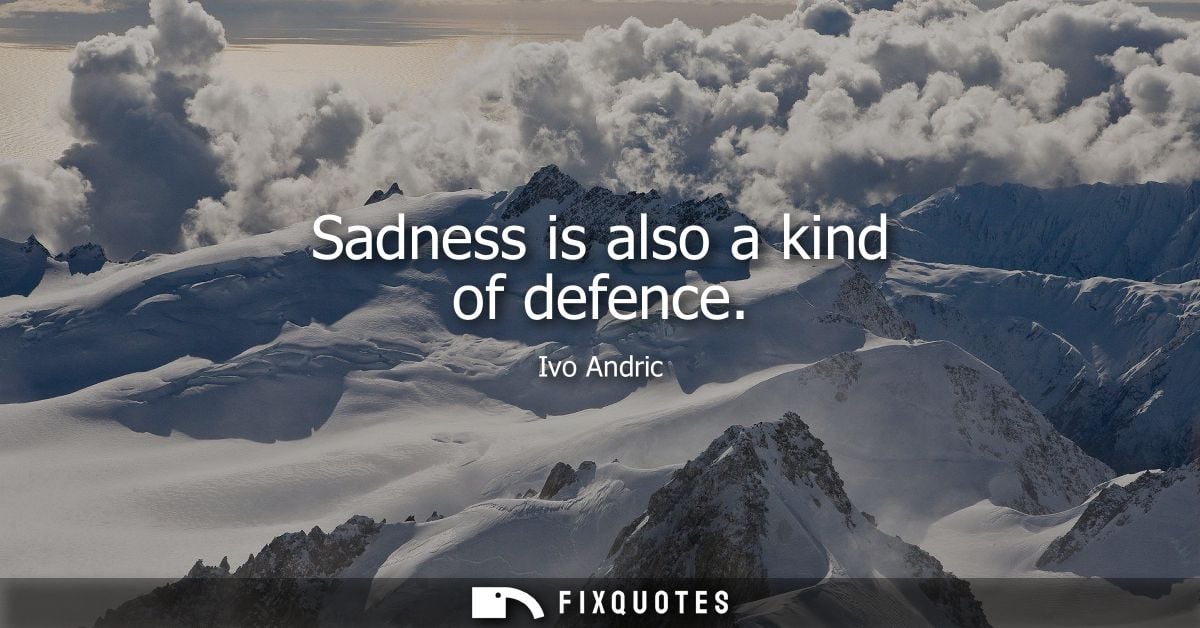
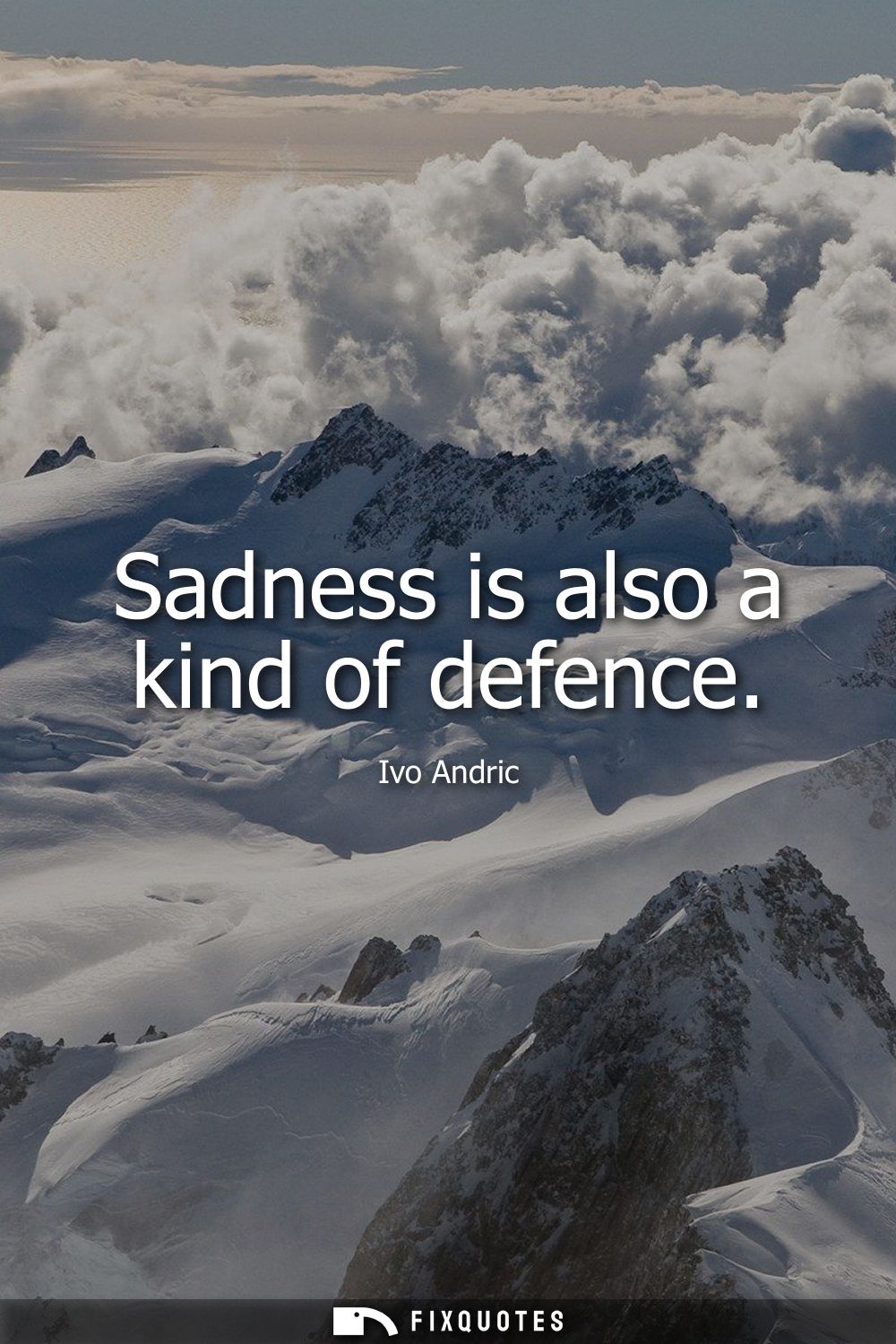
"Sadness is also a kind of defence"
About this Quote
Andric’s line turns sadness from a passive feeling into an active strategy: not just something that happens to you, but something you do. “Defence” is the tell. It’s a word from borders, barricades, and occupied streets - the vocabulary of a region that spent the 20th century learning how quickly the private life can be invaded by the public one. In that world, optimism isn’t simply naive; it can be dangerous, a brightly lit window that draws fire.
The subtext is that sadness creates distance. It lowers expectations, narrows desire, and makes loss feel pre-paid. If you’re already grieving, the next blow lands on ground you’ve already hardened. That’s not romantic melancholy; it’s psychological trench work. Sadness becomes a way to remain intact when history, family, and politics treat people as collateral.
Andric’s intent also carries a moral edge. Defence can slide into habit, then into identity: the person who stays sorrowful because it’s safer than hoping. The line quietly indicts the seductions of gloom - how it can masquerade as depth or realism while functioning as self-protection, even self-control. It grants you the authority of having “seen too much,” a credible pose in societies where credibility is often earned through suffering.
For a writer who chronicled Bosnia’s long memory of violence and coexistence, the sentence reads like a compressed ethnography: a culture where emotional restraint is not coldness but caution, where sadness is less a collapse than a shield held close to the chest.
The subtext is that sadness creates distance. It lowers expectations, narrows desire, and makes loss feel pre-paid. If you’re already grieving, the next blow lands on ground you’ve already hardened. That’s not romantic melancholy; it’s psychological trench work. Sadness becomes a way to remain intact when history, family, and politics treat people as collateral.
Andric’s intent also carries a moral edge. Defence can slide into habit, then into identity: the person who stays sorrowful because it’s safer than hoping. The line quietly indicts the seductions of gloom - how it can masquerade as depth or realism while functioning as self-protection, even self-control. It grants you the authority of having “seen too much,” a credible pose in societies where credibility is often earned through suffering.
For a writer who chronicled Bosnia’s long memory of violence and coexistence, the sentence reads like a compressed ethnography: a culture where emotional restraint is not coldness but caution, where sadness is less a collapse than a shield held close to the chest.
Quote Details
| Topic | Sadness |
|---|---|
| Source | Help us find the source |
| Cite |
Citation Formats
APA Style (7th ed.)
Andric, Ivo. (2026, January 16). Sadness is also a kind of defence. FixQuotes. https://fixquotes.com/quotes/sadness-is-also-a-kind-of-defence-133219/
Chicago Style
Andric, Ivo. "Sadness is also a kind of defence." FixQuotes. January 16, 2026. https://fixquotes.com/quotes/sadness-is-also-a-kind-of-defence-133219/.
MLA Style (9th ed.)
"Sadness is also a kind of defence." FixQuotes, 16 Jan. 2026, https://fixquotes.com/quotes/sadness-is-also-a-kind-of-defence-133219/. Accessed 12 Feb. 2026.
More Quotes by Ivo
Add to List