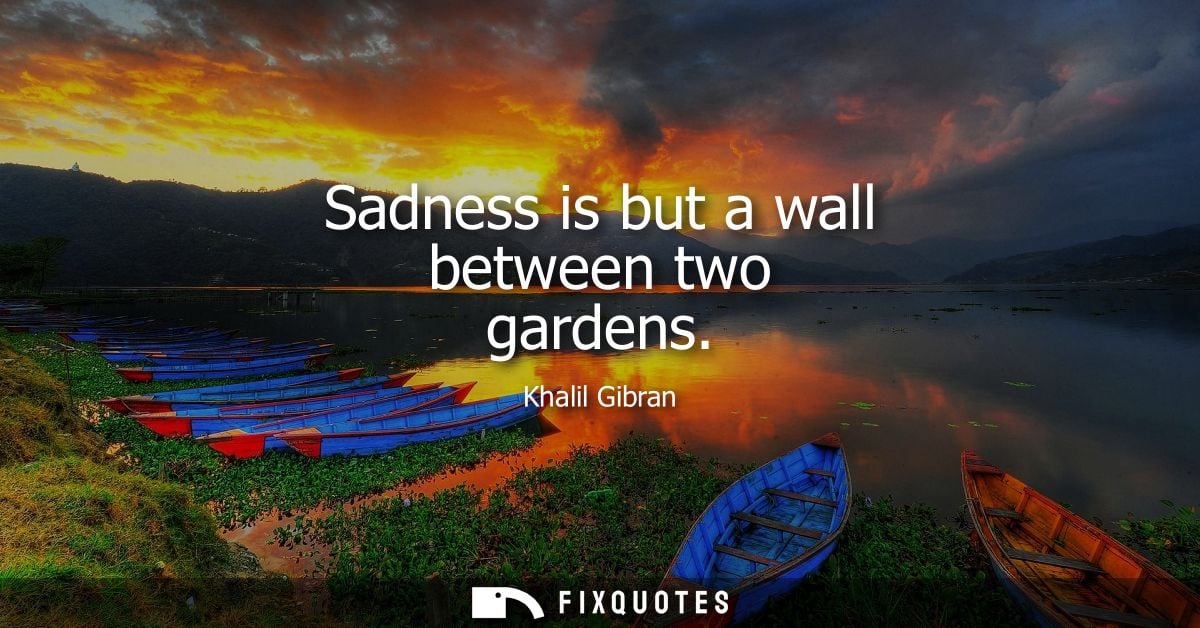
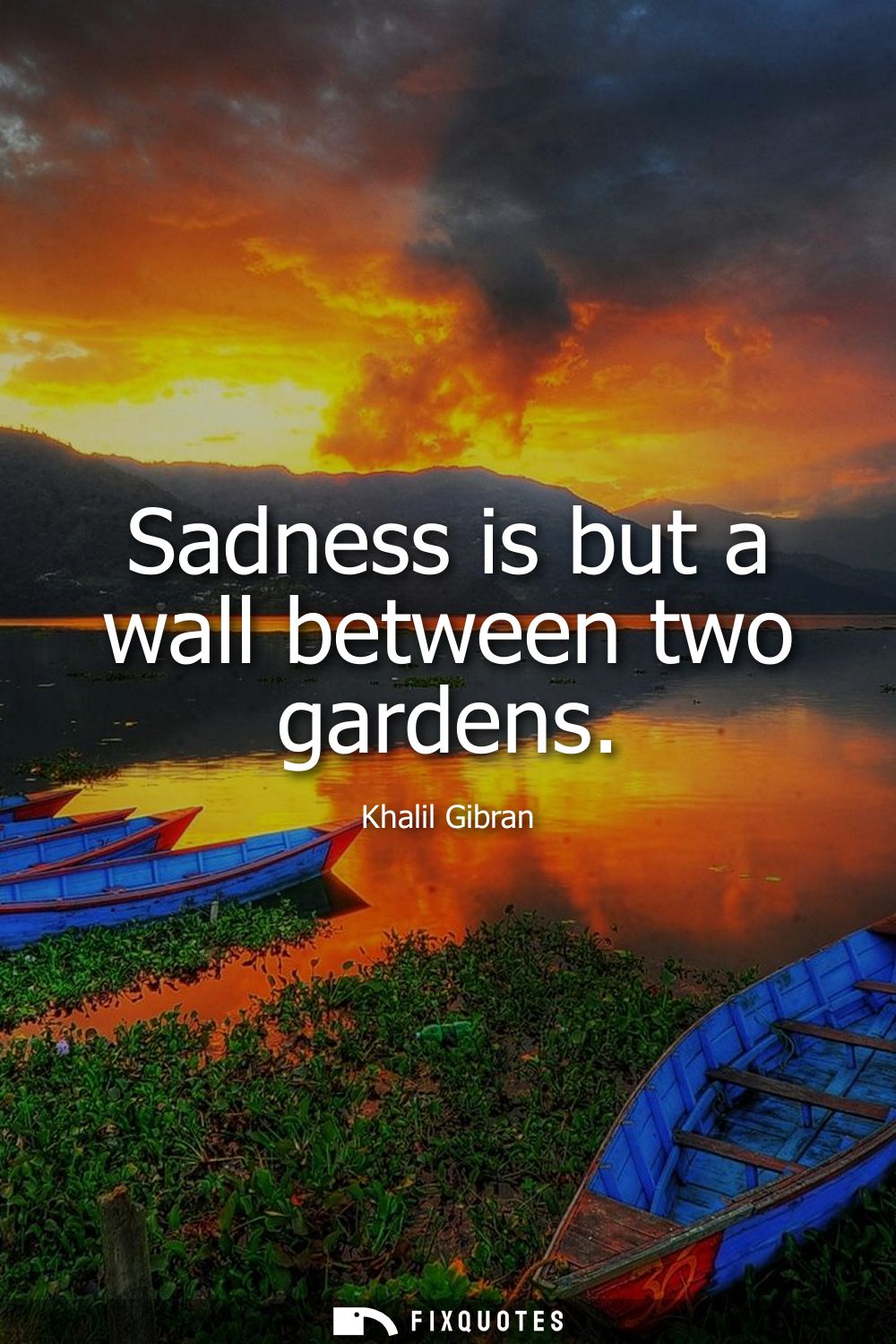
"Sadness is but a wall between two gardens"
About this Quote
A wall is such a deceptively modest object: it separates, it shelters, it obstructs. Gibran makes sadness legible by giving it architecture. Not a pit, not a storm, not a lifelong sentence - a wall. That choice matters. Walls imply boundaries that can be approached, traced, even climbed, and they also hint at design: someone built this, or at least someone maintains it. Sadness, in this framing, is real and solid, but not ultimate.
The line’s trick is its double consolation. First, it refuses to romanticize grief as a sacred abyss. “But” downgrades sadness from totalizing identity to temporary partition. Second, it doesn’t leap straight to toxic positivity. He doesn’t call the wall an illusion; he admits the blockage. You can’t see the other garden clearly from where you stand, and that is the point. A garden is cultivated life - tended, imperfect, seasonal. By placing two gardens on either side, he suggests continuity rather than replacement: what’s beyond the wall isn’t a different universe, it’s another plot of living, another phase of growth.
Context sharpens the appeal. Gibran, an immigrant straddling Arabic literary tradition and Western romantic mysticism, specialized in metaphors that travel well across cultures and religions. This is grief translated into a portable image, suited to early-20th-century dislocation: loss as separation from a familiar landscape, hope as the knowledge that beauty still exists, just out of sight.
The line’s trick is its double consolation. First, it refuses to romanticize grief as a sacred abyss. “But” downgrades sadness from totalizing identity to temporary partition. Second, it doesn’t leap straight to toxic positivity. He doesn’t call the wall an illusion; he admits the blockage. You can’t see the other garden clearly from where you stand, and that is the point. A garden is cultivated life - tended, imperfect, seasonal. By placing two gardens on either side, he suggests continuity rather than replacement: what’s beyond the wall isn’t a different universe, it’s another plot of living, another phase of growth.
Context sharpens the appeal. Gibran, an immigrant straddling Arabic literary tradition and Western romantic mysticism, specialized in metaphors that travel well across cultures and religions. This is grief translated into a portable image, suited to early-20th-century dislocation: loss as separation from a familiar landscape, hope as the knowledge that beauty still exists, just out of sight.
Quote Details
| Topic | Sadness |
|---|---|
| Source | Sand and Foam (1926) — aphorism commonly cited as “Sadness is but a wall between two gardens.” |
| Cite |
Citation Formats
APA Style (7th ed.)
Gibran, Kahlil. (2026, January 15). Sadness is but a wall between two gardens. FixQuotes. https://fixquotes.com/quotes/sadness-is-but-a-wall-between-two-gardens-17363/
Chicago Style
Gibran, Kahlil. "Sadness is but a wall between two gardens." FixQuotes. January 15, 2026. https://fixquotes.com/quotes/sadness-is-but-a-wall-between-two-gardens-17363/.
MLA Style (9th ed.)
"Sadness is but a wall between two gardens." FixQuotes, 15 Jan. 2026, https://fixquotes.com/quotes/sadness-is-but-a-wall-between-two-gardens-17363/. Accessed 28 Mar. 2026.
More Quotes by Kahlil
Add to List