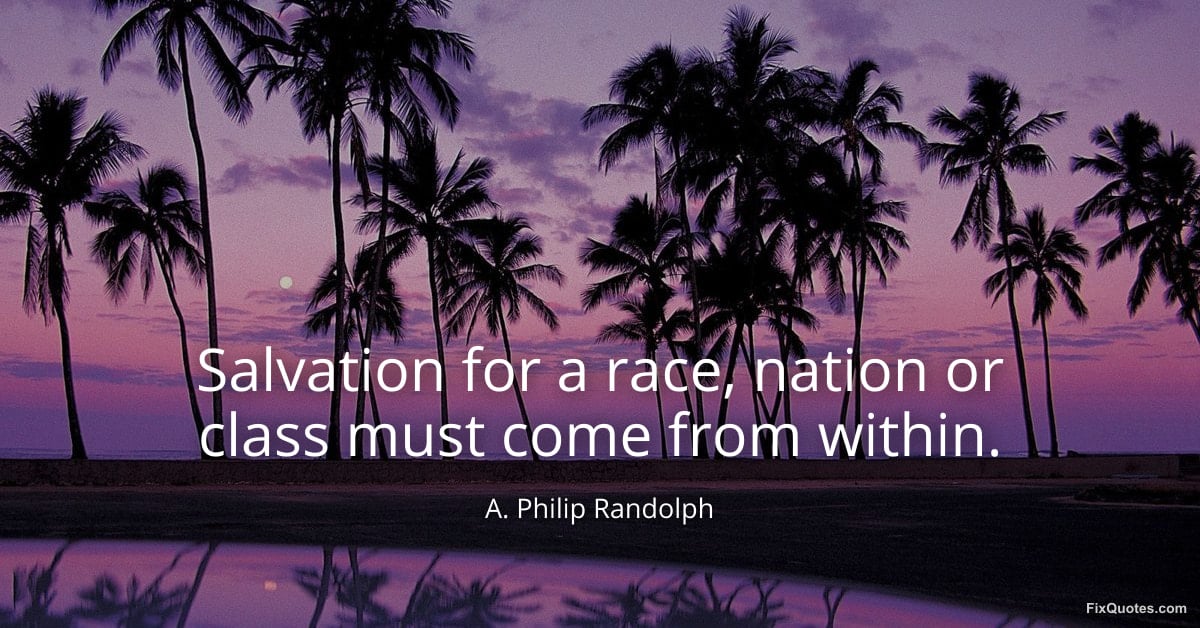
"Salvation for a race, nation or class must come from within"
About this Quote
Randolph’s line is a rebuke to the comforting myth that freedom arrives as a gift. “Salvation” is a deliberately loaded word for a labor and civil-rights organizer: it borrows the moral thunder of religion, then yanks it out of the church and into the streets, the union hall, the ballot box. The point isn’t inward-looking self-help; it’s power-building. If a race, nation, or class waits for rescue from benevolent elites, it has already accepted its place in someone else’s story.
The phrasing matters. By stacking “race, nation or class,” Randolph refuses to let liberation be siloed. He’s speaking to Black Americans living under Jim Crow, to workers facing exploitation, to any collective being managed by outsiders who claim to know what’s best. “Must” is the hinge: not “should,” not “ideally,” but an insistence that agency is nonnegotiable. The subtext is strategic as much as spiritual: rights conceded from above are fragile; rights demanded from below create durable leverage.
In Randolph’s America, incremental sympathy was plentiful, structural change scarce. He helped force the issue through organized pressure, most famously by threatening mass mobilization that pushed the federal government to act against discrimination in defense industries, and later shaping the momentum that made the 1963 March on Washington possible. The line compresses that whole playbook: outsiders can be allies, but they can’t be the engine. Liberation outsourced is liberation postponed.
The phrasing matters. By stacking “race, nation or class,” Randolph refuses to let liberation be siloed. He’s speaking to Black Americans living under Jim Crow, to workers facing exploitation, to any collective being managed by outsiders who claim to know what’s best. “Must” is the hinge: not “should,” not “ideally,” but an insistence that agency is nonnegotiable. The subtext is strategic as much as spiritual: rights conceded from above are fragile; rights demanded from below create durable leverage.
In Randolph’s America, incremental sympathy was plentiful, structural change scarce. He helped force the issue through organized pressure, most famously by threatening mass mobilization that pushed the federal government to act against discrimination in defense industries, and later shaping the momentum that made the 1963 March on Washington possible. The line compresses that whole playbook: outsiders can be allies, but they can’t be the engine. Liberation outsourced is liberation postponed.
Quote Details
| Topic | Equality |
|---|---|
| Source | Help us find the source |
| Cite |
Citation Formats
APA Style (7th ed.)
Randolph, A. Philip. (2026, January 16). Salvation for a race, nation or class must come from within. FixQuotes. https://fixquotes.com/quotes/salvation-for-a-race-nation-or-class-must-come-108327/
Chicago Style
Randolph, A. Philip. "Salvation for a race, nation or class must come from within." FixQuotes. January 16, 2026. https://fixquotes.com/quotes/salvation-for-a-race-nation-or-class-must-come-108327/.
MLA Style (9th ed.)
"Salvation for a race, nation or class must come from within." FixQuotes, 16 Jan. 2026, https://fixquotes.com/quotes/salvation-for-a-race-nation-or-class-must-come-108327/. Accessed 27 Mar. 2026.
More Quotes by Philip Randolph
Add to List