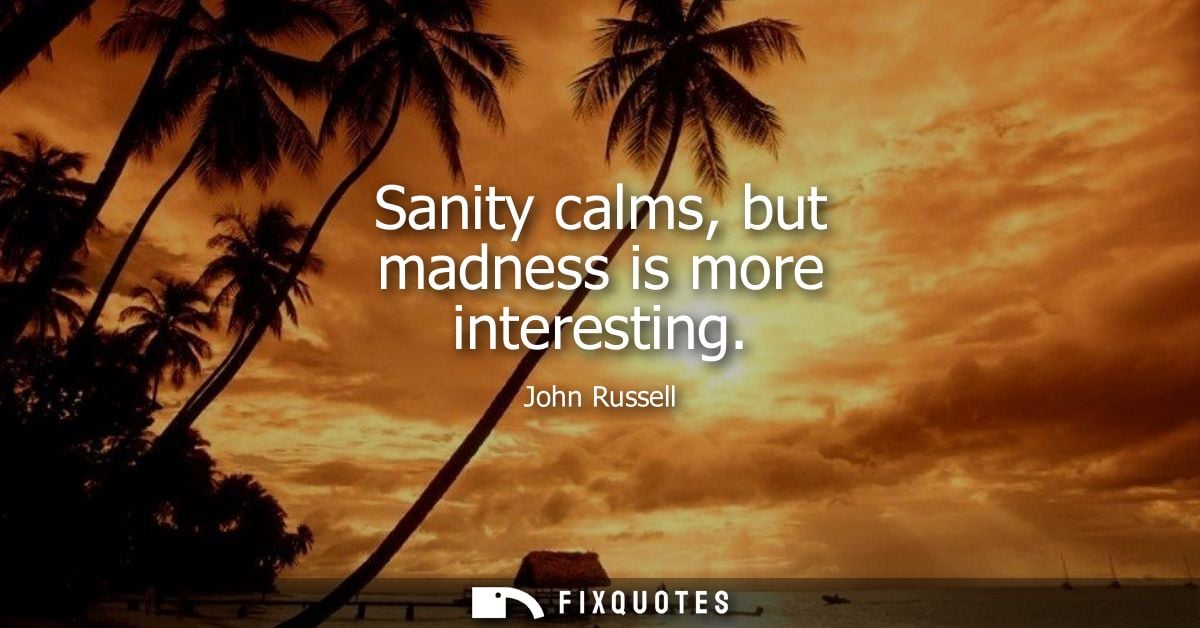
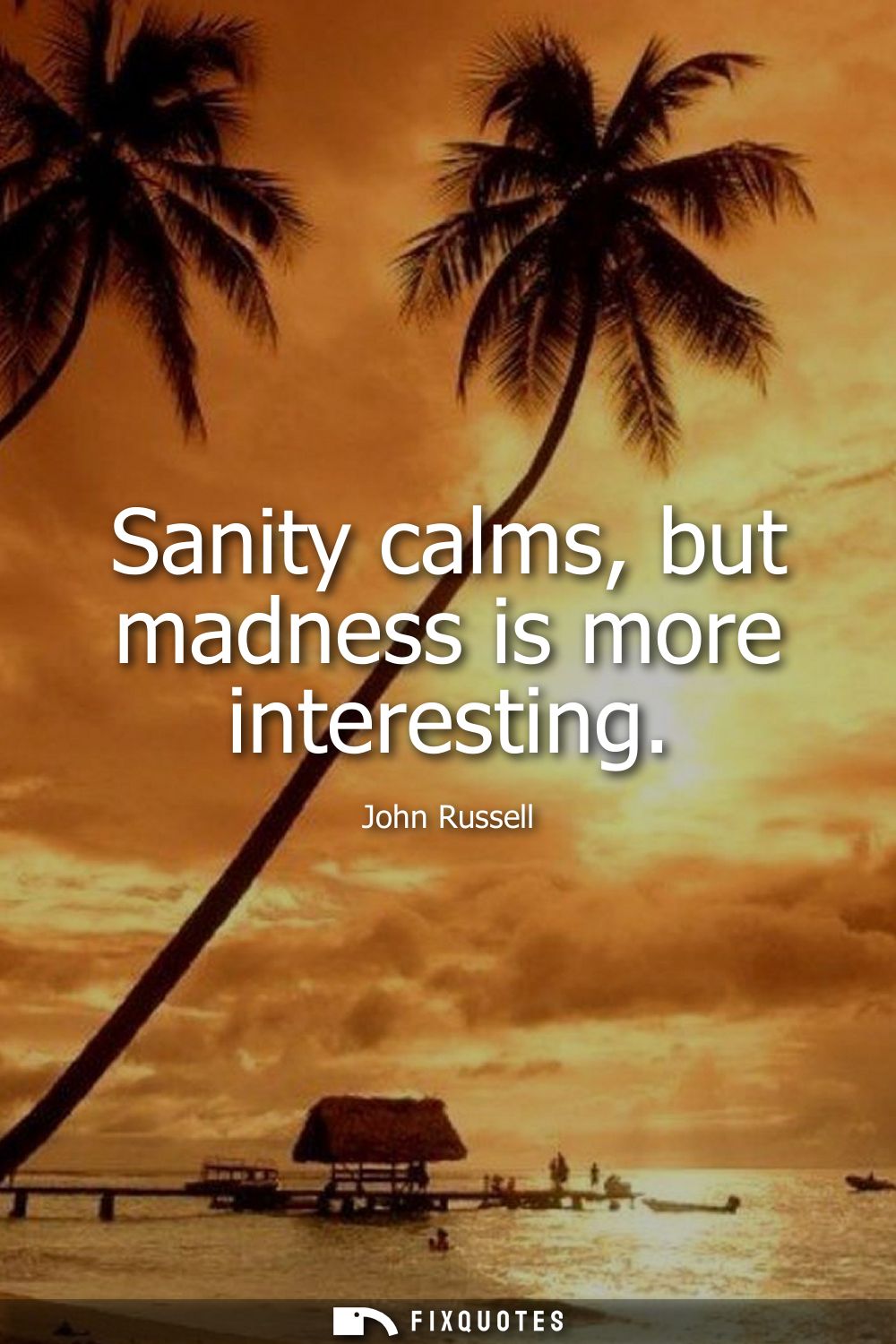
"Sanity calms, but madness is more interesting"
About this Quote
“Sanity calms, but madness is more interesting” is an actor’s confession disguised as a life lesson. It values the steadying comfort of normalcy while admitting, almost sheepishly, that normalcy doesn’t sell. Calm is what we want after the curtain drops; “madness” is what keeps us watching while it’s up.
The line works because it frames stability as a sedative and instability as a stimulant. “Sanity” isn’t attacked; it’s praised for what it does (it calms), then quietly demoted for what it doesn’t do (it rarely compels). “Madness,” meanwhile, isn’t necessarily clinical. In performance language, it’s excess: obsession, risk, contradiction, the character choice that breaks polite realism. That word carries danger and taboo, so the quote borrows its voltage without having to spell out the particulars.
The subtext is industry-aware. Film and theater reward characters who leak, spiral, rupture, reinvent. Audiences lean in when someone is about to do the thing a sensible person wouldn’t. Russell’s phrasing hints at the actor’s daily bargain: cultivate enough sanity to function, then manufacture believable chaos on command. It also nods to celebrity culture, where “interesting” often means “unmanageable,” and where public breakdowns can be packaged as narrative arcs.
Context matters: coming from an actor, it’s less a blanket endorsement of instability than a pragmatic aesthetic rule. Drama is motion, and motion often looks like madness. Calm may be healthier. It just rarely gets the close-up.
The line works because it frames stability as a sedative and instability as a stimulant. “Sanity” isn’t attacked; it’s praised for what it does (it calms), then quietly demoted for what it doesn’t do (it rarely compels). “Madness,” meanwhile, isn’t necessarily clinical. In performance language, it’s excess: obsession, risk, contradiction, the character choice that breaks polite realism. That word carries danger and taboo, so the quote borrows its voltage without having to spell out the particulars.
The subtext is industry-aware. Film and theater reward characters who leak, spiral, rupture, reinvent. Audiences lean in when someone is about to do the thing a sensible person wouldn’t. Russell’s phrasing hints at the actor’s daily bargain: cultivate enough sanity to function, then manufacture believable chaos on command. It also nods to celebrity culture, where “interesting” often means “unmanageable,” and where public breakdowns can be packaged as narrative arcs.
Context matters: coming from an actor, it’s less a blanket endorsement of instability than a pragmatic aesthetic rule. Drama is motion, and motion often looks like madness. Calm may be healthier. It just rarely gets the close-up.
Quote Details
| Topic | Witty One-Liners |
|---|---|
| Source | Help us find the source |
| Cite |
Citation Formats
APA Style (7th ed.)
Russell, John. (2026, January 15). Sanity calms, but madness is more interesting. FixQuotes. https://fixquotes.com/quotes/sanity-calms-but-madness-is-more-interesting-100937/
Chicago Style
Russell, John. "Sanity calms, but madness is more interesting." FixQuotes. January 15, 2026. https://fixquotes.com/quotes/sanity-calms-but-madness-is-more-interesting-100937/.
MLA Style (9th ed.)
"Sanity calms, but madness is more interesting." FixQuotes, 15 Jan. 2026, https://fixquotes.com/quotes/sanity-calms-but-madness-is-more-interesting-100937/. Accessed 11 Mar. 2026.
More Quotes by John
Add to List