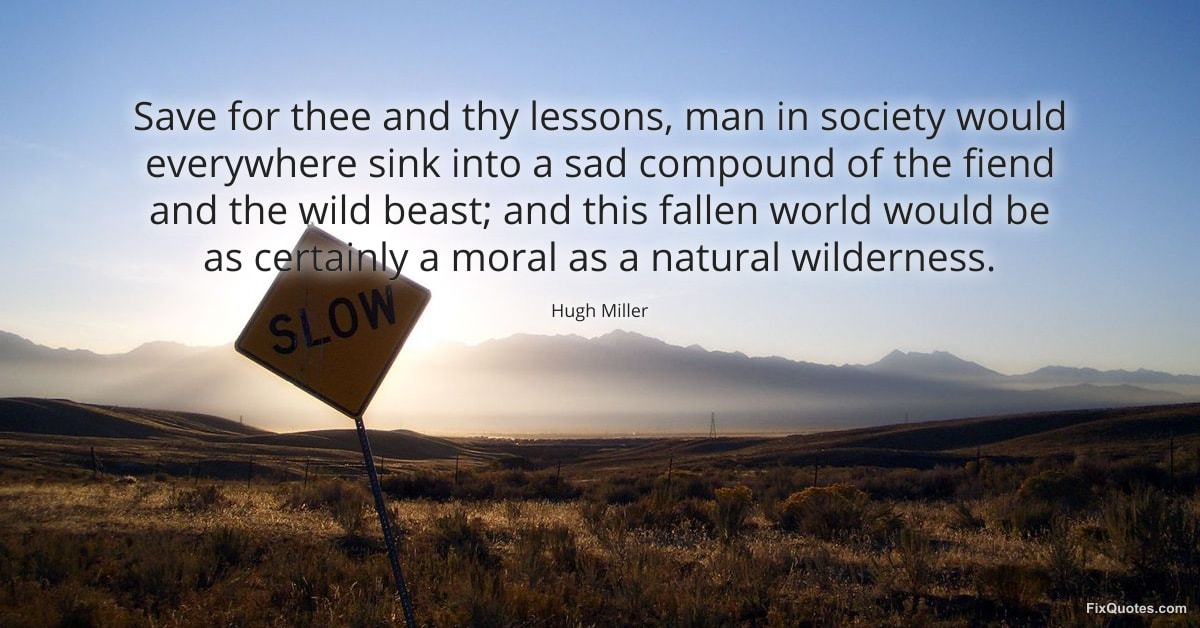
"Save for thee and thy lessons, man in society would everywhere sink into a sad compound of the fiend and the wild beast; and this fallen world would be as certainly a moral as a natural wilderness"
About this Quote
Miller’s intent is corrective, almost prosecutorial. He’s addressing an implied “thou” that sounds like God, but also like conscience, education, Scripture, maybe even the civilizing work of institutions. As a 19th-century Scottish scientist and public intellectual, he wrote in a culture where geology was unsettling literal readings of Genesis, and where industrial modernity was rearranging old social bonds. His subtext: scientific progress doesn’t automatically refine us. In fact, absent moral instruction, knowledge and society can just become better tools for predation.
The sentence works rhetorically by refusing the era’s comfortable optimism. “Society” isn’t portrayed as naturally uplifting; it’s a containment system. The violent imagery (“fiend,” “wild beast,” “wilderness”) is doing more than scaring the reader. It insists that moral formation is not ornamental but infrastructural, as necessary as roads or laws. Miller is staking a claim that the real catastrophe is not ignorance of the earth’s strata, but the erosion of the inner restraints that keep humans from acting like apex predators with a theological vocabulary.
Quote Details
| Topic | Ethics & Morality |
|---|---|
| Source | Help us find the source |
| Cite |
Citation Formats
APA Style (7th ed.)
Miller, Hugh. (2026, January 17). Save for thee and thy lessons, man in society would everywhere sink into a sad compound of the fiend and the wild beast; and this fallen world would be as certainly a moral as a natural wilderness. FixQuotes. https://fixquotes.com/quotes/save-for-thee-and-thy-lessons-man-in-society-61885/
Chicago Style
Miller, Hugh. "Save for thee and thy lessons, man in society would everywhere sink into a sad compound of the fiend and the wild beast; and this fallen world would be as certainly a moral as a natural wilderness." FixQuotes. January 17, 2026. https://fixquotes.com/quotes/save-for-thee-and-thy-lessons-man-in-society-61885/.
MLA Style (9th ed.)
"Save for thee and thy lessons, man in society would everywhere sink into a sad compound of the fiend and the wild beast; and this fallen world would be as certainly a moral as a natural wilderness." FixQuotes, 17 Jan. 2026, https://fixquotes.com/quotes/save-for-thee-and-thy-lessons-man-in-society-61885/. Accessed 13 Feb. 2026.