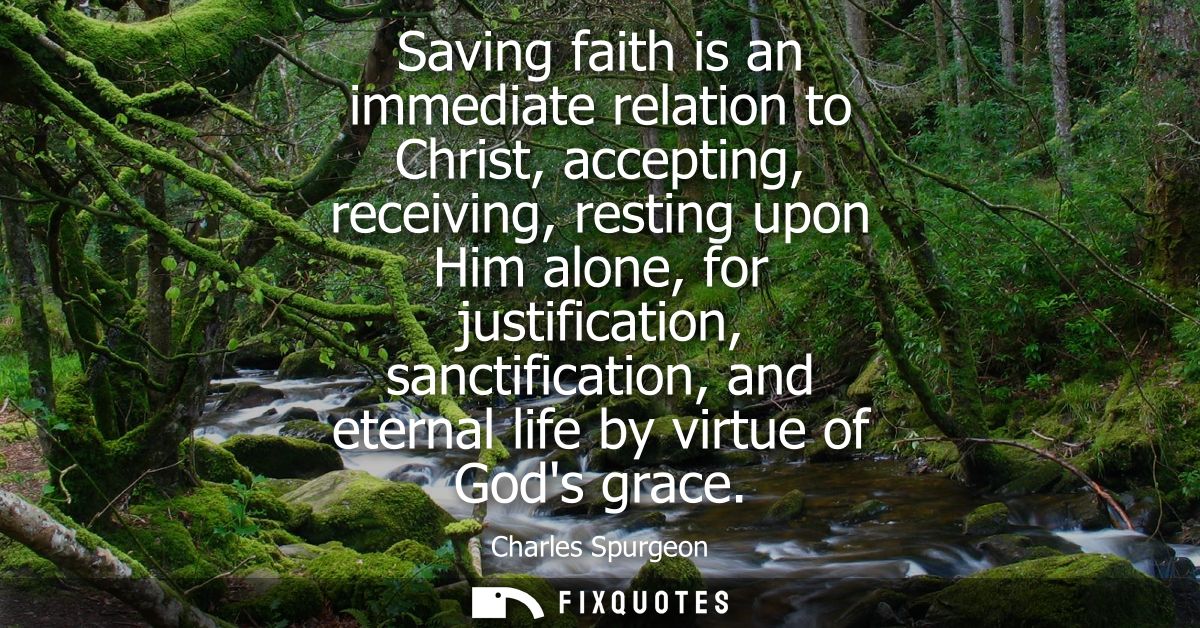
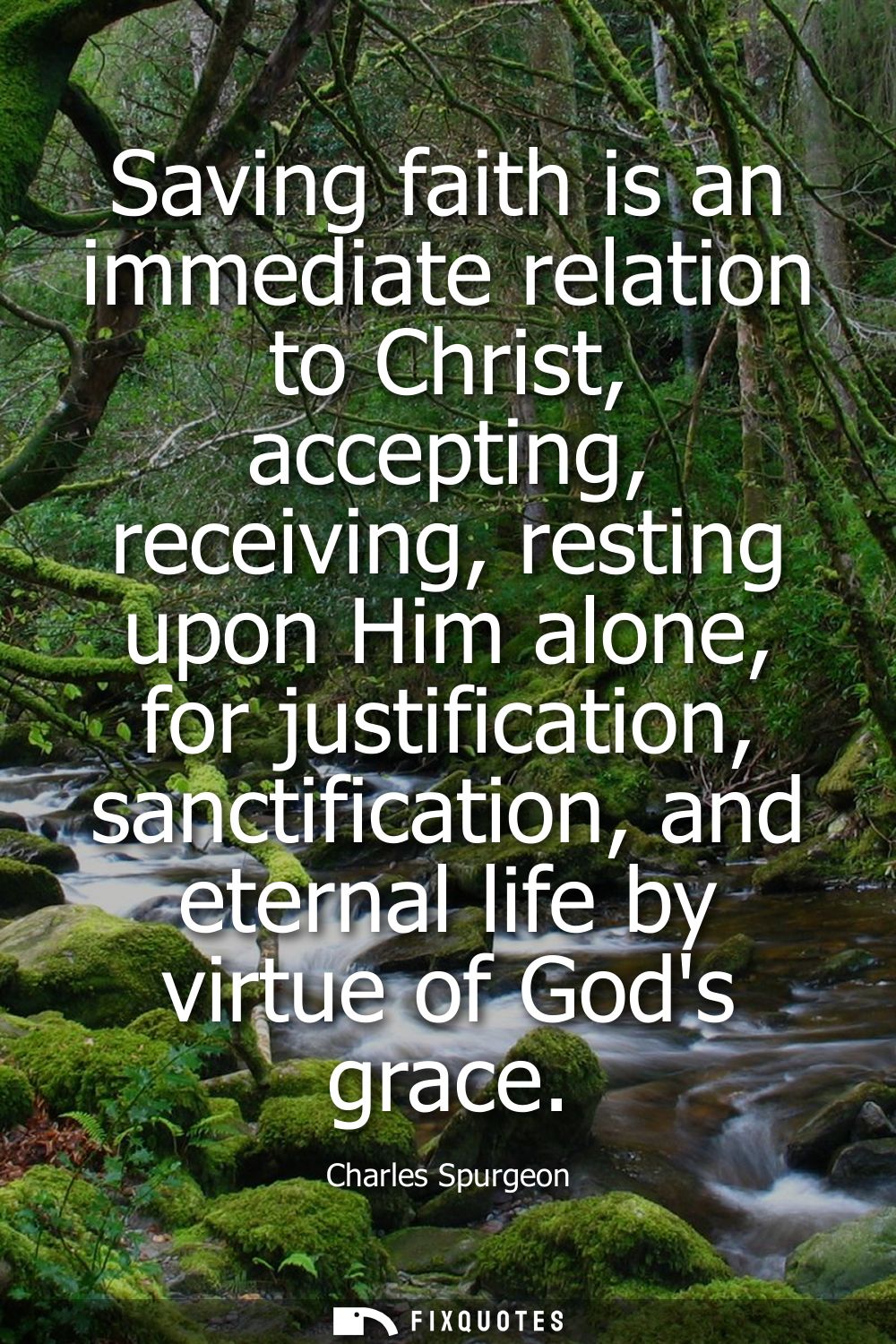
"Saving faith is an immediate relation to Christ, accepting, receiving, resting upon Him alone, for justification, sanctification, and eternal life by virtue of God's grace"
About this Quote
Spurgeon’s line is a piece of theological engineering: it strips “faith” of every decorative accessory and reduces it to contact. Not admiration. Not churchly habit. Not moral self-improvement dressed up as religion. An “immediate relation to Christ” bypasses the whole middle layer of Victorian respectability and spiritual credentialing. In a culture that prized propriety and self-discipline, Spurgeon insists that the decisive move is relational and instantaneous: accepting, receiving, resting. The verbs are doing the argument. They’re bodily, almost domestic, and they escalate from active to surrendered, pushing the listener from grasping to leaning all their weight somewhere else.
That “Him alone” is the pressure point. It’s polemic as much as devotion, aimed both at sacramental systems that locate grace in mediated channels and at the subtler Protestant temptation to smuggle human performance back into salvation. Spurgeon, the great popular preacher of London, is preaching to crowds who know how easy it is to confuse religiosity with rescue.
The threefold payoff - justification, sanctification, eternal life - is not a checklist but a claim of total dependence. Christ isn’t only the entry point (forgiveness) but the ongoing source (holiness) and the final horizon (life). That’s the subtextual rebuttal to anxious spirituality: you don’t start with grace and then switch to self-management.
“By virtue of God’s grace” seals the logic. Even the act of “resting” isn’t a heroic achievement; it’s surrender enabled by the very mercy it seeks. In Spurgeon’s hands, certainty doesn’t come from the intensity of belief, but from the object it clings to.
That “Him alone” is the pressure point. It’s polemic as much as devotion, aimed both at sacramental systems that locate grace in mediated channels and at the subtler Protestant temptation to smuggle human performance back into salvation. Spurgeon, the great popular preacher of London, is preaching to crowds who know how easy it is to confuse religiosity with rescue.
The threefold payoff - justification, sanctification, eternal life - is not a checklist but a claim of total dependence. Christ isn’t only the entry point (forgiveness) but the ongoing source (holiness) and the final horizon (life). That’s the subtextual rebuttal to anxious spirituality: you don’t start with grace and then switch to self-management.
“By virtue of God’s grace” seals the logic. Even the act of “resting” isn’t a heroic achievement; it’s surrender enabled by the very mercy it seeks. In Spurgeon’s hands, certainty doesn’t come from the intensity of belief, but from the object it clings to.
Quote Details
| Topic | Faith |
|---|---|
| Source | Help us find the source |
More Quotes by Charles
Add to List