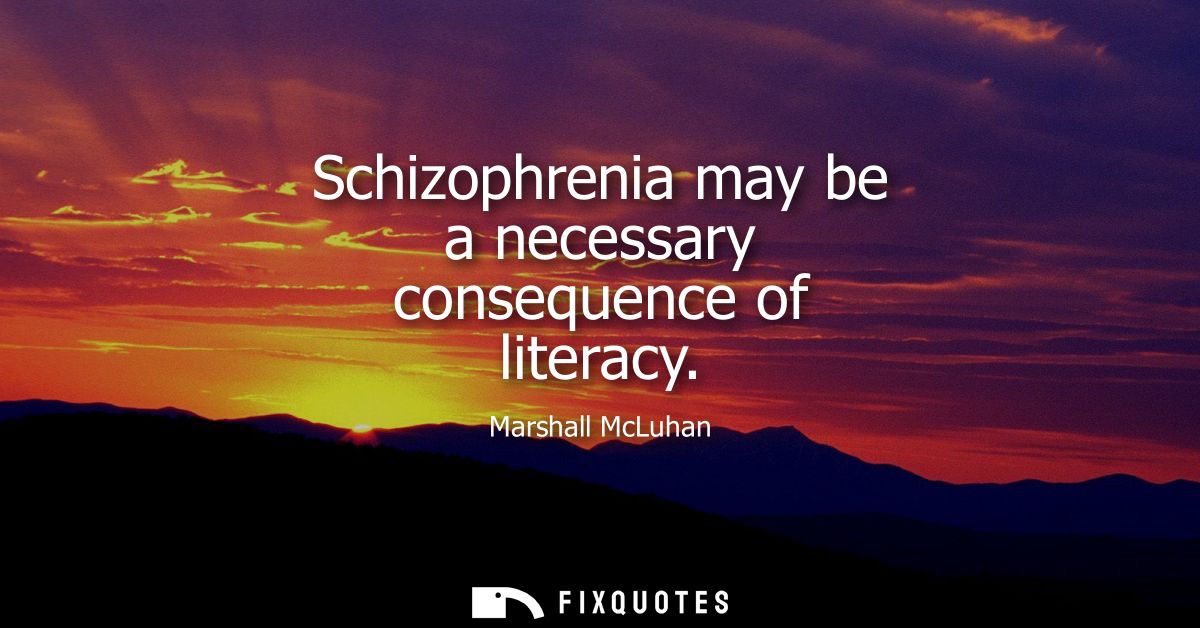
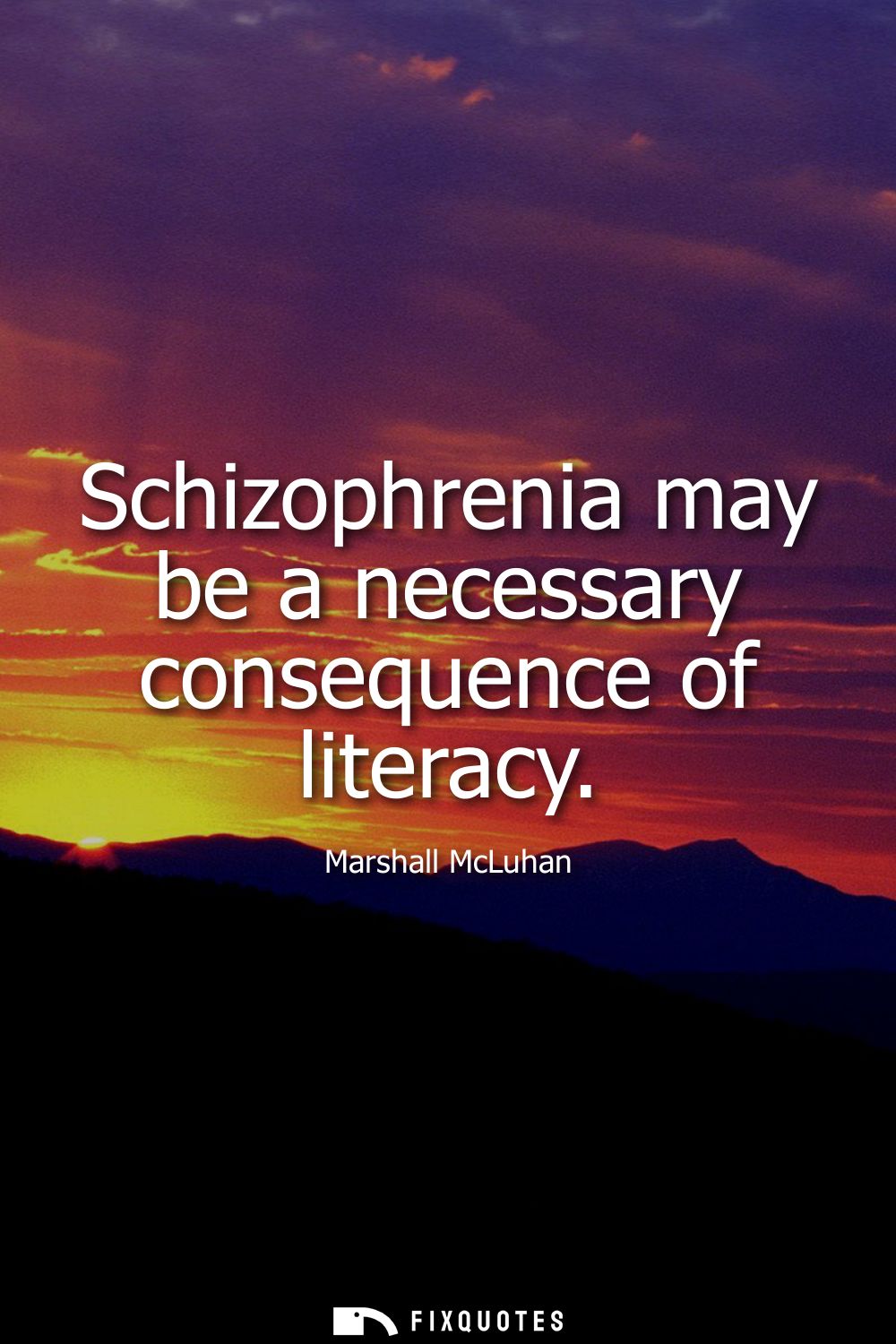
"Schizophrenia may be a necessary consequence of literacy"
About this Quote
McLuhan’s provocation lands like a diagnosis disguised as a compliment. Literacy, the engine of modern “civilization,” is recast as a technology that splits the mind against itself. Not schizophrenia as a clinical claim, but as a metaphor for psychic partition: the self divided into reader and doer, private inner narration and public performance, abstract symbol and messy sensation.
The line only makes sense inside McLuhan’s larger argument that media reshape perception before they reshape politics. Alphabetic literacy trains us to think linearly, to privilege sequence, categories, and detached analysis. That training is powerful, but it comes with a cost: it yanks experience out of the immediate, communal, multisensory world and relocates it into a silent interior. Reading is intimacy with a disembodied voice. Writing is speech severed from a speaker. The “necessary consequence” is that we become fluent in living in two places at once: in the room and in the text, in the body and in the grid of concepts.
Subtextually, McLuhan is also poking at modernity’s self-satisfaction. If literacy produces the rational, bureaucratic, individuated subject, it also produces alienation, fragmentation, the sense that consciousness is a committee. The word “schizophrenia” is deliberately inflammatory because it names what polite accounts of progress avoid: that our prized ability to step back from life can become a permanent estrangement from it.
Context matters: mid-century media upheaval, with television and electronic networks challenging print’s dominance. McLuhan isn’t nostalgic so much as diagnostic. He’s warning that every medium builds a mind in its image, then acts shocked when that mind cracks along the seams.
The line only makes sense inside McLuhan’s larger argument that media reshape perception before they reshape politics. Alphabetic literacy trains us to think linearly, to privilege sequence, categories, and detached analysis. That training is powerful, but it comes with a cost: it yanks experience out of the immediate, communal, multisensory world and relocates it into a silent interior. Reading is intimacy with a disembodied voice. Writing is speech severed from a speaker. The “necessary consequence” is that we become fluent in living in two places at once: in the room and in the text, in the body and in the grid of concepts.
Subtextually, McLuhan is also poking at modernity’s self-satisfaction. If literacy produces the rational, bureaucratic, individuated subject, it also produces alienation, fragmentation, the sense that consciousness is a committee. The word “schizophrenia” is deliberately inflammatory because it names what polite accounts of progress avoid: that our prized ability to step back from life can become a permanent estrangement from it.
Context matters: mid-century media upheaval, with television and electronic networks challenging print’s dominance. McLuhan isn’t nostalgic so much as diagnostic. He’s warning that every medium builds a mind in its image, then acts shocked when that mind cracks along the seams.
Quote Details
| Topic | Deep |
|---|---|
| Source | Help us find the source |
| Cite |
Citation Formats
APA Style (7th ed.)
McLuhan, Marshall. (2026, January 18). Schizophrenia may be a necessary consequence of literacy. FixQuotes. https://fixquotes.com/quotes/schizophrenia-may-be-a-necessary-consequence-of-15896/
Chicago Style
McLuhan, Marshall. "Schizophrenia may be a necessary consequence of literacy." FixQuotes. January 18, 2026. https://fixquotes.com/quotes/schizophrenia-may-be-a-necessary-consequence-of-15896/.
MLA Style (9th ed.)
"Schizophrenia may be a necessary consequence of literacy." FixQuotes, 18 Jan. 2026, https://fixquotes.com/quotes/schizophrenia-may-be-a-necessary-consequence-of-15896/. Accessed 12 Mar. 2026.
More Quotes by Marshall
Add to List