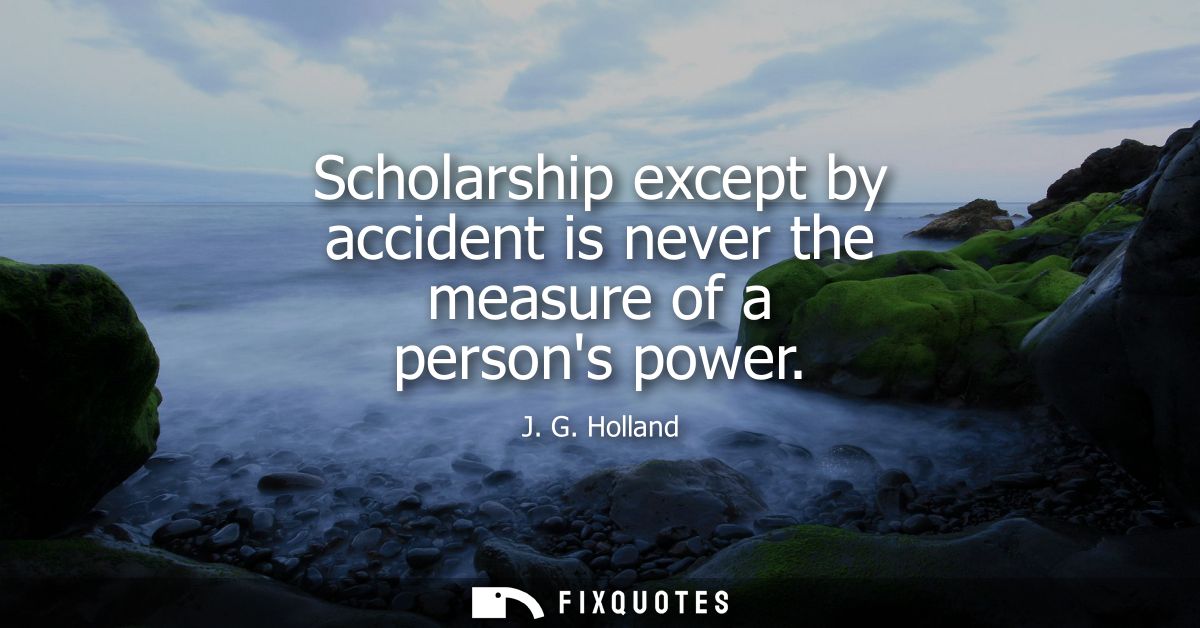
"Scholarship, except by accident, is never the measure of a person's power"
About this Quote
The subtext is a shrewd reading of how power actually behaves: it’s social, performative, networked. Scholarship is inward-facing; power is outward-facing. One accumulates knowledge, the other organizes people, resources, and fear. Holland, writing in an America where higher education was expanding but still gatekept, is basically warning readers not to confuse mental furniture for leverage. You can know everything and still be ignorable.
As a novelist, Holland also understands narrative authority: who gets listened to is rarely the most informed person in the room. Power rewards fluency, charisma, and the ability to set terms - to define what counts as “common sense” - more than it rewards correctness. That’s why the quote still lands: it calls out a modern habit of treating expertise as a force field. Sometimes it is; often it’s just a library card in a world run by landlords, bosses, party machines, and whoever controls the microphone.
Quote Details
| Topic | Knowledge |
|---|---|
| Source | Help us find the source |
| Cite |
Citation Formats
APA Style (7th ed.)
Holland, J. G. (2026, February 16). Scholarship, except by accident, is never the measure of a person's power. FixQuotes. https://fixquotes.com/quotes/scholarship-except-by-accident-is-never-the-167613/
Chicago Style
Holland, J. G. "Scholarship, except by accident, is never the measure of a person's power." FixQuotes. February 16, 2026. https://fixquotes.com/quotes/scholarship-except-by-accident-is-never-the-167613/.
MLA Style (9th ed.)
"Scholarship, except by accident, is never the measure of a person's power." FixQuotes, 16 Feb. 2026, https://fixquotes.com/quotes/scholarship-except-by-accident-is-never-the-167613/. Accessed 8 Mar. 2026.