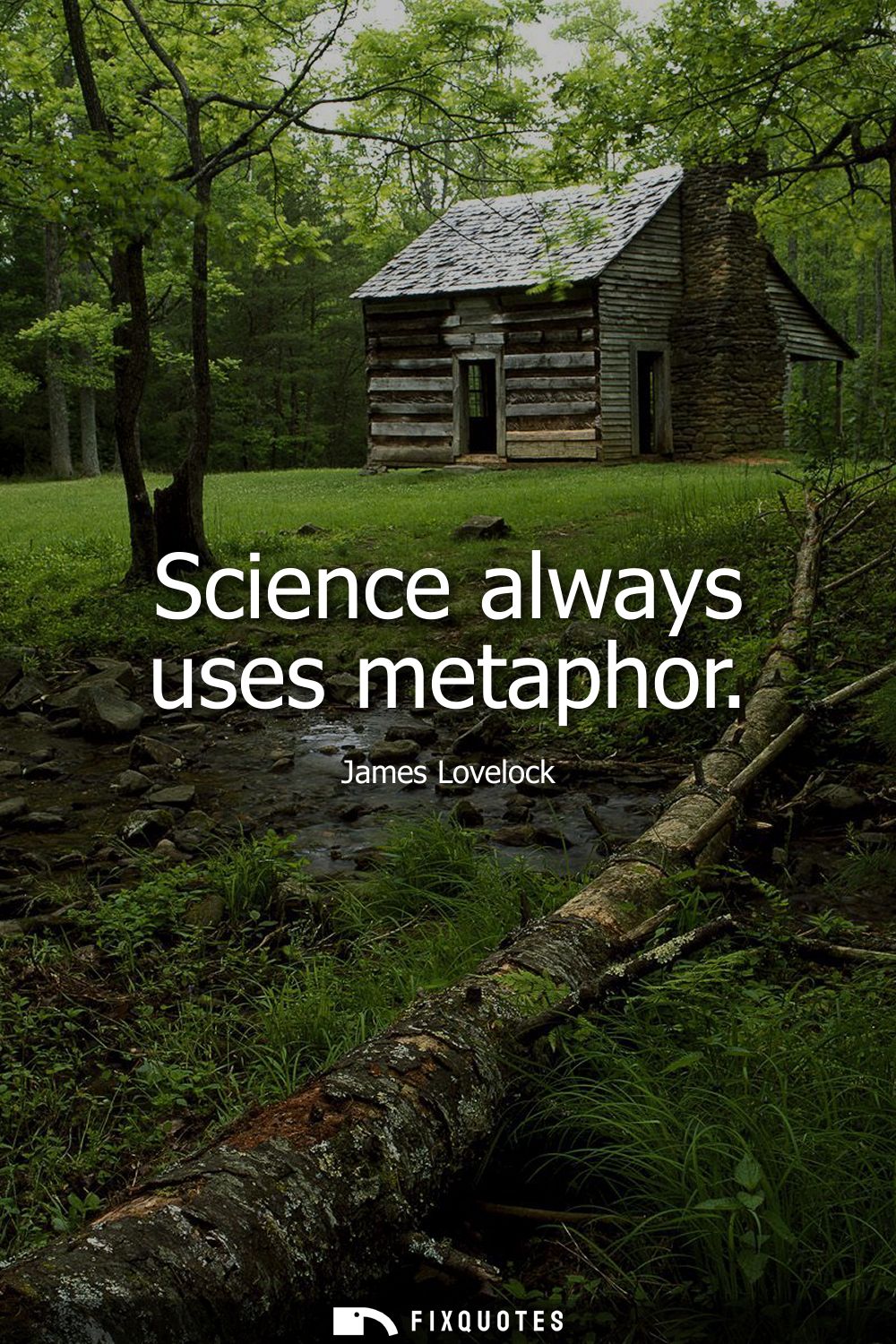
"Science always uses metaphor"
About this Quote
Science likes to cosplay as pure literalism, but Lovelock is reminding you it runs on figurative language as much as lab equipment. “Science always uses metaphor” is a quiet provocation from a scientist best known for the Gaia hypothesis, a framework critics loved to dismiss as mystical precisely because it sounded like a metaphor: Earth as an organism, self-regulating, alive. Lovelock flips the charge. Metaphor isn’t a leak in the ship of science; it’s part of the engine.
The intent is methodological, not poetic. Metaphors are the scaffolding that lets researchers grab something too complex, too small, or too abstract to see directly: genetic “code,” electrical “circuits” in the brain, the “big bang,” “dark matter,” “selection” as if nature were an agent with taste. These are not decorative phrases; they’re working models that steer what questions get asked and what counts as an answer. Metaphor is how science compresses the unfamiliar into the manipulable.
The subtext is a warning about power and bias. Metaphors don’t just clarify; they smuggle values. Call the immune system an “army” and you invite a worldview of enemies and collateral damage; call it an “ecosystem” and you start looking for balance, not annihilation. Lovelock, writing in an era of systems thinking and planetary crisis, is also defending holistic models against a culture that equates seriousness with reductionism.
Context matters: from climate science to ecology, the most consequential debates aren’t only about data. They’re about which metaphor organizes reality well enough to act on it.
The intent is methodological, not poetic. Metaphors are the scaffolding that lets researchers grab something too complex, too small, or too abstract to see directly: genetic “code,” electrical “circuits” in the brain, the “big bang,” “dark matter,” “selection” as if nature were an agent with taste. These are not decorative phrases; they’re working models that steer what questions get asked and what counts as an answer. Metaphor is how science compresses the unfamiliar into the manipulable.
The subtext is a warning about power and bias. Metaphors don’t just clarify; they smuggle values. Call the immune system an “army” and you invite a worldview of enemies and collateral damage; call it an “ecosystem” and you start looking for balance, not annihilation. Lovelock, writing in an era of systems thinking and planetary crisis, is also defending holistic models against a culture that equates seriousness with reductionism.
Context matters: from climate science to ecology, the most consequential debates aren’t only about data. They’re about which metaphor organizes reality well enough to act on it.
Quote Details
| Topic | Science |
|---|---|
| Source | Help us find the source |
| Cite |
Citation Formats
APA Style (7th ed.)
Lovelock, James. (2026, January 18). Science always uses metaphor. FixQuotes. https://fixquotes.com/quotes/science-always-uses-metaphor-18048/
Chicago Style
Lovelock, James. "Science always uses metaphor." FixQuotes. January 18, 2026. https://fixquotes.com/quotes/science-always-uses-metaphor-18048/.
MLA Style (9th ed.)
"Science always uses metaphor." FixQuotes, 18 Jan. 2026, https://fixquotes.com/quotes/science-always-uses-metaphor-18048/. Accessed 12 Feb. 2026.
More Quotes by James
Add to List