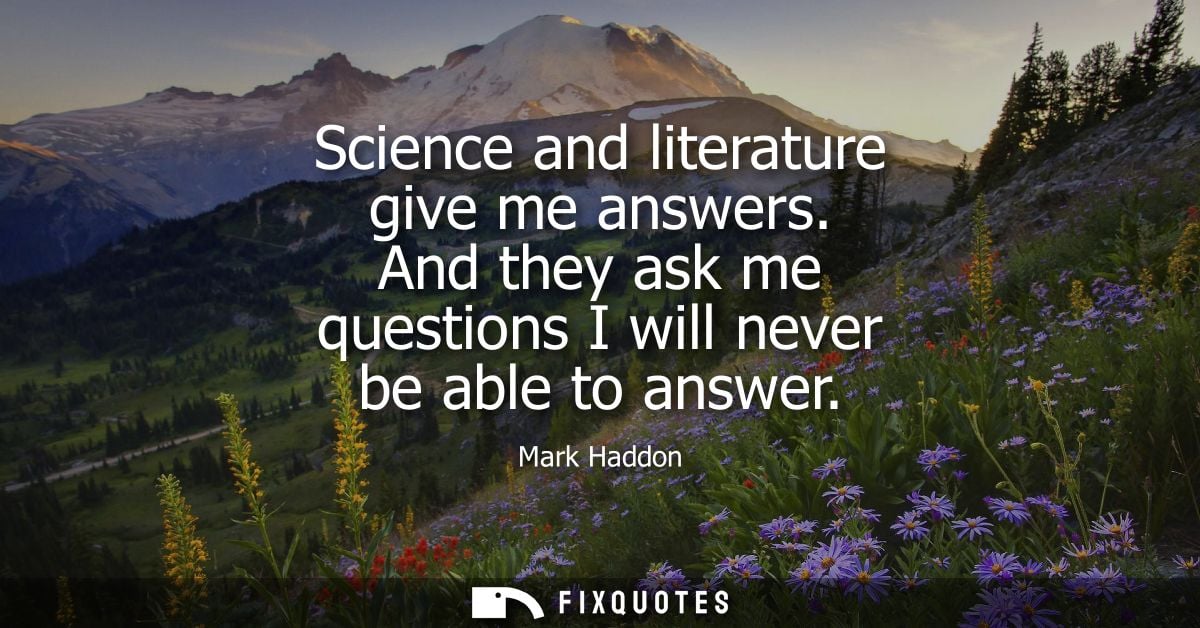
"Science and literature give me answers. And they ask me questions I will never be able to answer"
About this Quote
Then he flips the mood. The second sentence widens the horizon with a quiet sting: the best thinking doesn’t just resolve confusion, it manufactures better confusion. The subtext is a critique of the “STEM vs. humanities” culture war, where science gets cast as certainty and literature as vibe. Haddon insists both are engines of inquiry; their power is not only to explain but to unsettle. The line “I will never be able to answer” isn’t despair so much as discipline: a refusal of the modern demand that every question be closed, optimized, monetized, or made content-ready.
In context, that stance fits a novelist whose work often circles the boundaries of perception, explanation, and narrative control. Science offers models; literature offers interiority. Together they don’t just tell you what’s true - they show how partial every frame is. The intent lands as a manifesto for intellectual humility: the mature reader isn’t the person with the most answers, but the one who can stay present when the questions stop being winnable.
Quote Details
| Topic | Knowledge |
|---|---|
| Source | Help us find the source |
| Cite |
Citation Formats
APA Style (7th ed.)
Haddon, Mark. (2026, January 16). Science and literature give me answers. And they ask me questions I will never be able to answer. FixQuotes. https://fixquotes.com/quotes/science-and-literature-give-me-answers-and-they-95298/
Chicago Style
Haddon, Mark. "Science and literature give me answers. And they ask me questions I will never be able to answer." FixQuotes. January 16, 2026. https://fixquotes.com/quotes/science-and-literature-give-me-answers-and-they-95298/.
MLA Style (9th ed.)
"Science and literature give me answers. And they ask me questions I will never be able to answer." FixQuotes, 16 Jan. 2026, https://fixquotes.com/quotes/science-and-literature-give-me-answers-and-they-95298/. Accessed 21 Mar. 2026.